לעילוי נשמתIn memory ofאברהם בן יצחק ז״לAvraham ben Yitzchak z"l· Família Cohen
this week: Bamidbar
בְּמִדְבַּר
Bamidbar
Bamidbar 1:1-4:20
The Architecture of a Surviving Covenant
Beneath the military rosters and camp coordinates, the parashah constructs a defensive hierarchy to protect a fractured people from the lethal core of holiness.
Summary
1 min
The meticulous census and camp architecture of Parashat Bamidbar conceal a silent project of repair. On the surface, the counting of 603,550 fighting-age men and the precise arrangement of tribes around the Tabernacle read as an administrative prelude to the march. Yet every structural anomaly—the exemption of the Levites from the military roster, their substitution for the firstborn, the lethal warnings surrounding the Kohathites—responds to the unmentioned trauma of the golden calf. The census itself functions as a shepherd’s count after a predator’s strike, an act of divine reclamation proving the people are still cherished. The Levites, alone in refusing the idolatry, are carved out as a loyalist guard, inheriting the sacred service forfeited by the firstborn’s participation in the sin. The camp’s geometry institutionalizes this new reality: the Tabernacle sits at the dead center, buffered by Levites who shield a volatile nation from the lethal holiness it cannot safely approach. What appears as flawless order is in fact a negotiated settlement, a defensive architecture built over a fault line to preserve a covenant that has already nearly shattered.
The haftarah, from the First Book of Samuel, stages a different crisis of loyalty. On the eve of the new moon festival, Jonathan devises a coded signal—three arrows shot in a field—to tell David whether Saul’s murderous rage has made the court unsurvivable. When the king’s fury erupts and his spear flies at his own son, the signal confirms the worst. The parting between Jonathan and David is a scene of unbroken love and bitter grief, a covenant honored at the cost of a throne.
Generated 05/10/2026
Parashah SynthesisBy topic
The Book of Numbers opens with a vast administrative effort. In the deep wilderness, a year after the Exodus, the Israelite camp is transformed from a migrating multitude into a highly structured, textually precise formation centered entirely around the Tabernacle.
Synthesis topics
The Autoparashah methodology selected 7 topics to summarize the parashah's sequence.
On the first day of the second month, in the second year after the exodus from Egypt, the narrative opens in the wilderness of Sinai. God commands Moses and Aaron to take a comprehensive census of the Israelite community. The instructions are precise: they must record the names of every male aged twenty and over who is able to bear arms. This is a tally organized by ancestral houses and clans, assisted by a designated chieftain from each of the twelve tribes. The tone is highly structured and administrative, preparing a massive civilian population for the rigors of military mobilization and wilderness transit.
The exemption of the Levites
The text proceeds to list the results of this census, tribe by tribe. Judah emerges as the largest contingent with 74,600 men, while Manasseh is the smallest. The total number of fighting-age men reaches 603,550. Yet, immediately after delivering this imposing military roster, the text introduces a sharp structural exception. God explicitly commands Moses not to enroll the tribe of Levi in this national census. Instead of bearing arms, the Levites are assigned a distinct, exclusive function: they are to manage, transport, and guard the Tabernacle of the Pact. Any outsider who encroaches on this sacred precinct is to be put to death.
The four-division camp arrangement
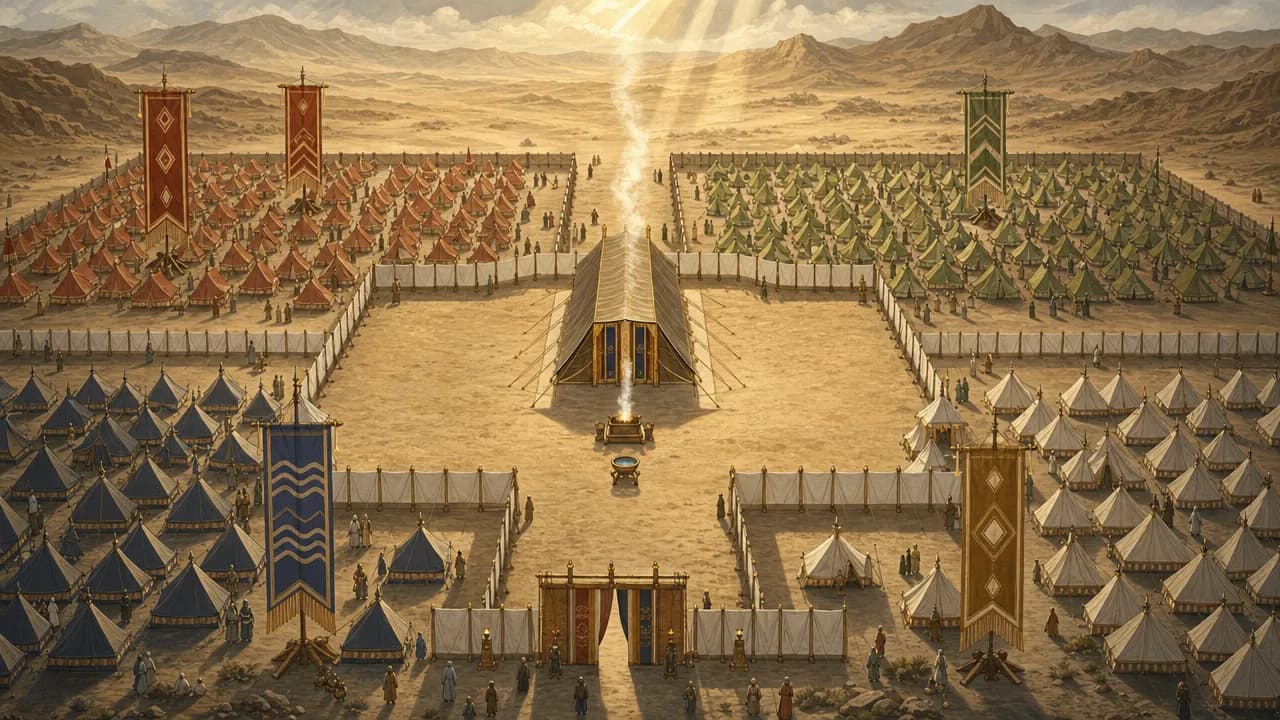
With the population counted and the Levites separated, the parashah establishes the physical geography of the camp. The Israelites are commanded to pitch their tents at a distance around the Tent of Meeting, organized into four massive divisions. Each tribe must camp under its specific standard and the banners of its ancestral house. Judah leads the eastern flank, Reuben the south, Ephraim the west, and Dan the north. The Levites and the Tabernacle occupy the exact center of this vast square. This formation dictates not only where they live but the exact order in which they will march when the cloud lifts.
The Levite census from one month old
The narrative then turns its full attention to the Levites, detailing their own distinct census. Unlike the other tribes, the Levites are counted from the age of one month and upward. Here, a profound legal transfer takes place. God declares that He is taking the Levites in place of every firstborn male among the Israelites. Originally, the firstborn of Israel were consecrated to God during the final plague in Egypt. Now, that dedicated status is stripped from the firstborn and transferred entirely to the Levite clans.
The disenfranchisement of the firstborn
Because this is a strict one-to-one substitution, the text demands an exact accounting. The total number of Levite males is 22,000, while the total number of Israelite firstborn is 22,273. To resolve the discrepancy of the 273 excess firstborn, God requires a redemption price of five sanctuary shekels per head. Moses collects this money and gives it to Aaron and his sons. The biological hierarchy of the firstborn is officially replaced by the tribal hierarchy of the Levites, formalized through a precise financial transaction.
The redemption of the excess firstborn
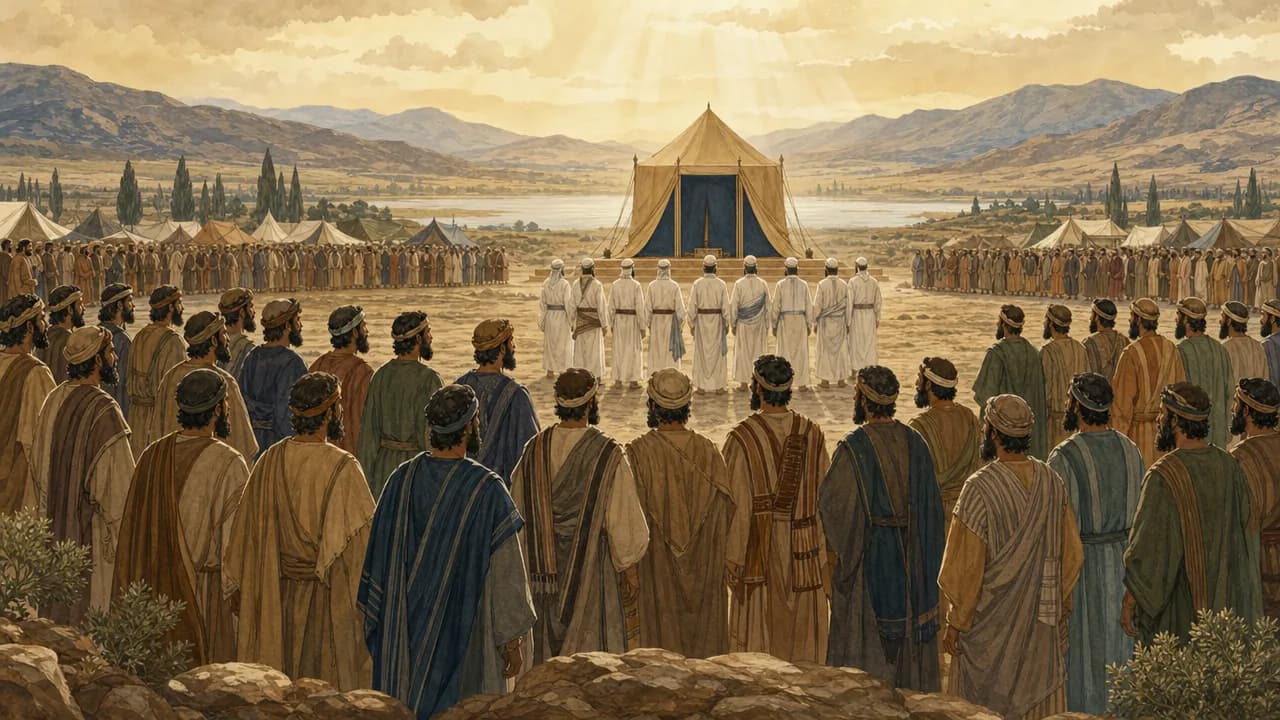
The parashah concludes by zooming in on the Kohathites, one of the three Levite clans, who are subjected to a third, highly specific census. Only Kohathite men between the ages of thirty and fifty are counted for active duty in the Tent of Meeting. Their responsibility is the transport of the most sacred objects: the Ark of the Pact, the table of display, the lampstand, and the altars. However, they are strictly forbidden from looking at or touching these objects directly. Aaron and his sons must first dismantle the sanctuary and wrap each item in specific blue, crimson, or purple cloths and dolphin skins. Only then may the Kohathites lift the carrying poles, ensuring they do not come into lethal contact with the raw holiness of the sanctuary.
Generated 05/10/2026
Analysis axes
They form the central interpretive thread and appear interspersed in the essay below, connecting the parashah's sequence to a unified reading shaped by Rashi.
1.The military census of the twelve tribesוידברRashi on 1:1
2.The exemption of the Levitesאך את מטה לוי לא תפקדRashi on 1:49
3.The four-division camp arrangementואני הנה לקחתיRashi on 3:12
4.The Levite census from one month oldבאחתRashi on 2:2
Interpretive Analysis4 Rashi axes at the turns of the reading
The parashah presents itself as a forward-looking administrative manual, organizing a new nation for its march through the wilderness. Beneath this surface of rosters and camp coordinates lies a silent architecture of repair. The text never explicitly names the trauma of the golden calf, yet every structural anomaly in these chapters—the exhaustive recounting of the people, the sudden elevation of Levi, the demotion of the firstborn—acts as a direct legal and spatial response to that unmentioned fracture. The administrative surface masks a profound reorganization of Israel's relationship to the sacred.
The opening census appears purely military, yet its timing betrays a different motive. The nation had just suffered a catastrophic rupture in its covenant, resulting in plague and divine wrath. Counting them head by head, tribe by tribe, operates as an act of divine reclamation. Just as a shepherd counts a flock after a predator strikes, this census is an expression of enduring attachment. The sheer repetition of the tally demonstrates that the people are still cherished, their presence still required for the indwelling of the divine presence. The numbers are a language of restoration, a meticulous accounting of a population that has just survived its own near-destruction.
This hidden context of the calf explains the abrupt removal of the Levites from the national roster. The text states they are exempt from the military tally to guard the Tabernacle, but their sudden promotion masks a deeper division. When the camp collapsed into idol worship, the Levites alone abstained, rallying to Moses. Their exclusion from the general census is not merely a functional assignment; it is an exemption from a compromised collective. They are carved out as a pristine legion, immune to the taint that swept through the rest of the tribes, and rewarded with absolute proximity to the divine presence.
The most radical shift occurs with the substitution of the firstborn, a move that represents a massive disenfranchisement. The firstborn were the original, natural priesthood of the home, consecrated during the Exodus to perform the sacred service. Their sudden replacement by the Levites is the structural fallout of the calf. The natural hierarchy of birth is stripped away, forfeited by the firstborn's participation in the sin, and replaced by a merit-based hierarchy of loyalty. The Levites inherit the sacred center precisely because the natural leaders of the households lost it.
Even the physical arrangement of the camp reflects this new, defensive reality. The tribes are ordered by distinct banners, a visual system of identity that binds them to their ancestral roots—echoing the blessings of the patriarchs—rather than their recent collective failure. By placing the Tabernacle at the dead center, buffered on all sides by the loyalist Levites, the architecture of the camp institutionalizes a protective distance. The sacred is no longer entrusted to the natural leaders of the tribes; it is guarded against them. The Levites form a human shield, preventing the volatile Israelites from encroaching on the lethal holiness of the sanctuary.
The intense warnings surrounding the Kohathites further underscore this volatility. Holiness in this parashah is not a benign force; it is a radiating power that demands absolute precision to survive. The elaborate wrapping of the Ark and altars in blue cloths and dolphin skins is a strict containment protocol. The wilderness camp is therefore not the original ideal of Israelite society, but a negotiated settlement. It is a fortress designed to hold a fragile people around a dangerous core of holiness, substituting natural birthrights with a rigid, defensive hierarchy. The meticulous order of the camp is the exact shape of a surviving covenant.
The parashah leaves Israel frozen in perfect formation, every tribe pinned to its coordinates, every Levite assigned to a pole or a curtain. Yet this flawless geometry is built over a fault line, holding the people at a safe distance from the very presence they journeyed into the wilderness to find.
Generated 05/10/2026
Context
This Haftarah is drawn from the First Book of Samuel, set in the early days of the Israelite monarchy. The prophet Samuel has already anointed David, the youngest son of Jesse, as the future king, yet Saul still occupies the throne. A dark jealousy has taken hold of Saul, and David, once the hero who slew Goliath, now flees for his life from the royal court.
The passage opens on the eve of the new moon festival, a time of sacred assembly and feasting at the king’s table. Jonathan, Saul’s son and heir apparent, has bound himself to David in a covenant of deep friendship. Now he must navigate the terrible tension between loyalty to his father and love for the man his father seeks to kill.
Interpretation
The Haftarah Explained
Jonathan devises a plan that turns an ordinary field into a place of hidden judgment. He tells David that his absence at the new moon meal will be noticed, and on the third day David must wait near the Ezel stone. Jonathan will shoot three arrows as if practicing at a mark and send a boy to retrieve them. The words he calls out will be the signal: if he says the arrows are on this side, David may return safely; if he cries that the arrows are beyond, David must flee, for the king’s wrath is certain.
The festival arrives and David’s seat remains empty. Saul says nothing the first day, reasoning that David must be ritually impure. But when the place is vacant again on the second day, the king’s suspicion sharpens. He questions Jonathan, who offers the excuse that David begged leave to attend a family feast in Bethlehem. At this, Saul’s fury erupts. He hurls insults at his own son, calling him the child of a rebellious woman, and declares that as long as David lives, neither Jonathan nor his kingship will be secure. Saul then seizes his spear and casts it at Jonathan, the same gesture of murderous rage he once aimed at David.
Jonathan rises from the table burning with anger and grief. He eats nothing that day, wounded both by his father’s humiliation and by the fate closing in on his friend. The next morning he goes out to the field with a young attendant and shoots the arrows beyond the boy. His voice carries the dreaded words: “The arrows are beyond you.” He hurries the boy away, and when they are alone, David emerges from his hiding place.
What follows is a parting of profound sorrow. David falls to the ground and bows three times. The two men kiss and weep together, David weeping longer. No bitterness passes between them, only the ache of a bond severed by forces beyond their control. Jonathan sends David away with a blessing of peace, invoking the eternal covenant they swore in God’s name, a pledge that would extend even to their descendants.
Interpretation
Message
At its heart this Haftarah is about the cost of faithfulness when the structures of power become corrupt. Jonathan loves his father and honors the throne, yet he refuses to surrender his moral clarity. He recognizes that Saul’s determination to kill David is not justice but madness, and he chooses to protect the innocent even at the price of his own inheritance. The covenant between Jonathan and David stands as a witness that human loyalty, rooted in the fear of God, can transcend the bitterest family divisions. Their tears in the field are not a sign of weakness but of a love that remains whole even as it is broken apart.
In a world where thrones are often built on blood, Jonathan shows that true kingship lies in the heart that keeps faith with God and with a friend.