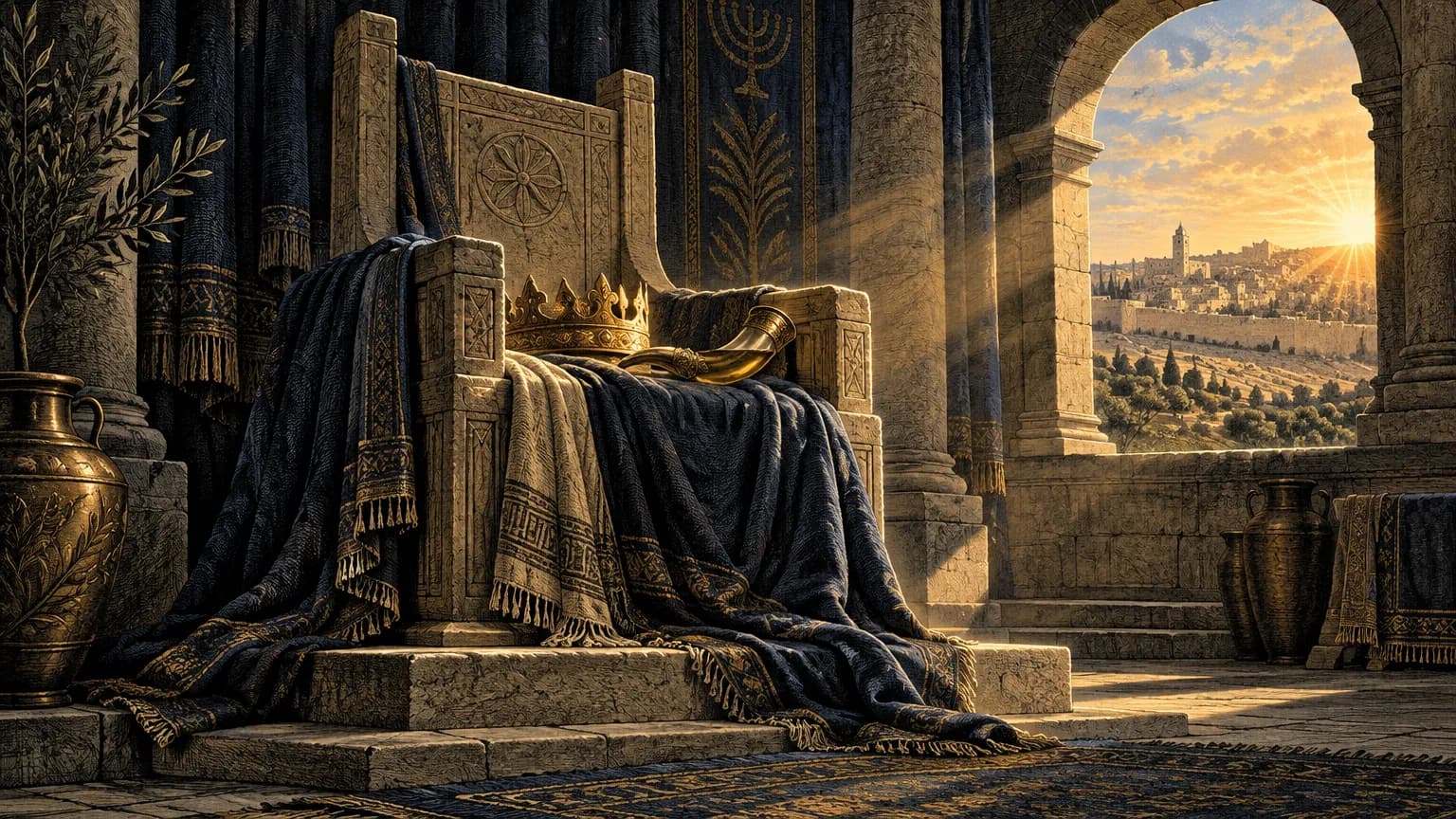
A Grave, a Tent, a Blessing: Bringing Heaven's God Down to Earth
After Sarah's death, Avraham secures God's earthly address: a purchased grave, a relit tent, and a blessing placed in Yitzchak's hands.
Summary
1 min
The divine presence takes enduring root on earth when the sacred covenant of the household outlives its founders, sustaining the quiet continuity of faith across generations.
Between two burials, Sarah's at the start and Avraham's at the end, Avraham buys a family grave and sends his servant to find a wife for his son Yitzchak. The reading turns on a phrase Avraham drops. He binds the servant by "the God of heaven and the God of the earth," but when recalling how God first called him from his father's house, he says only "the God of heaven." An old interpretation hears a confession: God was then known only in heaven, and became God of the earth because Avraham made His name familiar among people. If that earthly title depends on human speech, the question is whether it can outlive its founders. The narrative answers in concrete steps. Avraham pays full price for the cave of Machpelah, Sarah's burial site, before witnesses at the town gate, and the Hittites gathered there call him "the elect of God." When Rivkah, chosen for her generosity to a stranger at a well, enters Sarah's empty tent, tradition says the signs of Sarah's household return: a lamp burning all week, blessing in the dough, a cloud over the tent. God's presence on earth takes root through households that keep His name spoken.
The haftarah, from the opening of the book of Kings, finds King David aged and failing as his son Adoniyahu declares himself king, backed by the general Yoav and the priest Evyatar. The prophet Natan and Bat-Sheva, mother of Shlomo, remind David of his oath that Shlomo would reign, and David fulfills it that very day.
Generated 11/01/2026
Parashah SynthesisBy topic
This week's reading begins at a graveside and ends at one. Between those two burials, a servant crosses the desert, a young woman draws water for ten thirsty camels, and an empty tent is lit again. Read slowly, and the plain story of loss and succession turns out to carry a quiet question: how does a household that walks with God keep God present in the world once its founders are gone?
Synthesis topics
The Autoparashah methodology selected 7 topics to summarize the parashah's sequence.
The parashah opens with a death. The Torah counts out Sarah's years, one hundred and twenty-seven, and reports that she died in Hebron in the land of Canaan. Behind this moment lies a long road. Avraham and Sarah left their homeland at God's word, wandered the land promised to their descendants, and in old age received the son of that promise, Yitzchak. Yet after all those years Avraham owns no ground at all. The tone is hushed. Avraham mourns and weeps, and then he has to find somewhere to lay his wife.
Avraham buys the cave of Machpelah
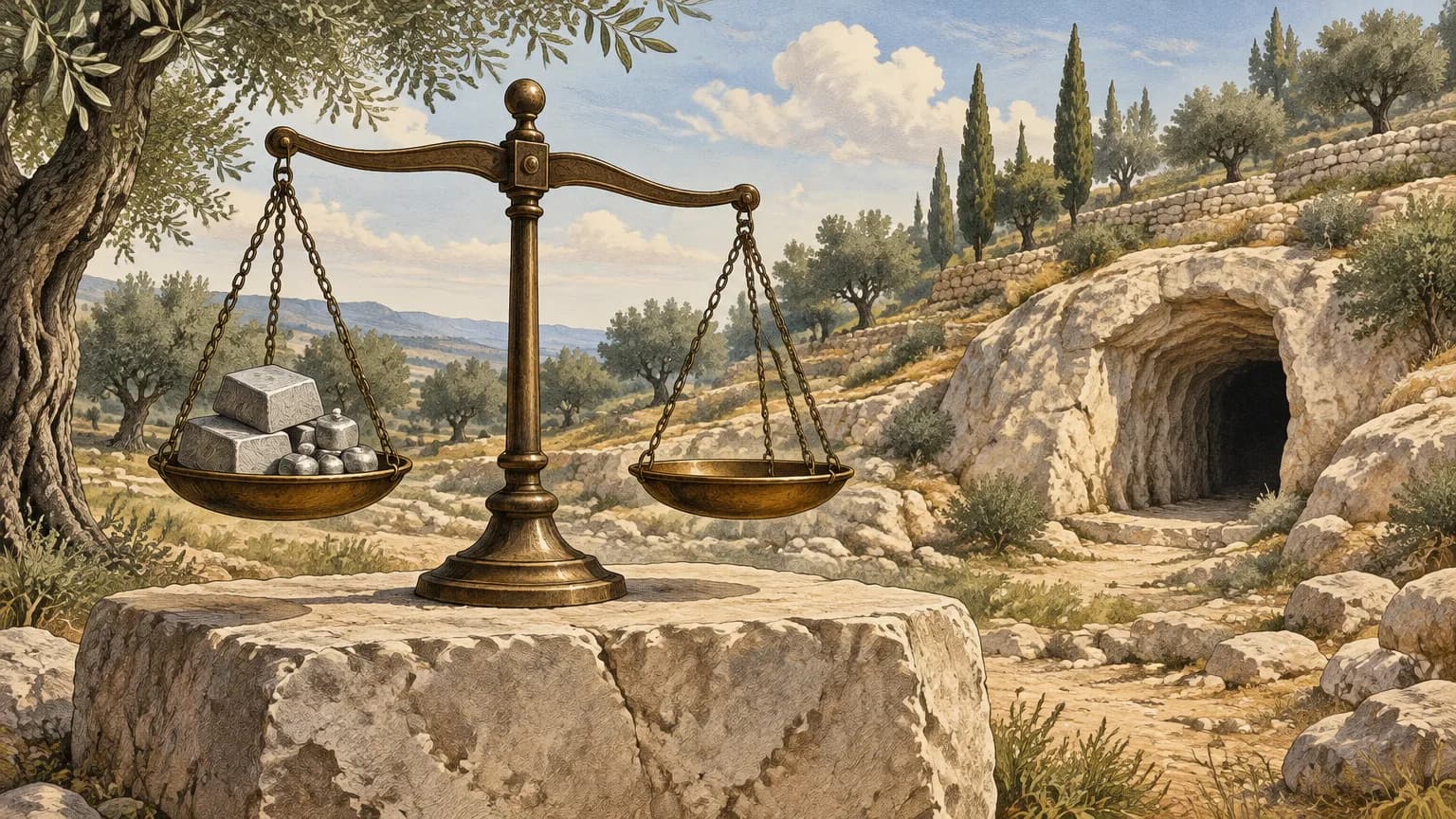
He rises from beside his dead and addresses the Hittites gathered at the town gate, the place where public business was conducted and witnessed. He calls himself "a resident alien among you." The Hebrew pairs two words, ger, a stranger, and toshav, a settled resident, and Avraham is in fact both: long established among them yet without land of his own. He asks for an achuzah, a permanent holding. The Hittites honor him and offer their finest graves, but a burial in someone else's tomb is a courtesy, not ownership. Avraham names the cave of Machpelah, which belongs to Ephron, and insists on paying the full price. Ephron offers it as a gift before the assembly, then mentions four hundred shekels with a polite shrug. Avraham weighs out the silver at the merchants' rate. The Torah lists the field, the cave, and the trees, and it names the witnesses. The detail serves a purpose, because a gift can be disputed later, while a paid and publicly witnessed sale cannot. Only then does Avraham bury Sarah.
Avraham weighs four hundred shekels of silver to purchase the cave of Machpelah, its surrounding field, and all its trees.
The servant's oath and Avraham's charge
Avraham is now old and blessed in all things, and he turns to Yitzchak's marriage. He has his senior servant place a hand under his thigh, a gesture of solemn oath, and swear by "the God of heaven and the God of the earth" not to take a Canaanite wife for Yitzchak, but to go to Avraham's birthplace. The servant asks whether, if the woman refuses to come, he should bring Yitzchak back there. Avraham's answer is absolute: never. As he recalls how "the God of heaven" took him from his father's house, the phrase "God of the earth" quietly drops away. A careful reader should notice the shorter title in Avraham's memory of his beginnings. God will send an angel ahead, Avraham promises, and if the woman will not come, the servant is released.
The sign at the well and Rivkah's kindness
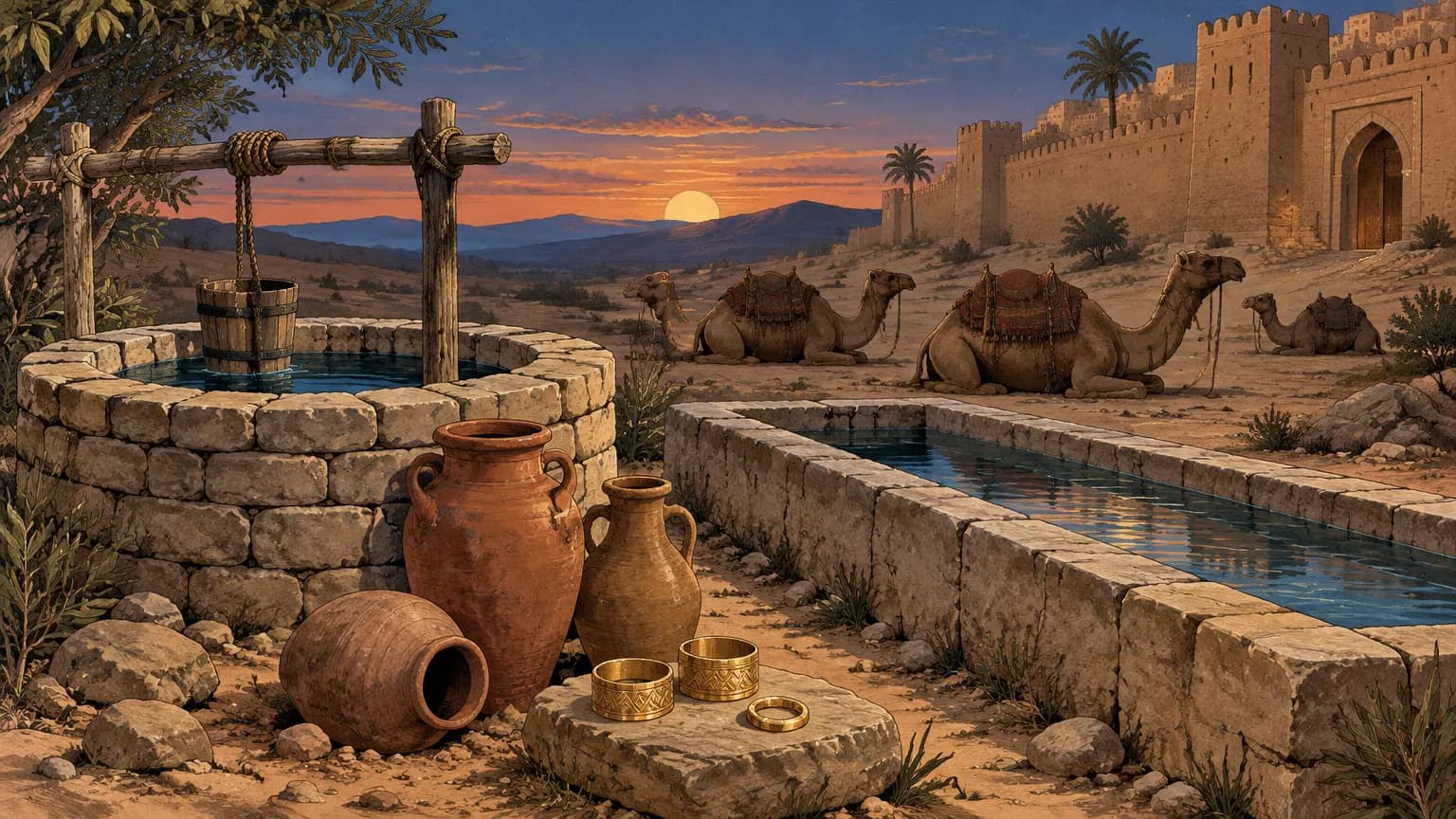
The servant travels with ten camels to Aram-naharaim, to the city of Nachor, Avraham's brother. At evening he halts by the well and prays for a sign: let the young woman who gives him a drink and offers, unasked, to water his camels be the one God intends. The sign is no small test. Watering ten camels after a desert crossing is hours of hauling, and only a deeply generous person would volunteer for it. Before he has finished praying, Rivkah appears. She is Nachor's granddaughter. She gives him water and then runs back and forth until every camel has drunk. He watches in silence, gives her gold jewelry, learns her family, and bows to bless God.
At the evening well outside the city, the camels drink from the trough, and gold jewelry rests upon the stone.
The servant retells the story and Rivkah consents
Rivkah's brother Lavan hurries out, his eye on the jewelry, and welcomes the man inside. The servant refuses to eat until he has told his errand, and the Torah repeats the whole story in his words. The repetition is deliberate, with small adjustments. He stresses Avraham's wealth and the family tie, and he places the gifts after learning her name. Lavan and Rivkah's father Betuel answer, "The matter was decreed by God." The next morning the family asks for ten days' delay. The servant presses, and they put the question to Rivkah herself, who answers simply, "I will." They send her off with a blessing that she become thousands of myriads.
Rivkah meets Yitzchak and enters Sarah's tent
Yitzchak, back from Beer-lahai-roi in the Negev, is walking in the field toward evening when he sees the camels. Rivkah sees him, alights, learns who he is, and covers herself with her veil. The servant reports everything. Then comes a compressed phrase: Yitzchak brought her "into the tent, Sarah his mother." The Hebrew runs tent and mother together. It was Sarah's tent, empty since her death, and it is now occupied again. He married Rivkah, loved her, and was comforted after his mother.
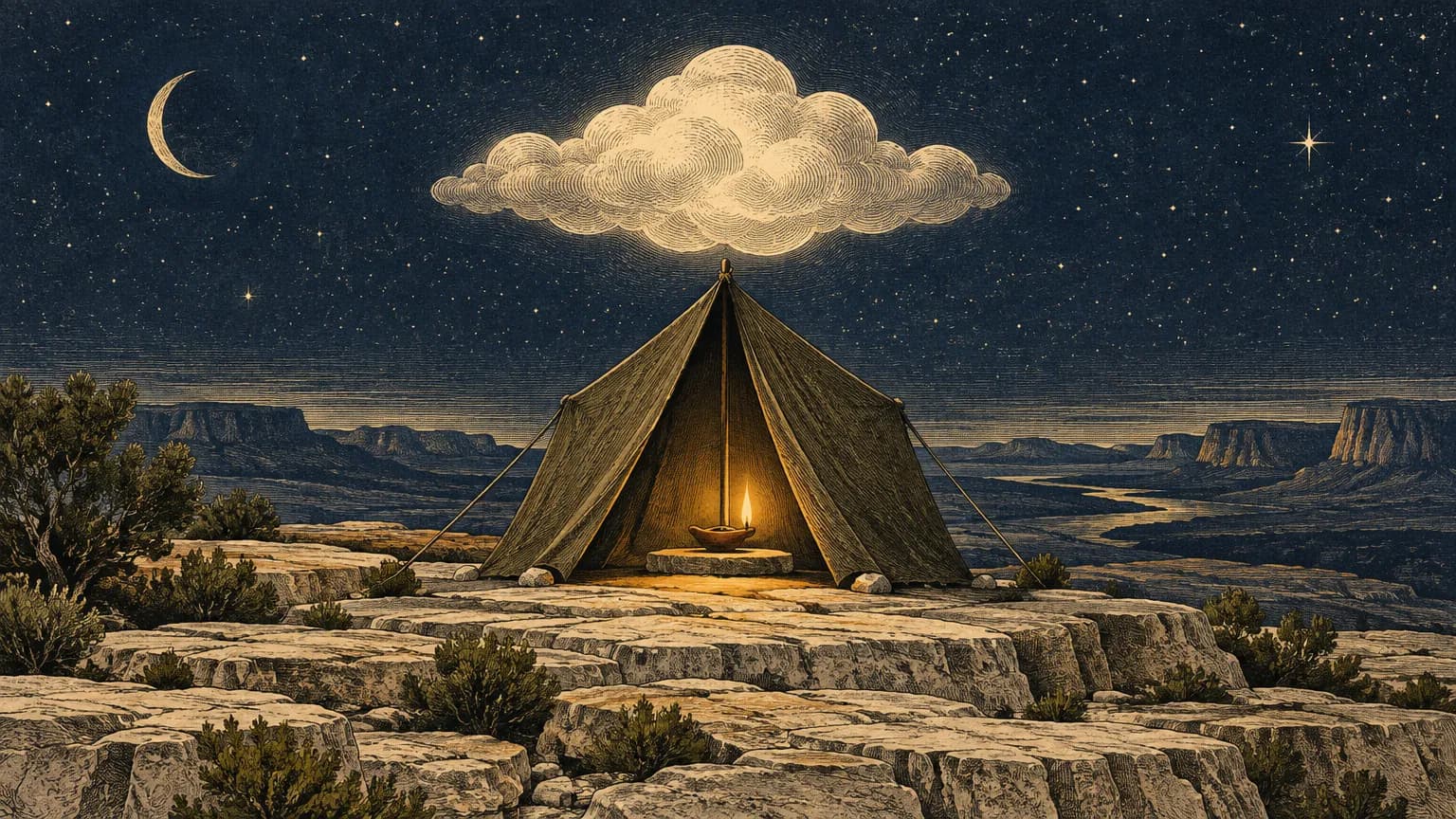
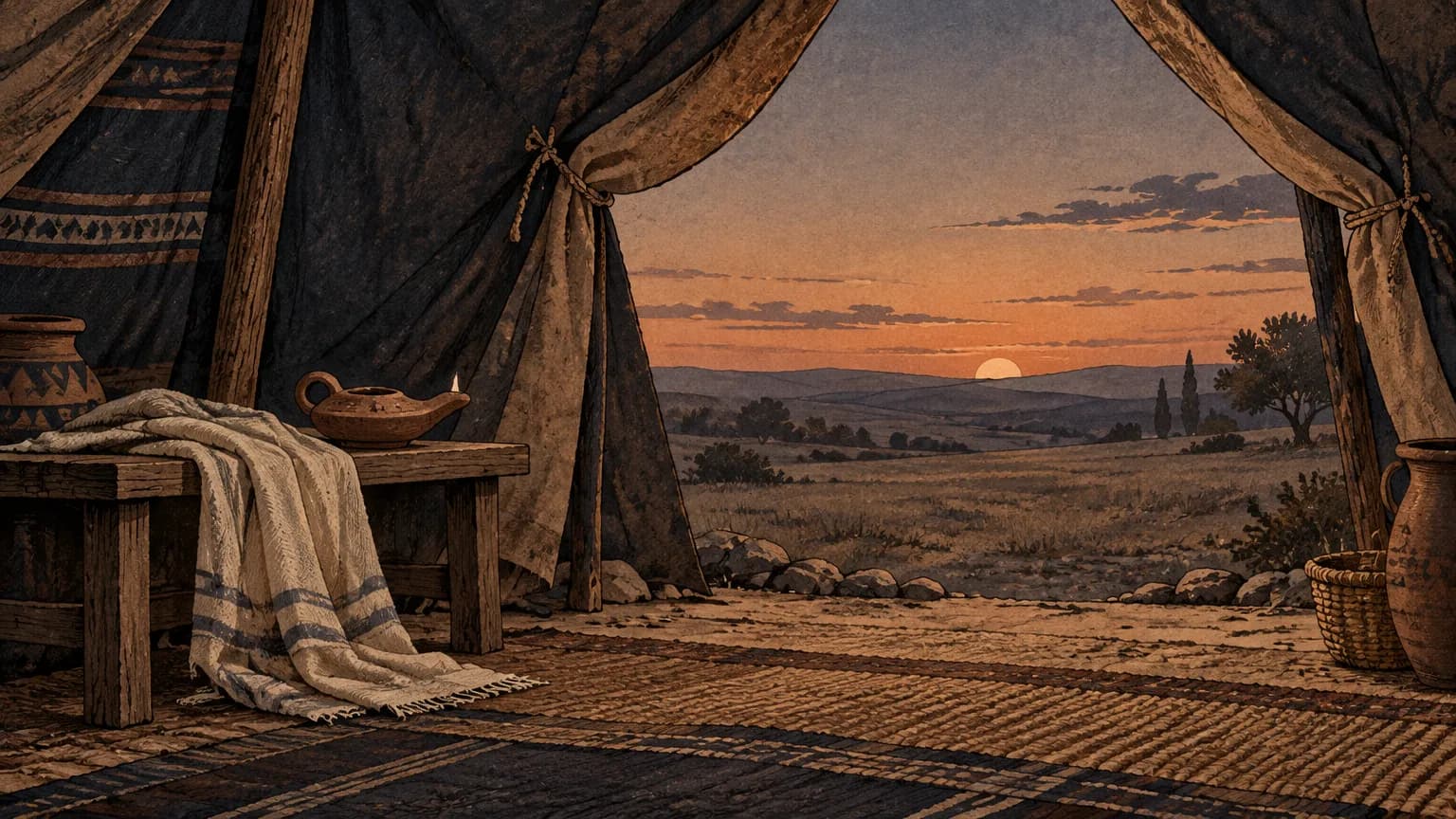
Rivkah is brought into the tent of Sarah, which stood empty since her death, bringing comfort after mourning.
Keturah's sons, Avraham's death, and Yishmael's line
Avraham takes another wife, Keturah, who bears him six sons, and the Torah lists some of their descendants. Then it says that Avraham gave "all that he had" to Yitzchak, and yet that he gave gifts to these other sons. The two statements fit together. Yitzchak alone is heir to the household and its standing. The others receive gifts during Avraham's lifetime and are sent east, so that no rival claim remains. Avraham dies at one hundred and seventy-five, old and content. Yitzchak and Yishmael bury him in Machpelah beside Sarah. God blesses Yitzchak, who settles near Beer-lahai-roi. The parashah closes with Yishmael's twelve chieftains, his death, and his people's wide territory. The founding generation has been laid to rest, and Yitzchak stands alone.
Generated 11/01/2026
Analysis axes
They form the central interpretive thread and appear interspersed in the essay below, connecting the parashah's sequence to a unified reading shaped by Rashi.
1.A parashah that opens with a death in Hebronגר ותושב אנכי עמכםRashi on 23:4
2.Avraham buys the cave of Machpelahה' אלהי השמים אשר לקחני מבית אביRashi on 24:7
3.The servant's oath and Avraham's chargeהאהלה שרה אמוRashi on 24:67
4.The sign at the well and Rivkah's kindnessויתן אברהם את כל אשר לו ליצחקRashi on 25:5
Interpretive Analysis2 Rashi axes at the turns of the reading
The parashah turns on a phrase Avraham drops. He binds his servant by "the God of heaven and the God of the earth," and four verses later, recalling his departure from home, he says only "the God of heaven." An old reading of the verse hears in this gap a confession of Avraham's life work. When God first took him from his father's house, He was God of heaven only. Now He is also God of the earth, because Avraham has made His name familiar in human mouths. On this reading, God's title on earth is something human speech confers, and it can lapse. That gives the parashah its real subject. It is not chiefly about mourning or matchmaking. It asks whether God's earthly address survives the death of the people who built it. Each movement answers by securing one piece of that address.
The proof lies in who speaks God's name. Count the voices. The Hittites call Avraham "the elect of God among us." Lavan greets the servant as "blessed of God." Lavan and Betuel concede that "the matter was decreed by God." None of these people belongs to the covenant, and nobody prompts them. The phrase Avraham omits from his memory of Haran is supplied, over and over, by strangers. The narrative itself performs his claim to have made God "God of the earth." That also explains the doubled self-description at the gate. In the same old reading, "stranger and resident" is an ultimatum: if you sell, I am a stranger and will pay; if not, I am a resident and will take it by right, for God said, "To your seed I will give this land." Avraham holds the stronger claim in reserve and pays anyway. A seized field would announce Avraham's power. A field sold to "the elect of God," before the whole assembly, announces God's presence on the ground. The four hundred shekels buy a public acknowledgment as much as a cave.
Sarah's death therefore threatens more than a marriage. The same tradition reads "the tent, Sarah his mother" as "and behold, she was Sarah his mother." While Sarah lived, a lamp burned from one Shabbat eve to the next, a blessing rested in the dough, and a cloud hung over the tent. When she died, all three ceased, and when Rivkah entered, they returned. These signs are strikingly domestic: light, bread, a covering cloud. They are the God of heaven made visible in a household's ordinary hours, the God of the earth at the scale of a single home. That is why Yitzchak's comfort follows the tent and not the wedding. It is also why the test at the well measured lavish kindness to a stranger. Rivkah was chosen for the very trait that made Avraham's tent a place where God's name was learned.
The final transfer completes a structural inversion. The parashah opens with Avraham refusing to accept as a gift what God had already promised him, insisting on paying for it. It ends with him handing over, as pure gift, what no silver could buy. The old reading explains "all that he had" as the blessing itself: God told Avraham "be a blessing," entrusting blessings to his hand to bestow on whom he wished, and Avraham passed them to Yitzchak. Keturah's sons receive gifts, which are things. Yitzchak receives the capacity to carry blessing. At the start, Avraham turns heaven's promise into an earthly deed. At the close, he turns his earthly life into a trust that is handed on. The sequence that follows is telling: the moment Avraham is buried, "God blessed his son Yitzchak." The transmission has held.
It is tempting to read this parashah as an interlude, a pause of funerals and courtship between Avraham's great trials and Yaakov's struggles. The text resists that. Here Bereshit tests whether the covenant can outlive its first generation, and the answer it gives is deliberately modest in scale: a burial plot bought before witnesses, a tent where bread and light return, and a son entrusted with blessing. The closing genealogy sharpens the contrast. Yishmael's twelve chieftains spread out from Havilah to Shur, with villages and encampments, far more land and power than Yitzchak's single cave and single tent. The Torah lets the imbalance stand without comment. God's earthly presence, in this book, takes root through households that keep His name spoken, not through territory, and the first piece of the promised land that Avraham's family owns is a grave.
The parashah begins with Sarah laid in the ground of Machpelah and ends with Avraham laid beside her, and between the two burials her tent burns with light again. Yet Yitzchak chooses to settle at Beer-lahai-roi, the well Hagar named for the God who saw her in the wilderness. Why does the heir of the blessing make his home beside a well that first belonged to the mother of the son who was sent away?
Rashi's Axes
The four threads structuring this week's reading
Apparent contradiction
גר ותושב אנכי עמכם
Rashi on Bereshit 23:4
Rashi addresses why Abraham describes himself using two contradictory legal designations—a foreigner without land rights and an established citizen. He resolves this by explaining that Abraham poses an ultimatum: if the Hittites deal cooperatively, he will act humbly as a buyer, but if not, he will assert his right to the land by divine grant.
Immediately after rising from Sarah's corpse to speak before the sons of Heth, and just prior to naming the cave of Machpelah, Abraham opens negotiations by presenting himself under two mutually exclusive legal categories. By asserting both foreign vulnerability and native entitlement before any price is discussed, Abraham creates an immediate legal impasse that would be absent if he approached the town as a standard customer. This calculated opening confronts the reader with an unresolved tension: can the covenantal promise of the land be realized through civil purchase without compromising Abraham's reliance on divine gift?
Apparent contradiction
ה' אלהי השמים אשר לקחני מבית אבי
Rashi on Bereshit 24:7
Rashi addresses why Abraham omits 'God of the earth' when recalling his initial calling, despite having just bound his servant by 'the God of heaven and the God of the earth' in verse 3. He explains that when Abraham was first taken from Mesopotamia, God was acknowledged only in heaven, whereas through Abraham's life work He became recognized on earth as well.
Just after placing his senior servant under oath by the God of heaven and earth, and right before dispatching him toward Aram-naharaim, Abraham recalls his original departure from Haran while conspicuously dropping 'God of the earth' from the divine title. Coming only four verses after Abraham insisted upon that double formula, this abrupt omission creates a sharp theological shift inside the servant's briefing. The discrepancy leaves an unresolved tension for the reader: if divine presence on earth is sustained entirely through human recognition established by Abraham, can that presence survive his passing without a matriarch who embodies the same mission?
Generated 11/01/2026
Even as an aging monarch's physical warmth fades, the steadfast honoring of a sacred oath ensures that divine justice and covenantal kingship endure into a new dawn.
Context
This Haftarah opens Sefer Melachim, the book that carries the story of Israel's kings from David's final days onward. David has reigned for forty years. He took the throne at thirty and is now seventy. The great wars of his life are behind him. What remains unsettled is the question every aging king must face: who will sit on his throne after him?
The prophet Natan, David's longtime counselor and the one who once rebuked him, stands at the center of the drama. Beside him is Bat-Sheva, mother of Shlomo. The words Scripture uses for David, "old, advanced in years," are the same words it once used for Avraham. That echo will turn out to matter.
Interpretation
The Haftarah Explained
Why should seventy be called old? Because David was as worn as a man of a hundred, spent by the many wars he had fought. Though they covered him with garments, he could not get warm. The sages explain that one who treats garments with disrespect finds that his own garments will not warm him. Long ago David cut the corner of King Shaul's robe, and now his clothing failed him. It is also said that David once saw the Angel of Death and was chilled with fear for the rest of his days. So his servants sought a young maiden, Avishag of Shunem, to attend him and keep him warm. David did not take her as a wife. He already had eighteen wives, the most a king is permitted.
Meanwhile Adoniyahu, son of Chaggit, grew proud. Scripture notes that his father had never once rebuked him. Handsome and born after Avshalom, he gathered chariots, horsemen, and fifty runners, and he declared himself king. Yoav, David's general, joined him out of calculation. Yoav had killed Avner, a warrior and a scholar, and he knew that David meant his successor to call him to account. He hoped a grateful Adoniyahu would spare him. Evyatar the kohen joined out of resentment, because David had made Tzadok Kohen Gadol, the high priest, instead of him. Adoniyahu held his feast at Even HaZochelet, a great stone that young men tried to move to prove their strength. It stood near Ein Rogel, the spring where clothes were washed.
Natan came to Bat-Sheva with urgent advice. If Adoniyahu were left to rule, Shlomo would one day have to fight him for the crown, and Bat-Sheva would suffer the disgrace of serving him. Long before, after her first child with David died, people had whispered that the death was punishment for David's sin. Bat-Sheva feared that any children she bore him would be shamed. David answered by swearing that her first son to live would reign after him. Natan, knowing this through prophecy, told her to go to the king. He would come in after her and confirm her words.
Bat-Sheva, as queen, entered David's chamber without waiting for permission. She reminded him of his oath and described the feast to which Shlomo had not been invited. Otherwise, she said, she and her son would be counted as "sinners." Some explain that people would say Shlomo had been passed over because of David's sin with her. Others explain that David himself would be sinning by breaking his oath. Then Natan arrived, and Bat-Sheva stepped out so that no one would suspect the two had planned this together. When Natan finished, David called her back and swore by the God who had rescued him from every trouble: Shlomo would reign, and that very day.
Interpretation
Message
Where does a person earn the crown of old age? Mishlei answers that gray hair is a crown of glory, found in the way of righteousness. Avraham kept "the way of the Lord, doing what is just and right," and so he was granted to be "old, advanced in years." David "administered justice and equity to all his people," and the same words were written of him. Shlomo taught, "Cast your bread upon the waters, for after many days you will find it." Give to the poor the way one throws bread into a river, expecting nothing back. One who gives in order to become rich may be given wealth. One who gives purely out of goodness is given many days. The Haftarah also teaches through Natan that although speaking against others is a grave sin, one may speak openly to stop those who stir up strife.
A long life built on justice and generous giving ends, fittingly, with a promise kept: David's sworn word to Bat-Sheva is fulfilled while he still lives to see it.