Moses Reads the Wilderness as a Map of Israel's Own Heart
The road into the Land runs through memory: before Israel can inherit, it must hear its own history spoken back plainly.
Summary
1 min
This image unites the wilderness delay with the prophetic call to justice, symbolizing the enduring responsibility of a people to recognize their Maker before they can inherit the promise.
The last book of the Torah opens with Moshe, on the eastern bank of the Jordan in the fortieth year since Egypt, turning to gather the whole people into a long retrospective before they cross into the Land. The analysis argues that the parashah is built to expose what actually delayed Israel, and that the answer is never military. The opening string of obscure place-names, it suggests, is a coded ledger of past failures, allowing Moshe to raise old wounds by allusion rather than accusation. That this rebuke comes only after Israel defeats the kings Sichon and Og is deliberate: criticism is bearable only from a leader who has already delivered tangible land. A quieter detail carries the deepest claim. During the thirty-eight years of wandering, after the doomed generation was condemned at Kadesh-barnea for refusing to enter, the intimate divine speech to Moshe lapsed, resuming only once that generation died out—evidence that even the prophet's access to God was bound to the standing of the people he carried.
In the haftarah, the first chapter of Yeshayahu, the prophet in Jerusalem summons heaven and earth as eternal witnesses against a people that fails to recognize its Maker as even an ox knows its owner. He rejects hollow sacrifices, demanding instead justice for the orphan, the widow, and the poor.
Generated 07/12/2026
Parashah SynthesisBy topic
The final book of the Torah opens not with a new event but with a voice: Moshe, standing east of the Jordan, turns to the whole people and begins to speak. What follows in this parashah is a long retrospective, a leader recounting where they have been before he tells them where they are going.
Synthesis topics
The Autoparashah methodology selected 6 topics to summarize the parashah's sequence.
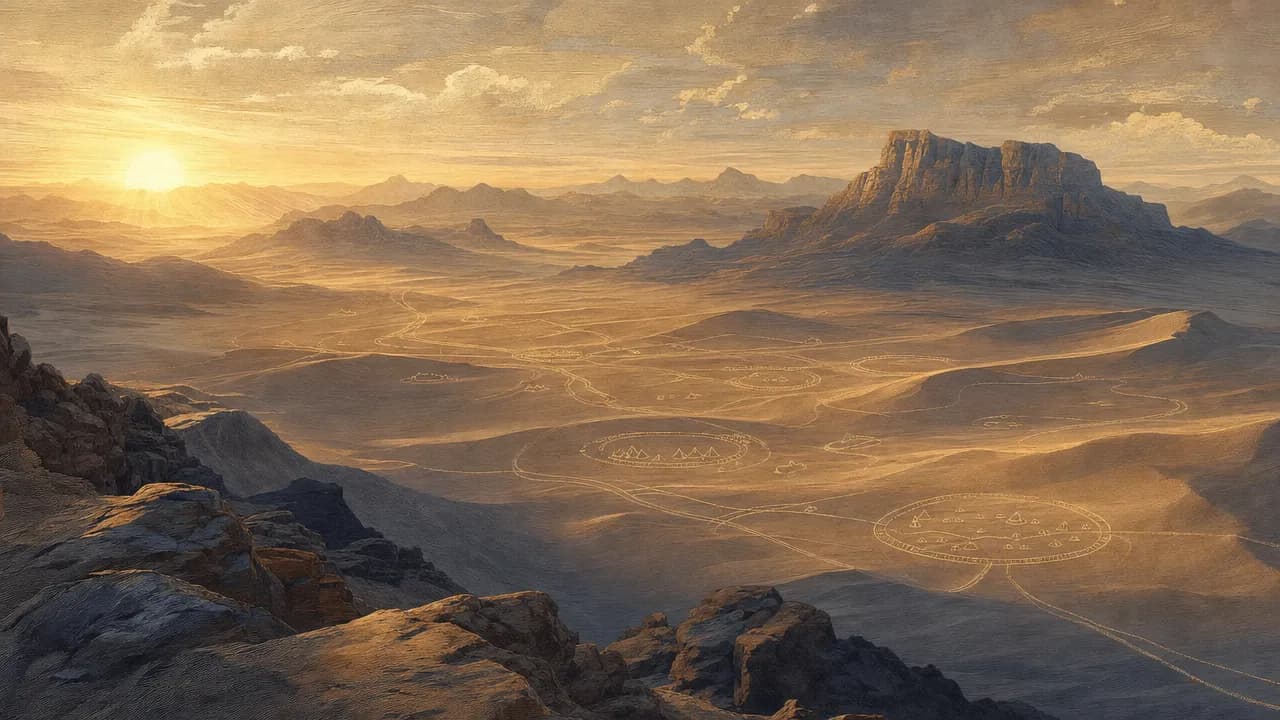
The parashah opens with a list that reads like a puzzle. "These are the words that Moshe addressed to all Yisrael on the other side of the Jordan"—and then, instead of the words themselves, a string of place-names: the wilderness, the Aravah, near Suf, between Paran and Tofel, Lavan, Chatzerot, and Di-zahav. These are not stops on a travel itinerary so much as reminders. Each name gestures toward a place where the people had once faltered, and by naming the sites rather than the sins, Moshe raises the whole history of the wilderness without shaming anyone to their face. The tone is set immediately: this is a speech of accounting, delivered gently, in the fortieth year since leaving Egypt, on the first day of the eleventh month.
The opening list of wilderness place-names serves as a gentle, unspoken map of the nation's history, recalling past struggles without explicit shame.
The burden of leadership and the appointment of judges
Moshe begins the account proper at Chorev, the mountain of the covenant, where God had told the people they had stayed long enough and must set out to take the Land promised to the avot. He recalls how quickly the sheer size of the nation overwhelmed a single leader. "How can I bear unaided the trouble of you, and the burden, and the bickering!" So he had the people choose wise and experienced men from each tribe, and appointed them as chiefs over thousands, hundreds, fifties, and tens, with officers for the tribes. To these judges he gave a charge that still rings with its own severity: hear both sides, judge without partiality, treat the small and the great alike, fear no litigant, "for judgment is God's." Anything too hard, they were to bring to him.
The spies, the refusal, and the wasted generation
From there Moshe moves to the hinge of the whole wilderness story. At Kadesh-barnea, on the threshold of the Land, the people asked to send men ahead to scout the route and the cities. Twelve were sent; they returned with fruit of the land and the words "It is a good land." Yet the people refused to go up, weeping in their tents and imagining that God had brought them out only to destroy them. Moshe reminded them how God had carried them "as a man carries his son," but they would not trust. The response was a sworn decree: that entire generation would not see the good land, none except Kalev, who had stayed loyal, and Yehoshua, who would lead in Moshe's place. Only their young children would enter. When the people then reversed themselves and charged up the mountain against orders, they were routed and chased like a swarm of bees, and their weeping afterward went unanswered.
Skirting Esau, Moab, and Ammon without war
The narrative then leaps across the decades of wandering. God tells Moshe to turn the people north, and to pass carefully by three nations without provoking them. The descendants of Esav in Seir, and the descendants of Lot—Moav and Ammon—are not to be attacked, because God has already assigned those lands as inheritances that Israel has no claim upon. The people must even buy their food and water rather than seize anything. Woven into these instructions is a note that the old giant-peoples once held these territories and were displaced, a reminder that God alone sets the borders of nations. Quietly, the text marks that the full thirty-eight years passed here, until the last of the doomed generation of warriors had died out—and only then does God resume speaking to Moshe in the old way.
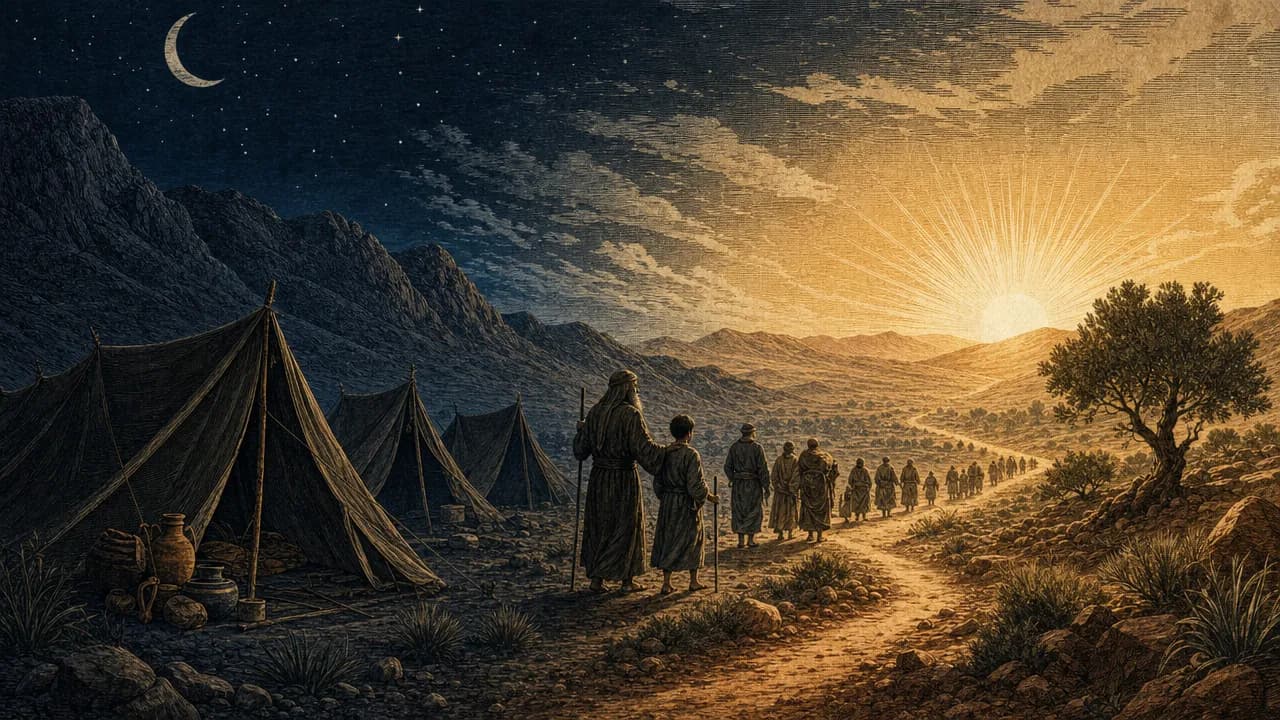
As the old generation passes in the quiet of the wilderness, a new generation prepares to step into the light of the promise.
The conquest of Sihon and Og
With the old generation gone, the tone shifts from restraint to conquest. God gives Sichon, the Amorite king of Cheshbon, into Israel's hand. Moshe first sends an offer of peaceful passage, but Sichon refuses, his will hardened so that he would come out to fight, and Israel defeats him and takes all his cities. They then turn toward Bashan and its king, Og—the last of the Refaim, the ancient giants, whose enormous iron bedstead the text pauses to describe. Here God tells Moshe explicitly, "Do not fear him," and Israel strikes Og and his people down as thoroughly as they had Sichon, capturing sixty fortified cities in the region of Argov.
Dividing the eastern land and charging Yehoshua
The parashah closes by settling accounts on the land just won. The territory east of the Jordan is apportioned to Reuven, Gad, and half of Menasheh, with named districts assigned to each. But Moshe binds the arrangement with a condition: the fighting men of these tribes must cross the Jordan as an armed vanguard, at the head of their brothers, and only after the rest of Israel has secured its inheritance may they return to their families and flocks in the east. The last words are directed to Yehoshua. Having seen with his own eyes what God did to these two kings, he is told not to fear the kingdoms ahead, "for it is the ETERNAL your God who will battle for you." The parashah ends on the near edge of the Land, everything won so far behind them, everything still to be won laid before the man who will lead them in.
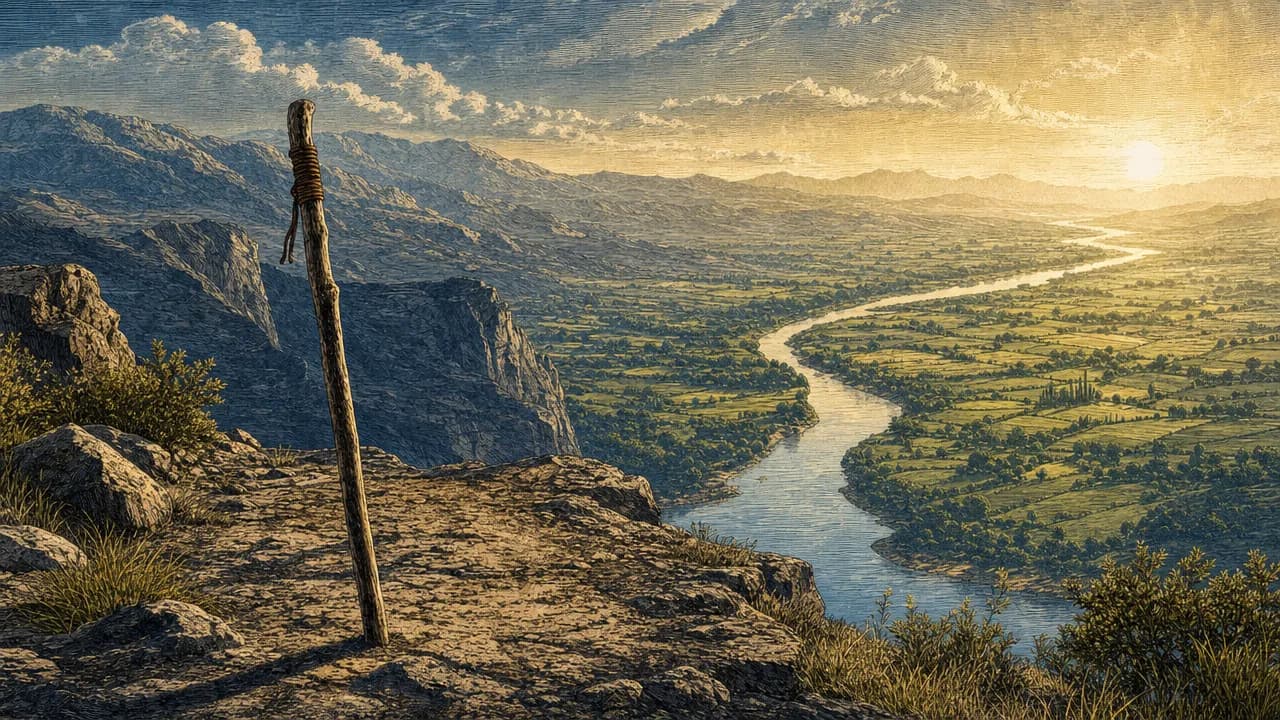
Standing on the threshold of the Jordan, the nation looks forward to the inheritance ahead, anchored by the promise of divine support.
Generated 07/12/2026
Analysis axes
They form the central interpretive thread and appear interspersed in the essay below, connecting the parashah's sequence to a unified reading shaped by Rashi.
1.A speech that opens with veiled place-namesאלה הדבריםRashi on 1:1
2.The burden of leadership and the appointment of judgesאחרי הכתוRashi on 1:4
3.The spies, the refusal, and the wasted generationויהי כאשר תמו וגו' וידבר ה' אלי וגו'Rashi on 2:16
4.Skirting Esau, Moab, and Ammon without warאל תירא אתוRashi on 3:2
Interpretive Analysis4 Rashi axes at the turns of the reading
Read the parashah again with one question in mind: what actually delays Israel? The surface answer is enemies—Sichon, Og, giants in walled cities. But the text tells a different story. The nations that could physically block the road are precisely the ones Israel is forbidden to fight, and the two kings it does fight fall without difficulty. The real obstacles are internal, and the parashah is built so that its geography, its silences, and even its shifts in divine speech all trace the same buried argument: the journey into the Land is governed not by military readiness but by the moral and spiritual condition of the people and the man who leads them.
This is why the opening list of place-names is not decorative but foundational. Those obscure names—the wilderness, near Suf, Di-zahav—are the coded ledger of Israel's failures, laid down before a single law of the Land is taught. Moshe chooses allusion over accusation, and the choice is itself the thesis: the past is not erased on the threshold of the future, it is carried in. And the timing of the whole address confirms this. The text dates the speech pointedly to the period *after* the victories over Sichon and Og. Rebuke delivered by a leader who had produced nothing would invite the retort, "What claim has this man upon us?" Only once he has handed the people tangible land can Moshe safely name their oldest wounds. Criticism, the sequence insists, is only hearable from a proven protector—leadership and reproof are one act, not two.
The most revealing detail sits in the middle of the parashah, easy to pass over. As the wandering generation finishes dying, the text says, "when all the warriors among the people had died off, God spoke to me, saying"—and the resumption of speech is the point. Through the entire thirty-eight years of the decree, divine communication to Moshe had lost its intimate, affectionate register. The prophet's own access to God was suspended along with the people's standing. This is a startling claim about leadership: Moshe's spiritual height is not his private possession but is bound to the collective. When the nation lies under censure, even its greatest prophet speaks to God through a narrowed channel. The leader cannot rise above the people he carries; he descends with them and waits with them.
This mutual dependency explains a small asymmetry in the two conquests that would otherwise seem arbitrary. Before Sichon, God says nothing about fear. Before Og, He must say explicitly, "Do not fear him." Militarily this is backwards—Sichon is met first, the unknown quantity, while Og is the second and by then Israel has already won. What frightens Moshe about Og is not his army but his merit: Og was the one who, ages before, had brought Avraham word that Lot was captured, and that ancient act of service to the first of the avot might still shelter him. Moshe's anxiety is theological, not tactical. He fears that history has a claim, that a good deed done to Avraham centuries earlier might bend the divine plan. The reassurance he needs is not about swords but about whether merit can outweigh the present decree.
Notice what these threads share. The place-names encode moral memory; the timing of the rebuke turns on moral standing; the silence of thirty-eight years measures moral distance; and the fear of Og weighs moral merit against divine intent. In every case the operative variable is spiritual, never physical. The parashah systematically refuses to let military logic be the engine of the story. Even the eastern tribes are not allowed a purely practical settlement: Moshe binds their comfortable land to a covenantal obligation to fight at the front for their brothers. Possession is never merely possession.
This casts the whole book that now begins in a particular light. Devarim opens as a speech, not a chronicle, because its subject is not what happened but what the people made of what happened—and what they are now ready to receive. The generation that stands before Moshe is the one that was carried "as a man carries his son" through the wilderness precisely because it was still growing up. The parashah leaves them, and Yehoshua, on the very edge of the Jordan with the enemies already proven beatable, so that when the crossing finally comes the reader knows exactly what was ever truly in the way. It was never the giants.
The parashah ends with Yehoshua told to remember what his eyes have seen, and the whole address has been an exercise in exactly that—teaching a people to see their own road rightly. What remains unspoken is whether the next generation, standing where its parents once wept, has learned to trust the God who carried them. The Jordan is still uncrossed.
Generated 07/12/2026
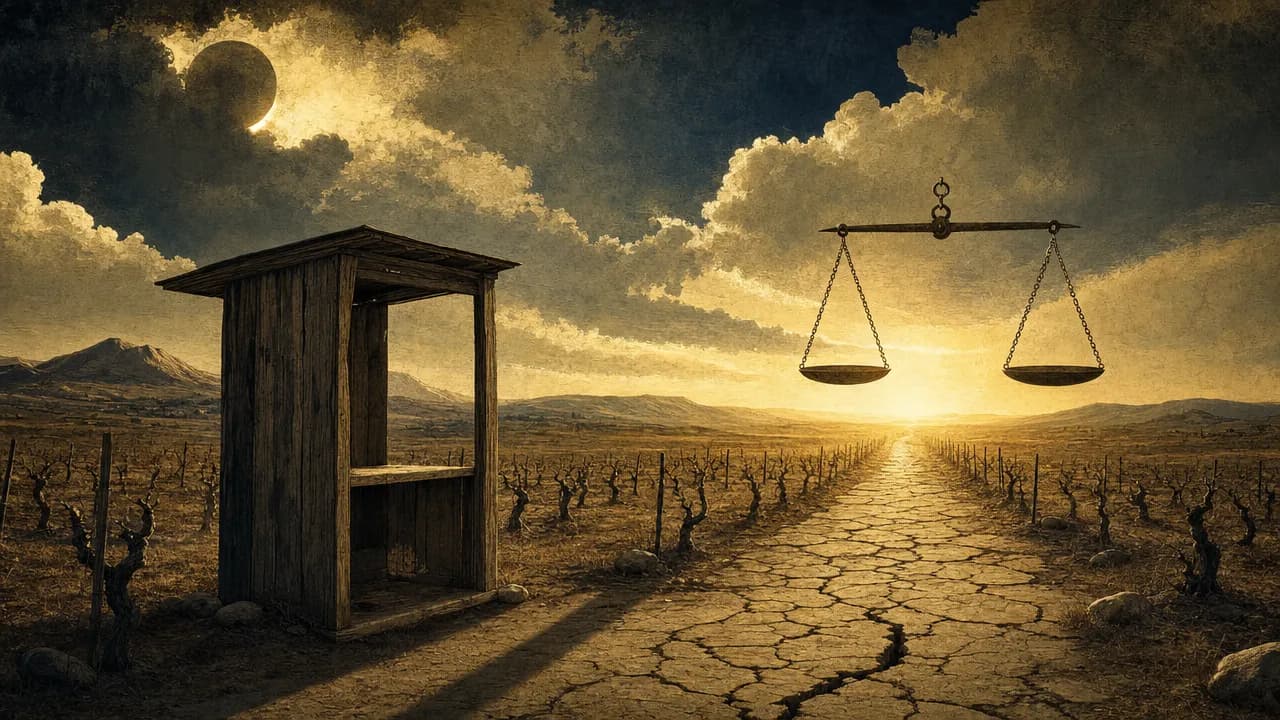
This illustration contrasts the desolation of a hollowed-out Jerusalem, symbolized by the empty vineyard booth, with the balanced scales of justice that offer the path to her ultimate redemption.
Context
This Haftarah opens the book of Yeshayahu, the prophet in Jerusalem who spoke through the reigns of several kings of Yehudah, the southern kingdom. His words were addressed to Israel and to Jerusalem alike, rebuking the people for their transgressions so that they might turn back and be pious, and so that the holy city would not be destroyed.
Yeshayahu himself descended from Tamar, the daughter-in-law of Yehudah, who was so modest that Yehudah did not recognize her. Our sages teach that a woman who is chaste is worthy that kings and prophets should come from her, and indeed King David and Yeshayahu both descended from Tamar.
Interpretation
The Haftarah Explained
The prophet calls out, "Hear, O heavens, and give ear, O earth." Heaven and earth are summoned as witnesses because they are eternal: a person cannot flee from them, and they will always be found to testify. They are also the very relatives of the human being, for the soul was given from heaven and the body is taken from the earth. There is a difference between Yeshayahu and Moshe: Moshe, who was close to heaven, said to it "understand," while Yeshayahu, being far from heaven, cried out "hear me" — for one who is distant must shout. And the witnesses come to punish first: if Israel sins, the heaven withholds its dew and rain, and the earth refuses to bring forth its yield.
God laments, "I reared children and brought them up." He raised Israel with Torah and good deeds, as one raises a child, and elevated them with His Shekhinah, yet they abandoned His Torah and angered Him. The rebuke sharpens with the ox and the donkey: an animal with no understanding still recognizes the master who feeds it, yet Israel, blessed with every good thing, refuses to recognize its Maker. The root of all this is that they did not want to study Torah. So the animals that know their owner will one day repay the one who did not acknowledge his own Master's goodness.
Because Israel would not be pious, the prophet warns that the land will be laid waste and strangers will devour its goods, and Jerusalem will be left "like a booth in a vineyard" — like the hut that stands empty and desolate once the wine has been gathered. Yet the Holy One, who desires Israel below on earth as He desires the angels above, allows a remnant to survive.
Then God asks what the offerings are worth when the heart's intention is not good: "What need have I of all your sacrifices?" Who asked the people to crowd His courts with empty ritual? He calls instead to "wash yourselves clean," to cease doing evil and learn to do good, to uphold the orphan and defend the widow. The faithful city that was once filled with justice — where, our sages say, no one passed a night bearing a sin, since the evening korban forgave the day's failing and the morning korban the night's — has become full of murderers. Her silver has turned false and her wine is cut with water, and her judges take bribes to rule falsely, so that the orphan is not heard and the widow's cause never reaches them.
Interpretation
Message
The prophet's central plea is that recognition of God is measured not by the volume of offerings but by honest justice. A judge who lets gold cover silver, who wears down the poor man until his money is spent before his case is heard, and who leaves the widow to turn away in despair, empties the city of the righteousness that once dwelled in it. But the closing promise remains open: when Israel dispenses proper justice to the poor as to the rich, and gives charity, then "Zion shall be saved in the judgment," and Israel will enter the redeemed city once more.
The animals know their Master; the challenge set before us is to know Him too — and to prove it through justice for the orphan, the widow, and the poor.