The Seams Are the Argument: How Ki Teitzei Chains Small Choices to Whole Destinies
Ki Teitzei arranges its laws by consequence, not topic — two chains running opposite directions from the same act of noticing.
Summary
1 min
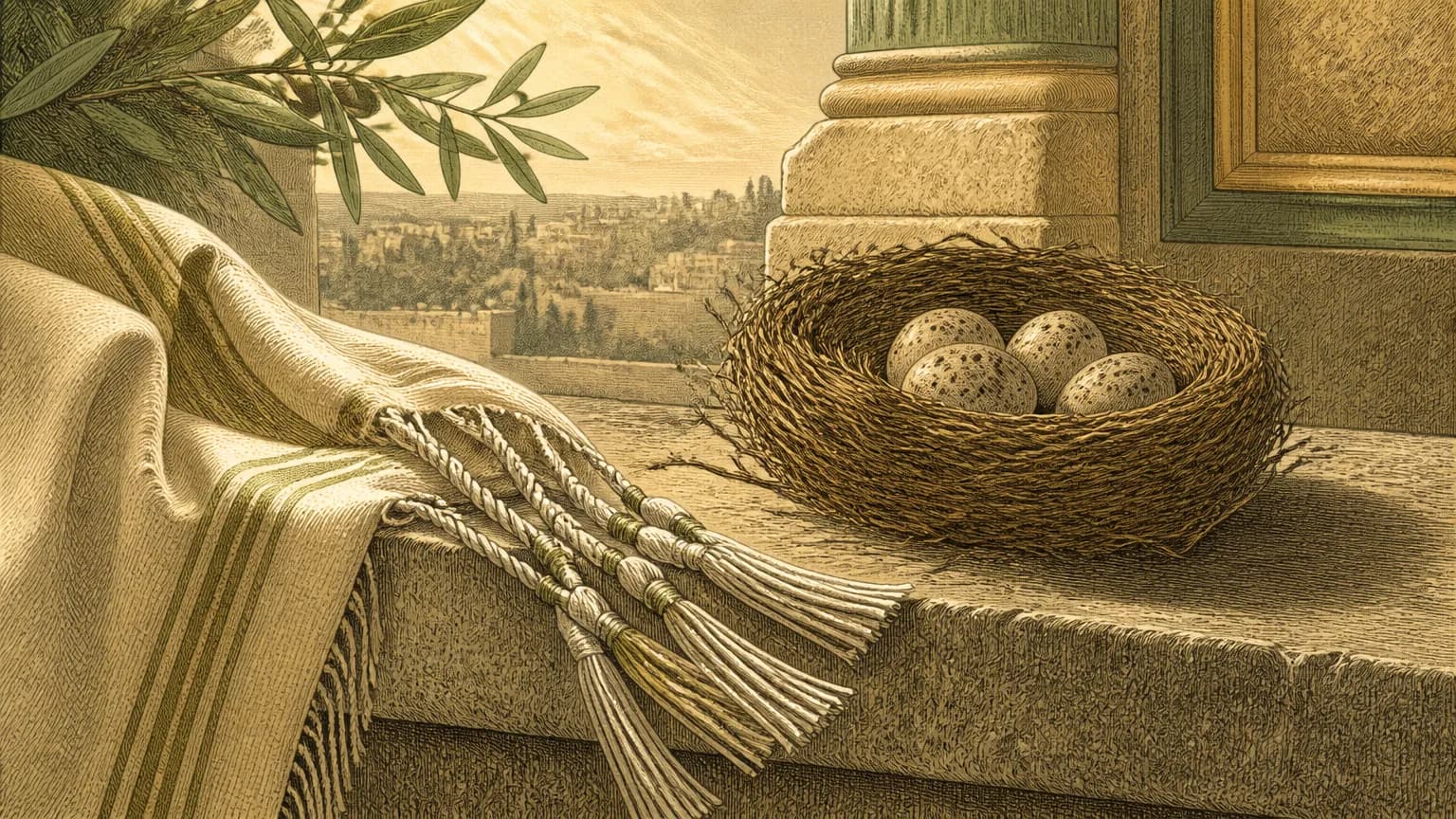
Tracing how minute choices cascade into vast moral destinies, the expanding canopy reflects small ethical deeds that culminate in a lasting sanctuary of covenantal peace.
Ki Teitzei is the Torah's densest stretch of law — dozens of commandments delivered by Moshe on the plains of Moav with almost no narrative between them, covering war, marriage, farming, lending and courts. The analysis argues that the apparent disorder is the point: the laws are joined not by subject but by consequence, and Rashi, the eleventh-century French commentator, reads the abrupt seams themselves as the claim. The parashah opens with a soldier who desires a woman taken captive; four laws later a son is condemned by his parents and a corpse hangs on a stake. Rashi links them as one chain: an indulged glance arriving at a grave. A second chain runs the opposite way, from a man who sends away a mother bird before taking her young to the parapet on the new house he will build — one mitzvah drawing another after it. The measure, then, is not the size of an act but what it tends to produce. Hence the closing seam: false weights hidden in a pouch precede Amalek, who struck the stragglers at the rear — the same failure to notice what is small.
In the haftarah, from the later chapters of Yeshayahu, Yerushalayim in exile is addressed as a childless woman told to sing. Her tent must be enlarged for the children coming; her Husband, who hid His face only for a moment, swears — as He swore after the flood — that His anger is finished and His love permanent.
Generated 08/16/2026
Parashah SynthesisBy topic
Ki Teitzei is the densest stretch of law in the Torah — dozens of mitzvot arriving one after another with almost no narrative to cushion them. Read slowly, in order, it turns out to have shape.
Synthesis topics
The Autoparashah methodology selected 6 topics to summarize the parashah's sequence.
Moshe is still speaking on the plains of Moav, and his address has settled into sustained legislation for a people about to cross into a land where they will live ordinary lives — farming, marrying, lending, litigating, going to war. The parashah opens abruptly on campaign: "When you take the field against your enemies," and a soldier sees among the captives a beautiful woman and desires her. From there the laws come in rapid succession, rarely more than a few verses each, with no headings and few transitions. Nothing here is framed as ceremony; almost everything is framed as something you will actually encounter.
Household order: captive, firstborn, wayward son, and everyday mercies
The captive woman is not simply handed over. She is brought into the household, her hair trimmed, her nails pared, her captive's garb discarded, and she is given a full month to weep for her father and mother before the soldier may approach her. The law functions as a delay and a stripping away of allure; if he then rejects her, he must set her free outright and may never sell her. Immediately next comes a man with two wives, "one loved and the other unloved," whose firstborn belongs to the unloved one — and who may not shift the double portion, two shares of the estate, to the favored wife's son. Next, a son so incorrigible that both parents together bring him to the elders and testify against him, and he is stoned. Then a body executed and hung on a stake, which must be buried the same day, because a corpse left exposed is an affront to God and defiles the land. The mood then softens: return your fellow's stray ox, sheep, donkey, garment, anything lost — "you must not remain indifferent"; lift a collapsed animal back onto its feet with its owner; keep the boundary between men's and women's dress; when you chance upon a nest, send the mother bird away before taking the young; build a parapet on your new roof so no one falls; do not sow mixed seed in a vineyard, do not yoke ox and donkey together, do not wear wool and linen woven as one, and make tzitzit, the fringes on the four corners of your garment.
Everyday domestic and natural encounters are elevated into sacred boundaries through mindful restraint, preserving life in its smallest and most vulnerable forms.
Marriage on trial, and who enters the assembly
The next block puts marriage on trial. A husband who slanders his bride, claiming she was not a virgin, is answered by her parents producing the cloth as evidence before the elders at the gate; if he lied, he is flogged, fined a hundred shekels paid to her father, and may never divorce her. If the charge holds, she is stoned at her father's door. Adultery kills both parties. A betrothed girl violated in the town is held responsible along with the man, since she did not cry out; violated in the open field she is guiltless, and the Torah says plainly why — "though the engaged woman cried for help, there was no one to save her," and the case is likened to murder. A man who seizes an unbetrothed girl pays fifty shekels, marries her, and forfeits forever the right to divorce her. Then come the rules of the kahal, admission into the assembly of Israel for purposes of marriage: a man whose organs of generation are destroyed; a mamzer, a child born of a forbidden union; and Ammon and Moav, barred permanently because they met Israel with no bread and water and hired Bilaam to curse the nation — a curse God turned into blessing. Edom, being kin, and Egypt, whose land once hosted Israel, are not to be abhorred at all: their descendants may enter in the third generation.
A camp made holy; loans, vows, and divorce
War returns, now as a question of holiness. The camp must be guarded from anything unseemly: a man rendered impure by a nocturnal emission withdraws until evening, bathes, and returns at sundown; a designated place outside the camp and a spike for digging keep the encampment clean, "since the ETERNAL your God moves about in your camp." A slave who escapes to you is not returned to his master. No Israelite may serve as a consecrated cult functionary, and no fee from prostitution may be brought to the House of God. Interest may not be taken from a fellow Israelite. A vow must be paid without delay, though no one is obliged to vow at all. A worker entering a neighbor's vineyard may eat his fill but not fill a basket. A husband who sends his wife away with a bill of divorce, who then marries another and is again widowed or divorced, may never be taken back by the first. A newly married man is released from the army for a year to gladden his wife. A millstone may not be taken as a pledge, for that is "taking someone's life in pawn." Kidnapping is capital. And in matters of tzaraat, the skin affliction diagnosed by the kohanim, obey them exactly — "remember what the ETERNAL your God did to Miriam."
The poor man's cloak, the laborer's wage, the flogged man's dignity
The following stretch reads as a sustained defense of people with no leverage. A creditor may not enter the house to seize a pledge but waits outside; a poor man's cloak taken in pawn must be returned by nightfall so he can sleep in it and bless you. A laborer's wage is paid the same day, before sunset, because "they are needy and urgently depend on it." No one is executed for a relative's crime. The stranger, the orphan, and the widow are not to be denied justice, and a widow's garment is never taken in pledge. The forgotten sheaf, the olives left after the first beating, the grapes missed on the vine — all belong to them, and twice the reason given is that you were a slave in Egypt. Even court punishment has a ceiling: the flogging is counted and capped, lest "your peer be degraded before your eyes." And the ox threshing your grain may not be muzzled while it works.
Sustaining the vulnerable without humiliation transforms routine agricultural labor and commerce into enduring covenants of dignity, justice, and community memory.
Yibbum, honest weights, and the memory of Amalek
The closing movement turns to a name that could be lost. When a man dies childless, his brother performs yibbum, marrying the widow so that the first son born will carry the dead man's name; if he refuses, she comes before the elders for chalitzah — she pulls the sandal from his foot, spits before him, and declares what is done to a man who will not build his brother's house, and his household is called thereafter "the family of the unsandaled one." A brief, severe case follows about a woman who intervenes in a brawl by seizing a man's genitals. Then weights and measures: no double set in your pouch or your house, only honest ones, "if you are to endure long on the soil." And with no transition at all, the parashah ends in memory and unfinished business: remember what Amalek did on the road, striking the famished and weary at the rear; when God has given you rest in the land, blot out that memory from under heaven. "Do not forget" are its final words.
Generated 08/16/2026
Analysis axes
They form the central interpretive thread and appear interspersed in the essay below, connecting the parashah's sequence to a unified reading shaped by Rashi.
1.A soldier on campaign, and the legislation beginsולקחת לך לאשהRashi on 21:11
2.Household order: captive, firstborn, wayward son, and everyday merciesכי תבנה בית חדשRashi on 22:8
3.Marriage on trial, and who enters the assemblyבנים אשר יולדו להם דור שלישי וגו'Rashi on 23:9
4.A camp made holy; loans, vows, and divorceזכור את אשר עשה לךRashi on 25:17
Interpretive Analysis4 Rashi axes at the turns of the reading
The natural way to read a legal collection this dense is to sort it: family law here, agricultural law there, war, commerce, courts. But the parashah resists sorting, and the resistance is deliberate. Its laws are joined not by subject but by consequence. Rashi, the eleventh-century northern French commentator, stops at four of the seams — the places where the text lurches from one domain to another without warning — and in each case reads the adjacency itself as the claim: what stands next to what tells you what produces what. Read that way, Ki Teitzei is not a miscellany but two chains running in opposite directions out of the same small human faculty, the decision of what to do with what you happen to see.
The descending chain is the parashah's opening. The soldier's desire is conceded, Rashi says, only because the Torah "speaks in view of man's evil inclination" — a permission granted to forestall something worse, hedged with a month of shaved head and pared nails precisely to make the concession unattractive. And then: "if he does marry her, in the end he will hate her, and ultimately he will beget a wayward and rebellious son by her. It is for this reason that these sections are put in juxtaposition." The loved-and-unloved wives, the contested birthright, the son dragged to the elders, the corpse that must come down from the stake before nightfall lest the land be defiled — this is not a list of unrelated household misfortunes. It is one appetite, indulged on a battlefield, arriving four laws later as a body requiring burial. The chain runs from a glance to a grave.
The ascending chain is built identically, and this is the surprise. A man walking a road happens on a nest; he sends the mother away and takes the young, at no cost to himself, and the very next verse hands him a new house and the obligation of a parapet. Rashi's principle here is mitzvah goreret mitzvah, one mitzvah drawing another in its wake: "if you have fulfilled the command of letting the mother bird go, you will in the end be privileged to build a new house and fulfill the command of a parapet." From the roof the sequence continues outward into his vineyard, his field, his plow team, his cloak, and finally the fringes on its corners. The two chains are perfectly matched in their starting conditions — a person on a journey, seeing something, at almost no expense either way. The parashah rates a deed not by its size but by what it is likely to produce next.
That standard needs a metric, and the parashah supplies one where a reader least expects it, in the roster of who may enter the kahal. Egypt enslaved Israel and drowned its infants; Moav withheld bread and hired a sorcerer. Egypt's descendants are admitted in the third generation, Moav's never. Rashi's resolution reorganizes the whole scale: "he who causes a man to sin does him greater harm than one who kills him, for the killer kills him only in this world, while the one who causes him to sin removes him from this world and the world to come." Moav's real weapon was not the withheld water but Baal Peor, the seduction into immorality and idolatry that Bilaam's failed curse gave way to. Harm that ends is survivable; harm that reproduces itself in the next generation is not. The parashah's grading system is generativity, not magnitude.
Which is why the last seam, the one that has puzzled readers most, is the argument's closing turn rather than an appendix. Weights and measures are the most private crime in the parashah: a second stone in a pouch, a shaved measure in a house, invisible to the customer and unprosecutable in practice. Rashi reads the pivot straight: "if you have cheated with measures and weights, be anxious about provocation from the enemy." Amalek does not attack the strong front of the column; he cuts down "all the stragglers in your rear," the famished and weary whom nobody was watching. A society that has trained itself not to notice a missing fraction has already trained itself not to notice the man falling behind. The pouch and the ambush are the same failure of attention, one hidden and one brazen.
This is why Devarim needs such a chapter at exactly this point. Moshe is addressing a generation whose supervised life is ending: no manna, no pillar of cloud, no daily miracle standing over their commerce. What replaces that supervision is not a heavier legal apparatus but a claim about how ordinary life actually works — that it is kinetic, that a chosen indulgence and a chosen restraint both accelerate, and that the moment of decision is almost always trivially small and unobserved. The easier reading, that this parashah is civil housekeeping tacked onto covenant, would make the birds and the sandal and the muzzled ox marginal. On the arrangement the text itself insists on, they are where the covenant is actually decided.
Twice the parashah forbids averting the eyes in nearly the same breath: of a lost ox, "you must not remain indifferent," and of Amalek, "do not forget." Between the stray animal on the road and the enemy at the rear of the camp lies the entire distance the parashah has traveled, and it is covered by a single verb. What, exactly, has a person seen and set down when he decides that something is too small to bother with?
Generated 08/16/2026
The expanding tent anchored before enduring mountains embodies the prophet's promise that exile was only a fleeting concealment before an everlasting covenant of peace.
Context
This Haftarah comes from the book of Yeshayahu, the prophet who spoke in Yerushalayim in the generations when the Assyrian empire pressed upon the kingdom of Yehudah, the southern kingdom centered on Yerushalayim and the Beit HaMikdash. In the later chapters of his book, Yeshayahu speaks past the destruction and exile that lay ahead, addressing the city itself in her desolation and telling her what is coming.
The image that governs these ten verses is a marriage. Yerushalayim in exile is a woman whose husband has gone from her — not a widow, for her Husband lives, but a wife left alone, abandoned and childless. Everything the prophet says here unfolds from that picture: the barren woman who will be surrounded by children, the tent too small for the family it must hold, the Husband who returns and swears never to depart again.
Interpretation
The Haftarah Explained
"Shout, O infertile one, you who bore no child!" The prophet turns to a woman who never knew the pangs of pregnancy, who longs for children and cannot conceive — and this is Yerushalayim during the exile, emptied of her inhabitants. Yet the city that was devastated will have more children than the nations around her, more than a woman securely settled with her husband. She had been like an abandoned wife whose husband is nonetheless still alive; now she is told to sing.
Because the children will be many, the tent must grow: "Enlarge the site of your tent, extend the size of your dwelling, do not stint! Lengthen the ropes, and drive the pegs firm." Make the curtains long and wide, stretch the cords, hammer the stakes fast — and not Yerushalayim alone, but the other cities of the land with her. "For you shall spread out to the right and the left" means she will grow strong to the south and the north and on every other side; her children will inherit many nations, and the towns left desolate will be settled by Yisrael once more.
"Fear not, you shall not be shamed." Do not be afraid of the hardships of leaving exile, for you will never again be put to shame. So great will the good be that the reproaches suffered in exile will simply be forgotten, and the disgrace of having lived like a widow will not even be remembered. The reason follows: "For the One who made you — whose name is GOD of Hosts — will espouse you." Your Master is your Maker and He is your Husband; in the exile it was the nations who ruled over you as a husband rules. Now the Holy One of Yisrael, who is God of the whole earth, is your Redeemer.
"GOD has called you back as a wife forlorn and forsaken." You are not a wife whose husband has died, but a wife whose husband was angry for a time and then returned. And should you fear that the forsaking is permanent — that He has simply found you undesirable, the way a man's affection can cool toward a wife grown old — the prophet answers: "Can one cast off the wife of his youth?" A man who married a young woman remembers, even when she has aged, that she is the very one who came to him in her youth. It is only a wife taken already old whom a man may come to despise. Yisrael is the wife of His youth.
"For a little while I forsook you, but with vast love I will bring you back." So abundant will the good of the days of Mashiach be that the whole exile will seem no longer than the blink of an eye. "In slight anger, for a moment, I hid My face from you" — a moment only; the compassion is forever. And the promise is sealed with an oath: as He swore after the mabul, the flood in the days of Noach, that its waters would never again cover the earth, so He swears that His anger and rebuke are finished. Mountains may be uprooted and hills shaken loose in time, but the oath will not depart.
"But my loyalty shall never move from you, nor My covenant of friendship be shaken — said GOD, who takes you back in love."
Interpretation
Message
The comfort of this Haftarah rests on a distinction that is easy to miss and impossible to forget once seen: exile is not widowhood. A widow has no one to wait for; an abandoned wife does. The whole difference between despair and hope lies there, and the prophet spends ten verses making sure Yerushalayim knows which of the two she is.
The Gemara in Sanhedrin draws out the tenderness in the image. Rabbi Yehudah taught his son Rabbi Yitzchak that a man's heart is truly glad only with his first wife, and Rav taught that a woman is wholeheartedly happy only with the man who married her as a virgin — and it is precisely this that stands behind "For the One who made you will espouse you." The bond formed at the beginning is the bond that holds. Yisrael was betrothed in her youth, and no lapse of years and no interval of anger dissolves what was made then.
Mountains can be moved and hills shaken, but the oath sworn to Yisrael cannot. The moment of hiding has passed; the kindness that follows it is everlasting.