As Bnei Yisrael reach the river's edge, vows, spoils, and boundary lines all press toward one measured order.
Summary
1 min
This image contrasts the enduring flow of divine order with the cracked, human-made vessels of speech and worship that fail to contain it, bridging the wilderness boundaries and the prophetic warning.
Encamped in the plains of Moav, across the Jordan from the promised land, Israel spends this closing portion of the book of Bamidbar settling everything that must be fixed before the crossing: vows, war, borders, and inheritances. Beneath this apparent checklist runs a single concern — what happens when human speech and appetite outrun the order God has set, and who has the standing to pull them back. The laws of vows open with the tribal heads rather than the people because a binding word to Heaven, though real, is not sovereign: a court stands above the mouth. The principle then turns on Moshe himself. Enraged at the returning soldiers after the war with Midian, he lets the law of purifying captured vessels slip from him, and it is his deputy Elazar who supplies it — the teacher of governed speech shown momentarily ungoverned. It recurs when Reuven and Gad ask to settle the eastern grazing land, naming pens for their flocks before cities for their children; Moshe accepts but reverses their sentence, restoring the proper priority. Entering the land, the reading argues, is less about taking it than accepting the order that holds words, spoils, memory, and inheritance each in its place.
In the haftarah, drawn from the opening chapters of the prophet Yirmiyahu, God brings a grievance against Israel: "What wrong did your fathers find in Me," that they abandoned Him for foreign gods once they reached the good land. Even nations loyal to idols they know are powerless do not trade them, yet Israel exchanged the living fountain for broken cisterns that hold no water.
Generated 07/05/2026
Parashah SynthesisBy topic
The people stand encamped in the plains of Moav, across the river from the land they have been promised. What follows is not story so much as preparation: the careful arrangement of words, wars, borders, and inheritances that must be settled before a single foot crosses the Jordan.
Synthesis topics
The Autoparashah methodology selected 6 topics to summarize the parashah's sequence.
The parashah opens not with the whole nation but with Moshe addressing the heads of the tribes: "This is the thing that God has commanded." The subject is the vow — a person's own words, offered to God or sworn as an obligation upon oneself. The governing rule is stark: one who makes a vow "shall not break his word; according to all that comes out of his mouth he shall do." Speech, once uttered toward Heaven, binds. The address is directed to the tribal leaders first because the release of vows is a matter for legal authority, not casual undoing.
War against Midian and the sanctified division of spoils
The text then turns to a woman's vows within a household. A young daughter still under her father's roof, and a wife under her husband, occupy a distinct position: a father or husband who hears the vow may either let it stand by his silence or annul it on the very day he hears it. If he says nothing, the vow holds; if he restrains her that day, it is dissolved and "God will forgive her." A widow or divorced woman, subject to no such household authority, is bound by whatever she has imposed on herself. Should a husband annul a vow only later, after having first upheld it, he — not she — bears the consequence of its breach. These are the boundaries between a man and his wife, a father and his young daughter.
The spoken vow is depicted as a binding thread of light, illustrating how human speech becomes a sacred and unbreakable obligation when directed toward Heaven.
Reuven and Gad ask to settle east of the Jordan
Attention shifts abruptly to war. God commands Moshe to take vengeance upon Midian for having drawn Israel into sin at Peor, after which Moshe is to be gathered to his people. A thousand men from each tribe go out, twelve thousand in all, with Pinchas carrying the sacred vessels and the trumpets. They slay the five kings of Midian and Bilaam son of Beor, and return with women, children, livestock, and vast plunder. Moshe is angered to find the women spared, for it was precisely they who had lured Israel at Peor; he orders the guilty among them removed. The soldiers, having touched death, must remain outside the camp seven days and purify themselves. Because the instruction for cleansing metal vessels — passing them through fire and then through the waters of purification — is delivered here by Elazar rather than Moshe, we understand that in the heat of his anger the specific law had slipped from Moshe's own mouth.
Forty-two encampments recalled and the charge to clear the land
The spoils are then counted and divided with great precision: half to the warriors, half to the community, with a levy drawn from each portion for the kohanim and the Leviim. The officers, discovering that not one of their men has been lost, bring the gold they have taken as an offering "to make atonement for our souls before God." Immediately after, the tribes of Reuven and Gad, rich in cattle, notice that the eastern lands are ideal grazing country and ask to settle there rather than cross the Jordan. Moshe hears their request as an echo of the spies who once broke the nation's resolve, and rebukes them sharply. They answer with a pledge: they will build "pens for our flocks here, and cities for our little ones," and will march as the vanguard until the land is conquered. Moshe accepts — but reorders their words, insisting they build cities for their children first and folds for their flocks after, correcting the priority they had let slip.
The mapped boundaries of Canaan and its appointed dividers
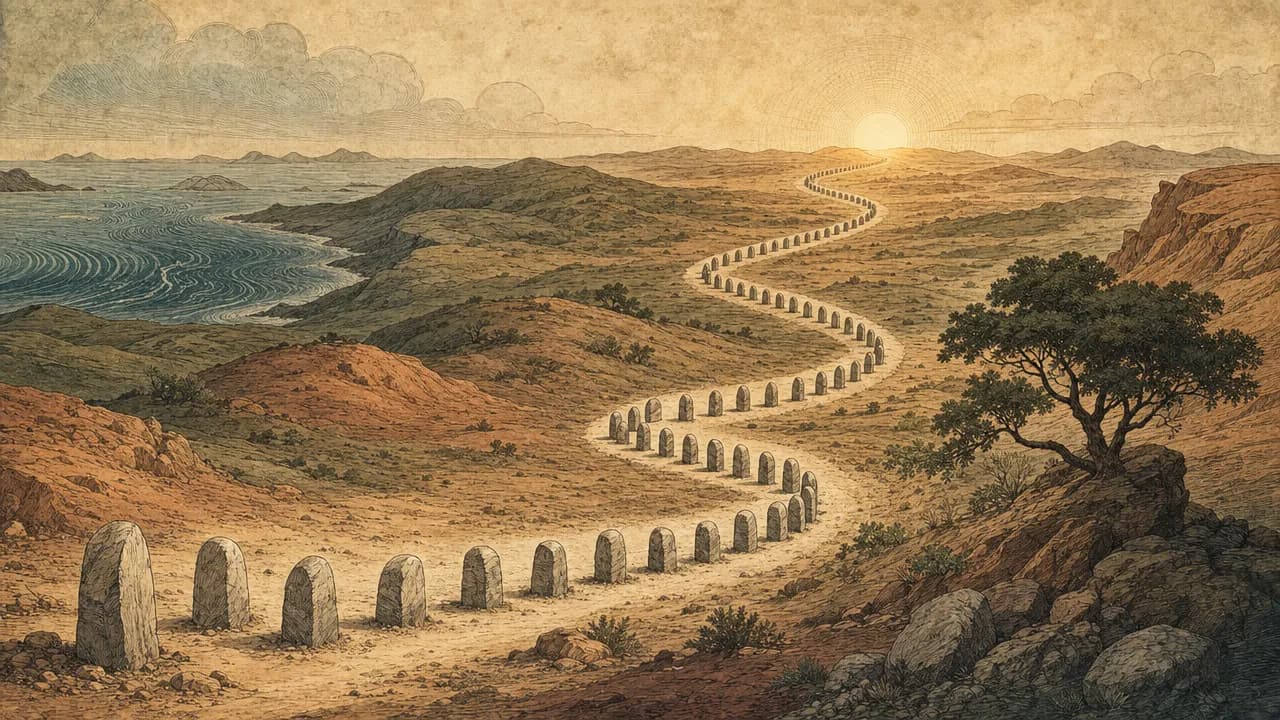
The narrative then pauses to look backward. Moshe records the marches of Israel from the day they left Egypt, station by station — forty-two encampments named in order, from Rameses to the plains of Moav. Woven into the list is the death of Aharon on Hor HaHar in the fortieth year. This long retrospective, set at the threshold between wandering and settlement, marks the completion of the journey. On its heels comes the command for the land ahead: dispossess its inhabitants, destroy their idols and high places, and take possession by lot. If the inhabitants are left in place, they will become "thorns in your sides," and Israel's own hold on the land will be endangered.
The forty-two encampments are visualized as a continuous path of stones, representing the structured memory of Israel's long journey from bondage to the threshold of inheritance.
Levitical cities, refuge for the manslayer, and the daughters of Zelophehad
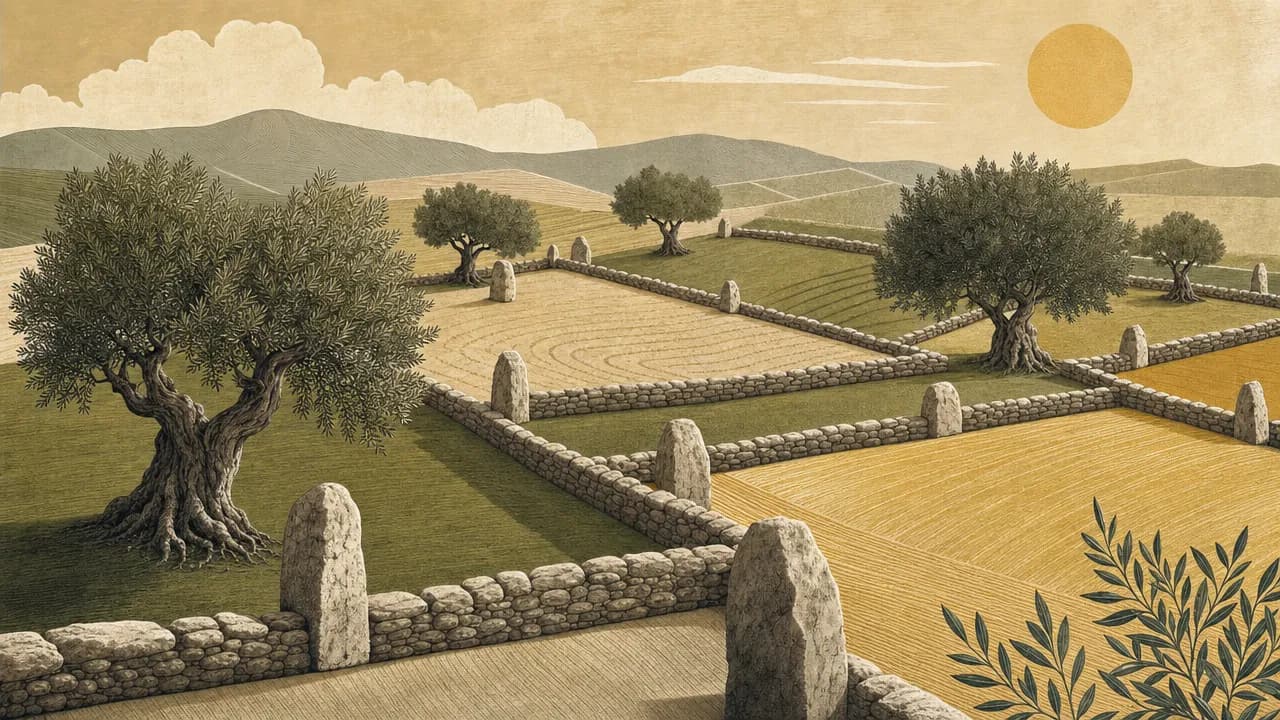
The remaining chapters draw the map and set the safeguards. God dictates the exact borders of Canaan — south, west, north, and east — and names the leaders, Elazar and Yehoshua together with one chieftain per tribe, who will apportion it. Forty-eight cities are set aside for the Leviim, six of them cities of refuge where one who kills unintentionally may flee the blood-avenger and remain until the death of the Kohen Gadol; deliberate murder, by contrast, admits no ransom and no refuge. Bamidbar closes by returning to the daughters of Tzelophchad: to keep their inherited portion from passing to another tribe through marriage, they are directed to marry within their father's tribe, which they do — sealing the principle that ancestral land stays fixed to its tribe. So the book ends, poised at the Jordan, its inheritances mapped and its words settled.
The structured division of the land and its fixed boundaries symbolize the permanent, divinely ordered inheritance secured for each tribe of Israel.
Generated 07/05/2026
Analysis axes
They form the central interpretive thread and appear interspersed in the essay below, connecting the parashah's sequence to a unified reading shaped by Rashi.
1.Vows and the authority to bind or release themראשי המטותRashi on 30:2
2.War against Midian and the sanctified division of spoilsאשר צוה ה' וגו'Rashi on 31:21
3.Reuven and Gad ask to settle east of the Jordanנבנה למקננו פהRashi on 32:16
4.Forty-two encampments recalled and the charge to clear the landאלה מסעיRashi on 33:1
Interpretive Analysis4 Rashi axes at the turns of the reading
Read once through, the parashah looks like a checklist of unrelated arrangements: vows, war, settlement, itinerary, borders, cities. But there is a single discipline running beneath all of them, and it announces itself in the very first word directed at the tribal heads. The parashah is governed throughout by a concern with what happens when human utterance and human appetite are allowed to outrun the order God has set — and with who has the standing to pull them back into line. The recurring gesture of the whole parashah is correction from above: a word spoken, a claim made, and then an authority that reshapes it before it can do damage.
This is why the laws of vows must open with the leaders and not the congregation. The ordinary householder can only silence a vow going forward, on the day he hears it. But the release of a vow already binding belongs to a different order of authority — the expert in the law, standing above the domestic sphere. The parashah thus begins by establishing a hierarchy over speech itself: a person's word to Heaven is real and binding, yet it is not sovereign. There is a court above the mouth. That principle, planted quietly at the head of everything, is the lens for what follows.
It reappears, startlingly, in Moshe himself. When the soldiers return from Midian and Moshe turns on the officers in anger, the law of purifying the captured vessels does not come from his mouth — it comes from Elazar. The man who opened the parashah teaching that words must be governed is himself, for a moment, ungoverned: anger overtakes him and the halachah slips away. The text does not soften this. The one who transmits the discipline of speech is shown subject to it, and the correction arrives from his deputy. Authority over the word is not a personal possession; even the greatest teacher can lose his grip on it, and the structure must catch what the individual drops.
Then Reuven and Gad step forward, and the same movement plays out in the register of desire. Their request is not wrong on its face — the land is genuinely good for cattle — but the shape of their sentence betrays them: "pens for our flocks" first, "cities for our little ones" after. Moshe does not merely approve or forbid. He takes their words and turns them over, answering with children first and flocks second. It is the identical gesture as the release of a vow: an utterance is caught in flight and reordered by an authority standing above it, so that what was subordinated to property is restored to its proper place. The correction is verbal, surgical, and precise — Moshe fixes the priority by fixing the sentence.
The long itinerary of encampments, so easily skimmed as a dry appendix, is the same principle turned toward memory. Set exactly at the seam between the wilderness and the land, the list of forty-two stations quietly reveals that across thirty-eight years the nation actually moved only a handful of times; the wandering that felt like ceaseless punishment was, when counted, long stretches of rest. Here the correction is not of a vow or an appetite but of the people's own account of their past. Left uncorrected, the wilderness reads as bare curse; recounted station by station, it discloses a patient ordering that carried them the whole way. The retrospective does for memory what Moshe's reversal did for Reuven and Gad's sentence — it puts the pieces back in their true proportion.
Seen this way, the closing chapters are not a change of subject but the same argument reaching the land itself. Borders are fixed so possession cannot drift; cities of refuge interpose measured judgment between a killing and the avenger's raw impulse; and Tzelophchad's daughters must marry within their tribe so that inheritance, like a vow, cannot slip loose from where it belongs. Bamidbar ends not with conquest but with everything pinned to its place — words, spoils, memory, land — because the book's final teaching is that entering the land is less a matter of taking it than of accepting the order that holds it. What could not be governed in the wilderness would not survive the crossing.
The parashah that begins with a mouth that must not break its word ends with daughters who bind themselves, willingly, to the tribe of their father. Between these two acts of speech lies the whole discipline of crossing over. What remains open is whether a people can carry such governance across a river — and keep it once the land is theirs.
Generated 07/05/2026
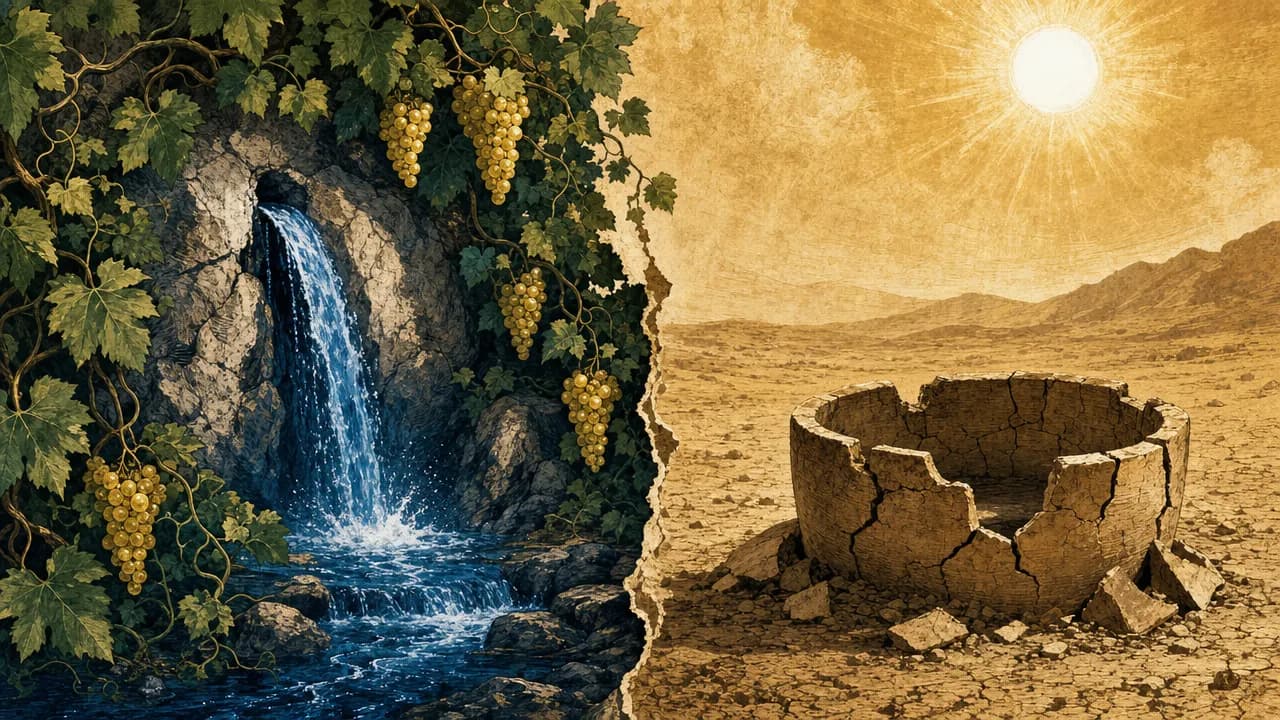
This illustration contrasts the living fountain of divine relationship with the broken, dry cisterns of idolatry, capturing Jeremiah's central lament over Israel's tragic and illogical betrayal.
Context
This Haftarah is drawn from the opening chapters of Sefer Yirmiyahu, the prophecies of Yirmiyahu, prophet in the final generations of the kingdom of Yehudah. He was descended from a family of kohanim in Anatot and began prophesying in the days of Yoshiyahu the son of Amon, king of Yehudah, continuing into the reign of Yehoyakim his son.
Yirmiyahu was appointed to speak far more words of rebuke than of comfort, and this passage is among his sharpest. It follows immediately upon God's recollection of Israel's early devotion, its bridal love in the wilderness, and now turns to indict the generations that abandoned that love once they entered the good land.
Interpretation
The Haftarah Explained
The prophet summons the whole House of Yaakov to hear God's grievance. "What wrong did your fathers find in Me," God asks, that they served foreign gods once they came to the land of Israel? They never paused to ask where was the God who took them out of Egypt and led them through a wilderness where nothing grew and no man had ever traveled. God brought them into a land of good fruit, and they defiled it with the worship of foreign gods. Even the kohanim did not ask where God was, the scholars did not teach the Torah, and the people followed false prophets who uttered false prophecies.
God calls the people to look to the far nations, the Kittim and Kedar, and see something astonishing: even those who bow to water or to fire, who know full well their gods are nothing and cannot help them, do not exchange them. Yet Israel, who had a true God, traded Him away for what is nothing. It would be fitting, God says, for the very heavens to be appalled at such a thing. The people committed a twofold wrong: to leave one god for another would be a single error, but they abandoned the eternal fountain that never ceases to flow for a broken cistern, a river that dries up at the first touch of heat.
Why then, the prophet asks, has Israel, called God's firstborn son, become so humbled and ashamed, with lions roaring over him and his cities left desolate? Even Noph and Tahpanhes, the Egyptian cities Israel relied upon for help, will bash in his head. All this is the price of forsaking the God who taught him the right way. What use is it to drink the waters of the Nile or the Euphrates, to seek help from Egypt or Assyria that can do no good? Their own misfortunes ought to reprove them.
God recalls how He broke Israel's yoke in Egypt, and how Israel promised to remain faithful yet turned instead, on every high hill and under every tree, to foreign gods, like a prostitute passing from one man to the next. Planted as a noble vine from good fathers and mothers, Avraham, Yitzchak, and Yaakov and their wives, the people became the opposite. Though they wash with soap, the stain of their sins remains. How can they claim they are not defiled when their deeds near the house of Peor testify against them? They are like a wild ass of the desert who sniffs the wind after her desire, whom none can restrain.
The prophets warned them not to journey to distant nations for help, lest they tear their shoes, go barefoot, and thirst on the long road, but they answered that they loved the strangers and would follow them. So Israel is shamed like a trusted man caught in theft, more embarrassed than a habitual thief, for her kings, nobles, kohanim, and prophets were thought pious. They say to wood, "You are my father," and to stone, "You gave birth to me," turning their backs to God, yet in their pain they cry out to Him. God answers: where are the gods you made? Let them save you now, for your foreign gods have become as many as your cities.
Interpretation
Message
The heart of this Haftarah is the strangeness of Israel's betrayal. Even nations that know their idols are powerless remain loyal to them, yet Israel exchanged the living God, the fountain that never runs dry, for gods that are nothing. The sin is doubled because it was committed against love: a people planted as a noble vine, drawn out of Egypt and carried through a deadly wilderness, turned away from the very One who taught them the right way and sought hollow help from Egypt and Assyria instead. Our sages heard in the opening question, "What wrong did your fathers find in Me," even the smaller act of leaving the synagogue while the Torah is being read, as if to ask God what injustice one has seen that one turns away.
When the strangers cannot save and the broken cisterns hold no water, only the fountain of living waters remains, waiting for a people to turn back and ask, at last, where is God.