this week: Nitzavim-Vayeilech · next: Ha'Azinu (09/19)
נִצָּבִים־וַיֵּלֶךְ
Nitzavim-Vayeilech
Devarim 29:9-31:30
Standing at the Threshold: A Covenant Built to Outlive Moshe
Before he dies, Moshe converts everything Israel relied on into things that can be written, read aloud, and handed on.
Summary
1 min
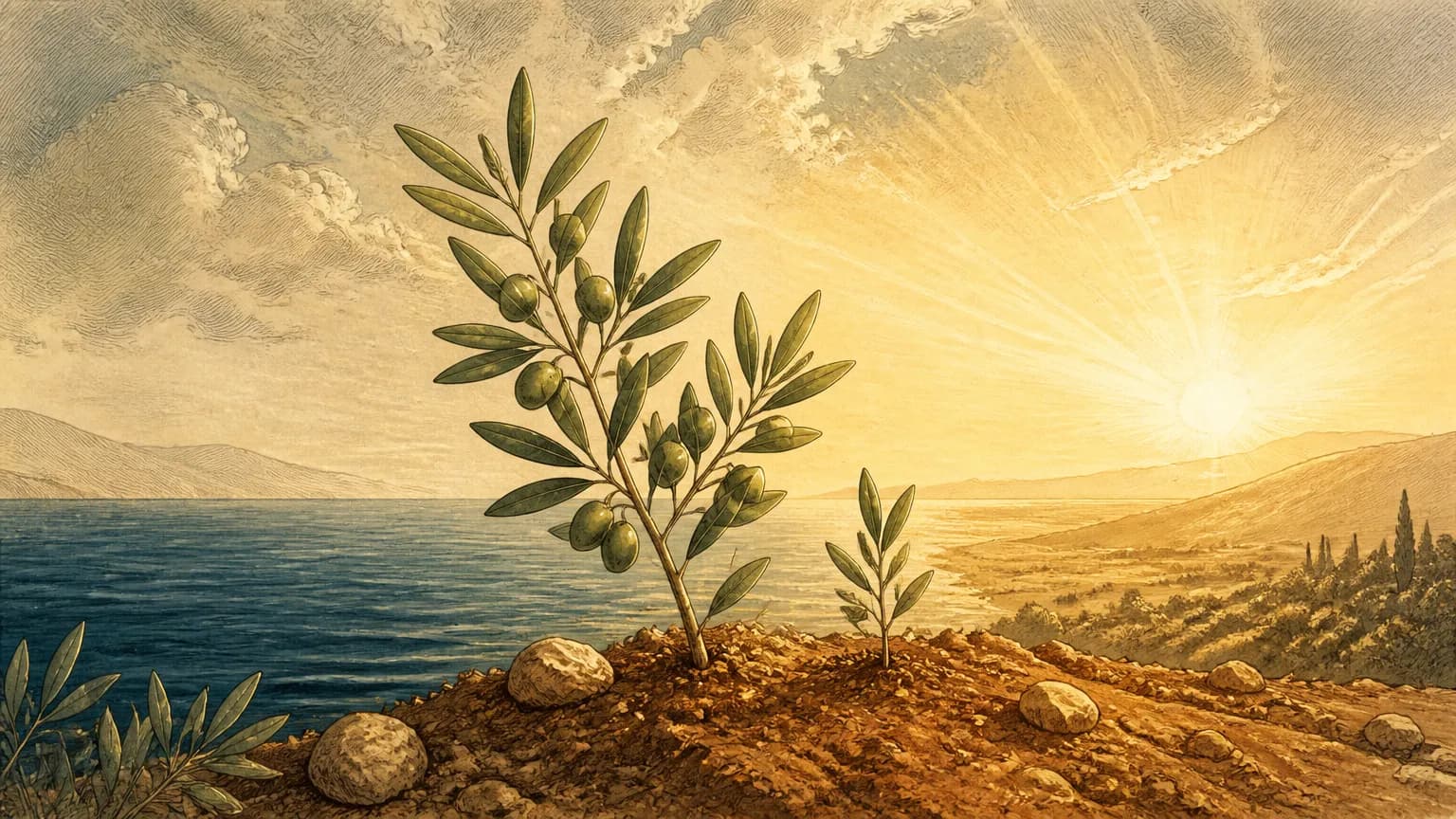
A resting scroll at the boundary and tender shoots rising from dry soil embody the transfer of communal responsibility and the quiet sprouting of promised redemption.
The portion opens with the entire nation on its feet — leaders, elders, women, children, the resident stranger, down to the woodchopper and waterdrawer — being sworn into the covenant at the edge of the land, and it continues through Moshe's final practical acts as leader. The reading offered here is that these chapters are less a farewell than a transfer of jurisdiction. After Moshe warns that private betrayal can scorch an entire land, he draws a boundary: concealed acts belong to God alone, overt acts to the community. Rashi, the eleventh-century French commentator, hears this as an answer to Israel's protest against collective liability, and notes that communal responsibility took legal effect only after the crossing of the Jordan — that is, only once Moshe was gone. His own words, "I can no longer go out and come in," mean not failing strength but withdrawn permission: the office passes to Yehoshua in public view. What he leaves behind works entirely on the visible and audible — a written scroll placed beside the Ark, a reading every seventh year that includes children who know nothing yet, and a song placed in the nation's mouth just as God announces He will hide His face.
In the haftarah, the last of the seven readings of consolation between Tishah B'Av and Rosh Hashanah, Yeshayahu shows Jerusalem clothed as a bride, redemption sprouting like buried seed, and God refusing to keep silent for Zion's sake. A parable closes it: the exiles' return brings joy, but the joy is complete only when the King Himself comes home.
Generated 08/30/2026
Parashah SynthesisBy topic
The parashah opens with the whole nation on its feet. Nothing is being narrated; everything is being ratified. What follows is Moshe's last practical act as leader — not a summary of the Torah, but the construction of the arrangements by which the Torah will keep working after he is gone.
Synthesis topics
The Autoparashah methodology selected 6 topics to summarize the parashah's sequence.
"You stand this day, all of you, before Hashem your God." The long recital of curses that has just ended left the people badly shaken, and Moshe's opening words are steadying rather than triumphant. He names every rank in turn — tribal heads, elders, officials, the whole body of Israel, children, wives, the ger dwelling in the camp, down to the woodchopper and the waterdrawer — because all of them are about to pass into an oath. This is not a replacement for Sinai. It is a ratification taken at the border, sworn by every stratum of the nation equally, and it explicitly includes the sanctions: the curses themselves are part of what is being accepted. Moshe states the purpose twice over, and the second half is the point that answers their fear — "in order to establish you this day as God's people and in order to be your God." The bond runs in both directions, and it was already sworn to Avraham, Yitzchak and Yaakov.
The covenant binds those not yet born
The oath then reaches past the assembly: "not with you alone, but both with those who are standing here with us this day and with those who are not with us here this day." Generations unborn are bound. Against that broad frame Moshe turns very narrow. You saw the detestable things of Egypt and of the nations you passed among; perhaps there is among you a man, a woman, a clan, a tribe whose heart is already turning. Such a person hears the oath and calculates immunity — "I shall be safe, though I follow my own willful heart" — a root sprouting poison weed and wormwood. Moshe answers that this will not be forgiven, and he widens the consequence to the land itself: soil burnt to sulfur and salt, sowing nothing, like the overturning of Sodom and Amorah. Children of later generations and foreigners from far off will stand and ask why, and the answer they receive is simply that the covenant was forsaken.
Hidden hearts, public deeds, shared liability
This raises an obvious and uncomfortable question: how can a whole land be ruined for what one person hides in his heart? The verse that closes the section is the answer, and it functions as a boundary line rather than a riddle. "Concealed acts concern Hashem our God; but with overt acts, it is for us and our children" to carry out this Torah. What is hidden is under divine jurisdiction alone. What is out in the open is the community's business, and the community is answerable for it. Israel is not being asked to police thoughts; it is being made responsible for what it can see, and for one another in what can be seen.
Return from exile and the nearness of Torah
With that boundary set, the tone turns entirely. When all these things have come upon you, blessing and curse alike, and you take them to heart among the nations where you have been scattered, and you return — then God returns to you. He gathers you from the ends of the sky, brings you to the land your ancestors held, makes you more numerous than they were, and "circumcises your heart": the obstruction that made obedience feel impossible is itself removed. Moshe then insists that nothing about this is remote. The mitzvah is not in the heavens, requiring someone to ascend and fetch it, nor across the sea. "The thing is very close to you, in your mouth and in your heart, to observe it." He sets life and prosperity against death and adversity, calls heaven and earth as witnesses, and presses the choice: choose life, by loving God, heeding His voice, and holding fast to Him.
Because the covenant is neither distant across the sea nor in the heavens, the path of life remains intimately accessible, rooted directly within the human heart and everyday observance.
Moshe at one hundred twenty; Yehoshua commissioned
Then Moshe goes and speaks to all Israel again, and the subject is his own end. "I am now one hundred and twenty years old, I can no longer go out and come in." What he no longer has is not strength but authority. The Torah will testify at his death that his eye was undimmed and his vigor unabated; what has been withdrawn is permission — the leadership has passed to Yehoshua. He reassures the people that God Himself will cross ahead of them and do to these nations what was done to Sichon and Og, and he charges them: be strong and resolute, He will not fail you or forsake you. Then, standing before the whole nation, he says the same words to Yehoshua directly. Next he writes the Torah down, hands it to the kohanim who carry the Aron HaBrit and to the elders, and legislates a public reading: every seventh year, the shmittah year of release, at Sukkot, when all Israel comes to the chosen place, this Torah is to be read aloud to men, women, children and gerim, so that even the children who know nothing yet will hear and learn to fear God.
The hidden face, the song, the deposited scroll
God then summons Moshe and Yehoshua to the Ohel Moed, the Tent of Meeting where God's word came to Moshe, and appears in a pillar of cloud. What is said there is bleak: Moshe will lie down with his ancestors, the people will stray after alien gods in the land they are entering, break the covenant, and be overtaken by many evils; they will say "our God is not in our midst," and God's answer is "I will keep My countenance hidden on that day." Immediately, a command: write down this song, teach it, put it in their mouths, so that it will testify — for it will never be lost from the mouth of their offspring. Moshe writes it and teaches it that day. Yehoshua is charged once more. Moshe finishes writing the Torah to the very end and instructs the Leviim to set the book beside the Aron as a witness, telling them plainly: I know your defiance — you have been defiant while I am still alive among you, how much more after my death. He gathers the elders and officials, calls heaven and earth to witness, and the parashah ends at the moment before the song itself begins.
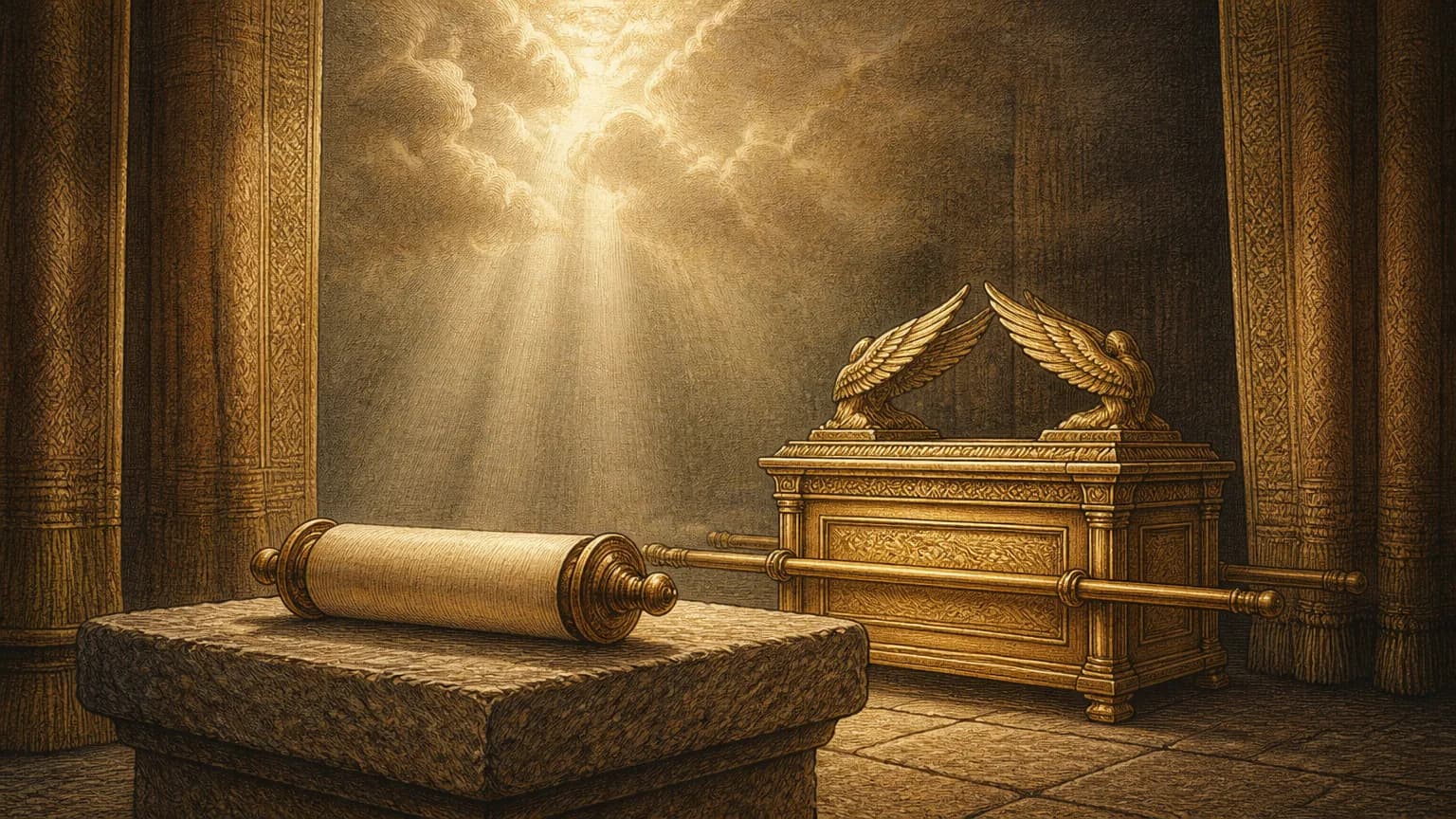
Set beside the Ark of the Covenant beneath the pillar of cloud, the completed scroll stands as an enduring, incorruptible witness to guide future generations through every season of history.
Generated 08/30/2026
Analysis axes
They form the central interpretive thread and appear interspersed in the essay below, connecting the parashah's sequence to a unified reading shaped by Rashi.
1.All Israel assembled to enter the oathוהוא יהיה לך לאלהיםRashi on 29:12
2.The covenant binds those not yet bornהנסתרת לה' אלהינוRashi on 29:28
3.Hidden hearts, public deeds, shared liabilityלא אוכל עוד לצאת ולבואRashi on 31:2
4.Return from exile and the nearness of Torahאחרי מותי כי השחת תשחיתוןRashi on 31:29
Interpretive Analysis4 Rashi axes at the turns of the reading
One root carries this parashah. When Moshe halts the vision of the scorched land with his aphorism that "the concealed things belong to Hashem our God, and the revealed to us and our children," he uses the root s-t-r, to hide. Two chapters later God uses that same root about Himself: "I will surely hide My face." Between those two hidings, the entire apparatus of the second half is assembled — a scroll written and deposited, a septennial reading, a song placed in the mouth, a successor installed in public view. The reading worth having is that this is not merely a farewell sequence but a jurisdictional one. The covenant is being deliberately relocated onto the side of the revealed, because the two presences Israel has leaned on — Moshe standing in front of them, and God's face turned toward them — are both about to be withdrawn.
Rashi, the eleventh-century commentator of northern France whose reading follows the plain sense while listening for its pressure points, hears the hidden-and-revealed verse as Moshe answering an objection Israel has just voiced: what can we possibly do, if You punish the many for the private thoughts of an individual? The answer draws a line of authority. Concealed matters are God's to judge; the revealed are ours, and ours to act on — "to remove the evil from among us." And Rashi adds a striking legal date: even for revealed sins, the community was not held liable until Israel crossed the Yarden and accepted the oath at Har Gerizim and Har Eival. Mutual responsibility is thus not a mood of solidarity but an institution with a starting point, and that starting point is precisely the moment Moshe is no longer there. Arvut begins where Moshe ends.
The same logic governs his strange declaration that he can no longer go out and come in. Rashi refuses the reading of physical decline, since Scripture itself will deny it, and renders the words as "I am not permitted" — the authority has been taken from me and given to Yehoshua. Leadership over Israel is therefore not a personal charisma that dies with the man but an office that changes hands by divine warrant, and the Torah stages the handover twice in the open: once "in the sight of all Israel," once in the Ohel Moed before the pillar of cloud. Even the words are transferred. "Be strong and resolute; He will not fail you or forsake you" is said first to the nation and then, verbatim, to Yehoshua. Nothing essential is left in Moshe's private possession.
What he deposits in its place is a set of instruments that all operate on the audible and the visible. The written Torah goes to two custodians at once, the kohanim who bear the Aron and the elders. Hakhel, the reading every seventh year, gathers men, women, children and gerim — including the children "who have not had the experience," which is the working mechanism for the covenant sworn earlier with "those who are not with us here this day." And the song is commanded in the very breath after God says His face will stay hidden: "put it in their mouths." The mouth is not a casual image here. Moshe had already promised that the mitzvah is not in the heavens nor across the sea but "in your mouth and in your heart." The nearness he described is the nearness he is now engineering — a Torah lodged where distance and hiddenness cannot reach it.
The last transfer is the most personal. "After my death you will surely corrupt yourselves," Moshe says — yet the record of Sefer Yehoshua is that the generation did not corrupt itself at all while Yehoshua lived. Rashi's resolution is that a person's disciple is as dear to him as his own body, and so long as Yehoshua stood, it was as though Moshe himself still lived. Moshe's death, for the purposes of this prophecy, is dated not to his breathing but to the end of the transmission. That is why the same man can assemble the terrified nation to tell them that God cannot dissociate Himself from them, and then, weeks later, forecast their betrayal without contradiction. The covenant is not built on the assumption that Israel will succeed; it is built to survive failure.
This is what Devarim has been quietly doing all along: a book that is Moshe speaking becomes, in these chapters, a book that is written, handed over, and stored beside the Aron. The easier reading — Nitzavim as consolation, Vayeilech as doom — will not hold. The gathering from the ends of the sky and the song that testifies against Israel are one instrument viewed from two angles, because a witness that convicts you is also a text that keeps you legible to yourself. The foreigners who come from distant lands and ask, "Why did God do thus to this land?" receive an answer only because the answer was written down in advance, and put in the mouths of children who had not yet done anything wrong.
The word "today" runs through the opening assembly like a drumbeat, and the covenant it seals reaches those who are not standing there. Somewhere in that reach is a scroll set beside the Aron and a song taught to people who had not yet needed it. It is worth asking what it means to be handed, in advance, the words that will one day explain your own failure back to you.
Generated 08/30/2026
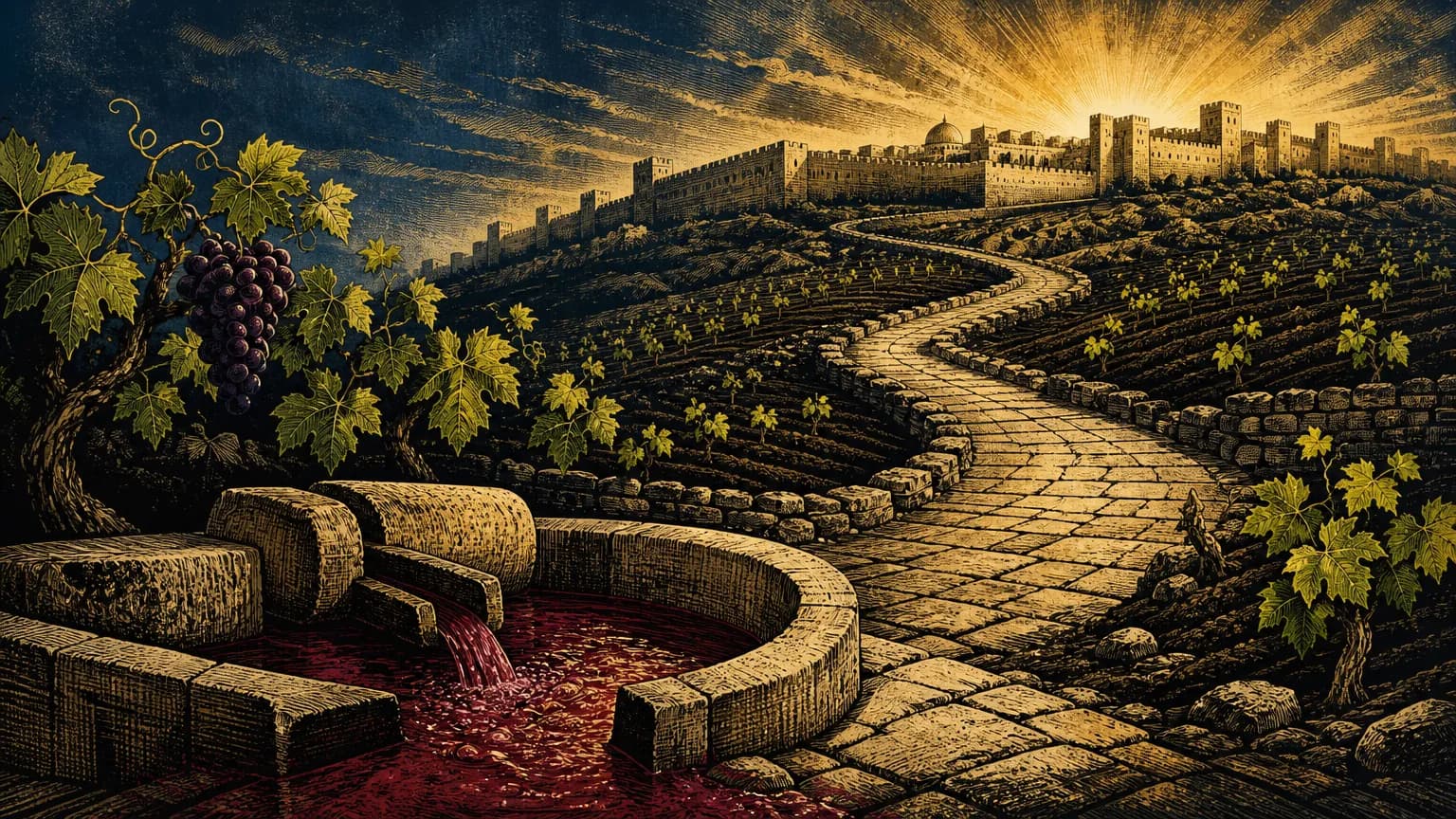
A cleared stone highway ascends past fertile vines and a carved winepress toward sunlit ramparts, embodying the promised redemption where the Creator Himself returns to espouse and restore desolate Zion.
Context
This Haftarah is drawn from the later chapters of Yeshayahu, the prophet who spoke in Jerusalem in the era of the Assyrian threat, and whose words reach far beyond his own generation to the exile and the redemption that follows it. It is the seventh and final of the shiv'ah d'nechemta, the seven haftarot of comfort read between Tishah B'Av and Rosh Hashanah, and it is read on the Shabbat of Nitzavim, at the very edge of the new year.
The chapters here are spoken to a Jerusalem that lies desolate and to a people scattered among the nations. The prophet's voice moves back and forth between the city speaking of her own joy, God speaking of His refusal to keep silent, and a vision of the Holy One returning from battle against the nations. Everything in the passage looks toward the days of the Mashiach, the anointed king who will gather in the exiles.
Interpretation
The Haftarah Explained
The Haftarah opens with the voice of Jerusalem and of Israel together: "I greatly rejoice in God." We rejoice in the Holy One when we go out from exile, for He has clothed us in garments of salvation and a robe of righteousness — His lovingkindness, which is compared to a fine garment. He has robed us in honor "like a bridegroom adorned with a turban," like a kohen dressed in his beautiful vestments, like a groom in his finest clothes. Then the prophet compares redemption to a seed. A man throws seed into the ground and sometimes despairs of it, certain it has been lost in the earth — and so Israel were scattered and seemingly lost in exile for long generations. But the seed sprouts. So Israel in the days of the Mashiach will be like a garden that has been sown, and God will make righteousness and love grow up before all the nations.
"For the sake of Zion I will not be silent." Israel are in exile on account of God's own city, and He declares that He Himself wishes to redeem them and will not hold His peace. Her righteousness will go forth like light, her salvation like a burning torch seen from far off; the nations will see her justice and the kings her glory, and she will be given a new name that God Himself will make known. She will be a crown of beauty in His hand, strengthened by Him always. No longer will her land be called forsaken or desolate. A ruined land empty of people is like a woman with no husband — and therefore her land will be espoused, for the Holy One desires her. And just as a young man is a fitter match for a young woman than an old man, so it was that when the nations dwelt in the land it was like an old man taking a maiden; when Israel return to their land, it will be a youth espousing a maiden, and God will rejoice over her as a bridegroom over his bride.
Upon the walls God sets watchmen — angels who plead that He rebuild Jerusalem. Unlike ordinary guards who watch by day and sleep at night, these never fall silent, for the meaning is that the Holy One places His own supervision over the city. And the exiles too are addressed: do not sleep and do not be still; keep praying and praising until the walls and the city are established. God swears by His right hand that strangers will no longer eat the grain and drink the wine for which Israel labored. Those who harvest and gather will themselves eat and drink and praise Him in His sacred courts — the tithes and the fruits of the fourth year, which are eaten in Yerushalayim.
Then the road is prepared: pass through from city to city, clear the path by which Israel will travel to Jerusalem, raise the banner high so that all Israel scattered among the cities can see it. God proclaims to the ends of the earth that the Mashiach is coming, and the reward He has prepared is with Him — payment for all the suffering Israel bore in exile for His name. Finally the prophet sees the Holy One as a mighty warrior returning from Edom, from the great city of Bozrah, His garments stained red with the blood of those He has struck down. The nations are like grapes in a winepress: "I trod out a vintage alone." No merit of Israel's accomplished this, and no nation stood at His side; He looked and found none to help Israel, and His own arm and His own wrath against the nations wrought the victory. The Haftarah closes gently — the prophet recalling God's kindnesses, His declaration that Israel are His people who will not deal falsely, and the assurance that Israel's troubles are loathsome to Him, that He redeemed them in love and pity and raised them up all the days of old.
Interpretation
Message
There is a parable about a queen whose husband, son, and son-in-law all traveled to a distant land. Word comes that her son is returning, and she says: let my daughter-in-law rejoice. Word comes that her son-in-law is returning: let my daughter rejoice. But when she is told that her husband is coming home, she says — now the joy is complete. So the prophets said to Jerusalem, your children are coming from afar, and she answered, let Mount Zion rejoice. Your daughters are coming: let the daughters of Yehudah exult. But when the prophets said, your King is coming, she said, now my joy is full: "I greatly rejoice in God."
That is the note on which the seven weeks of consolation end. The return of the exiles, the rebuilding of the walls, the harvests eaten by those who planted them — all of these are real and promised. Yet the deepest joy of this Haftarah is not in any single gift but in the Giver: a Jerusalem crowned in God's own hand, a land espoused because He desires her, and a redemption He insists on accomplishing Himself, refusing to keep silent for Zion's sake.
Israel entered these seven weeks in mourning and leaves them dressed as a bride. The comfort is not merely that the exile ends, but that the One who ends it is coming Himself.