The Flood, Babel, and Why Heaven Judged How People Treated Each Other
From the Flood to Babel, Parashat Noach judges humanity less by its stance toward Heaven than by its conduct toward one another.
Summary
1 min
The deluge reveals that civilization collapses not from theological rebellion alone, but when unchecked interpersonal violence and exploitation dissolve the essential moral bonds of human community.
Parashat Noach moves from a flood that destroys a corrupt humanity, through the tower of Babel, to the family of Terah setting out toward Canaan. Its argument is that Heaven judged these generations less by how they stood toward God than by how they treated one another. When God explains the flood, He names only chamas, meaning violence and seizing what belongs to another. Although a classic reading also charges that generation with idolatry, the sages conclude that the decree was sealed on robbery alone. The builders of Babel, who tried to raise a tower to heaven, rebelled against God openly, yet they were only scattered, because their shared language reflected real harmony. Noach himself remains an open question: the Torah calls him righteous "in his generations," which the sages read as praise or as limitation, and he never speaks to the world he was spared from. The parashah closes by recording Terah's death before his son Avram leaves, though Terah lived about sixty years longer. The Torah reorders time so no one would say the future patriarch abandoned his father, introducing him through his honor as a son.
In the haftarah, from the consoling later chapters of Yeshayahu, the prophet tells exiled Jerusalem, pictured as a barren, abandoned wife, to sing. Her Husband, God, still lives, and His anger lasted only a moment. He swears, as after the Flood, never again to be angry with her, and calls all who thirst to come to Torah as to water.
Generated 10/11/2026
Parashah SynthesisBy topic
The world is barely ten generations old, and already it has gone wrong. Parashat Noach opens on a single family standing against a ruined earth. It ends with another family setting out on a road whose destination is not yet named. Between them come a flood, a covenant, a curse, a map of nations, and a tower left unfinished. Read slowly, the parashah keeps asking one question: what does a world need in order to survive?
Synthesis topics
The Autoparashah methodology selected 6 topics to summarize the parashah's sequence.
The parashah opens with a formula Bereshit uses to begin a new chapter of human history: "These are the generations of Noach." Instead of a list of children, though, it gives a portrait. Noach is righteous, blameless "in his generations," and he walks with God. That small qualifier stops the reader. Was Noach righteous even in a corrupt age, holding firm where everyone else gave way? Or was he righteous only by the standard of his age? The Torah does not say, and the phrase leaves both readings open. The world around him is described plainly: the earth is corrupt and "filled with chamas." The word means violence, specifically seizing what belongs to another, and God names it as the reason the end has come.
The ark, the rising waters, and a world erased
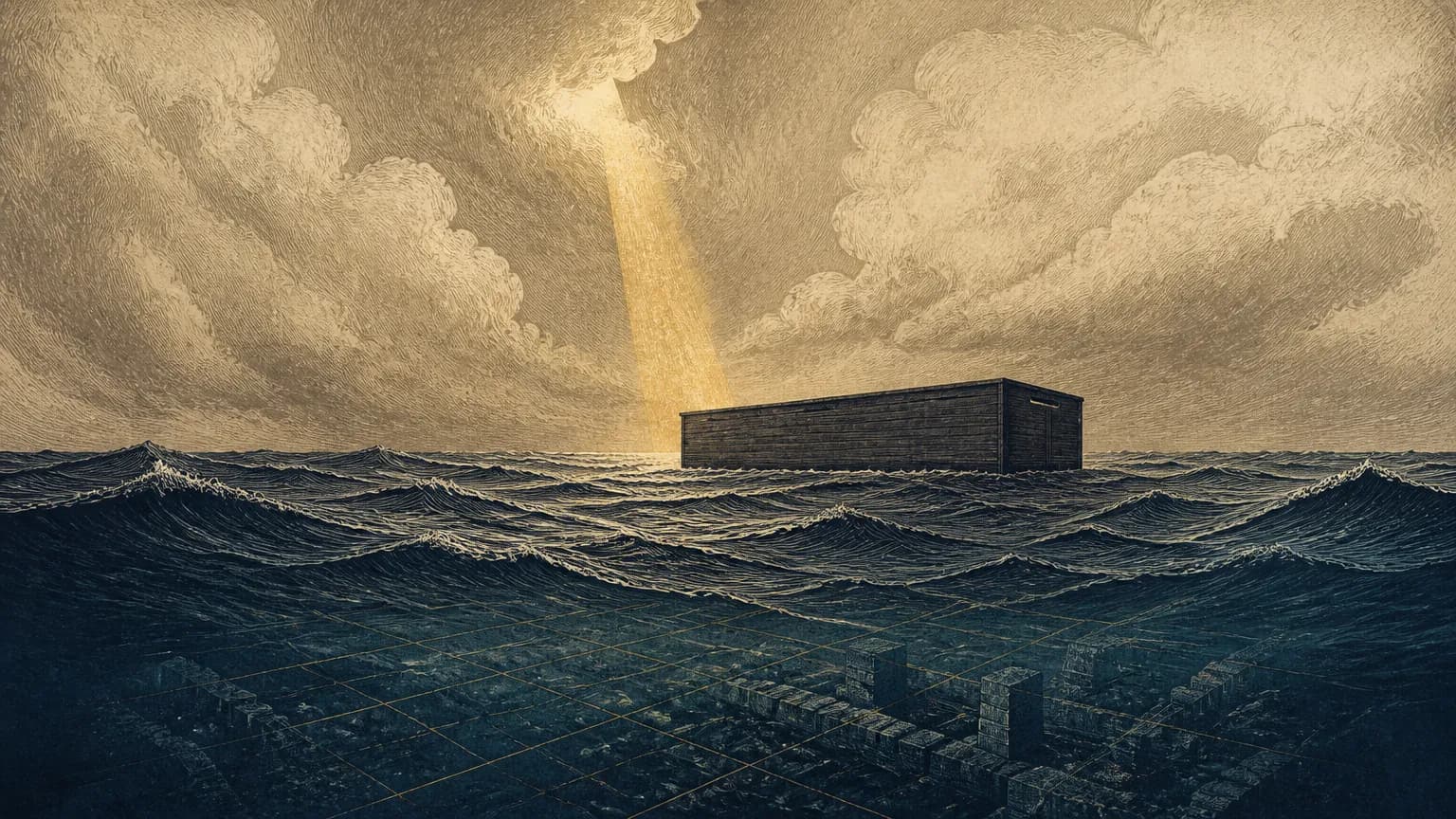
God tells Noach to build an ark, a great box-like vessel of gopher wood. It is three hundred cubits long, sealed with pitch, built in three levels, and fitted with a door and a light-opening. Noach is to bring in his wife, his three sons Shem, Cham, and Yefet, and their wives, along with pairs of every creature. A second command adds seven pairs of the pure animals, which will later be fit for offerings. Twice the Torah reports that Noach did exactly as commanded, and the doubling reflects two stages of instruction rather than a contradiction. The flood comes on a precise date. The fountains of the deep burst, the windows of heaven open, and God Himself shuts the door. The waters rise fifteen cubits above the highest mountains, and every breathing thing on dry land dies.
Raven, dove, and the promise of the seasons
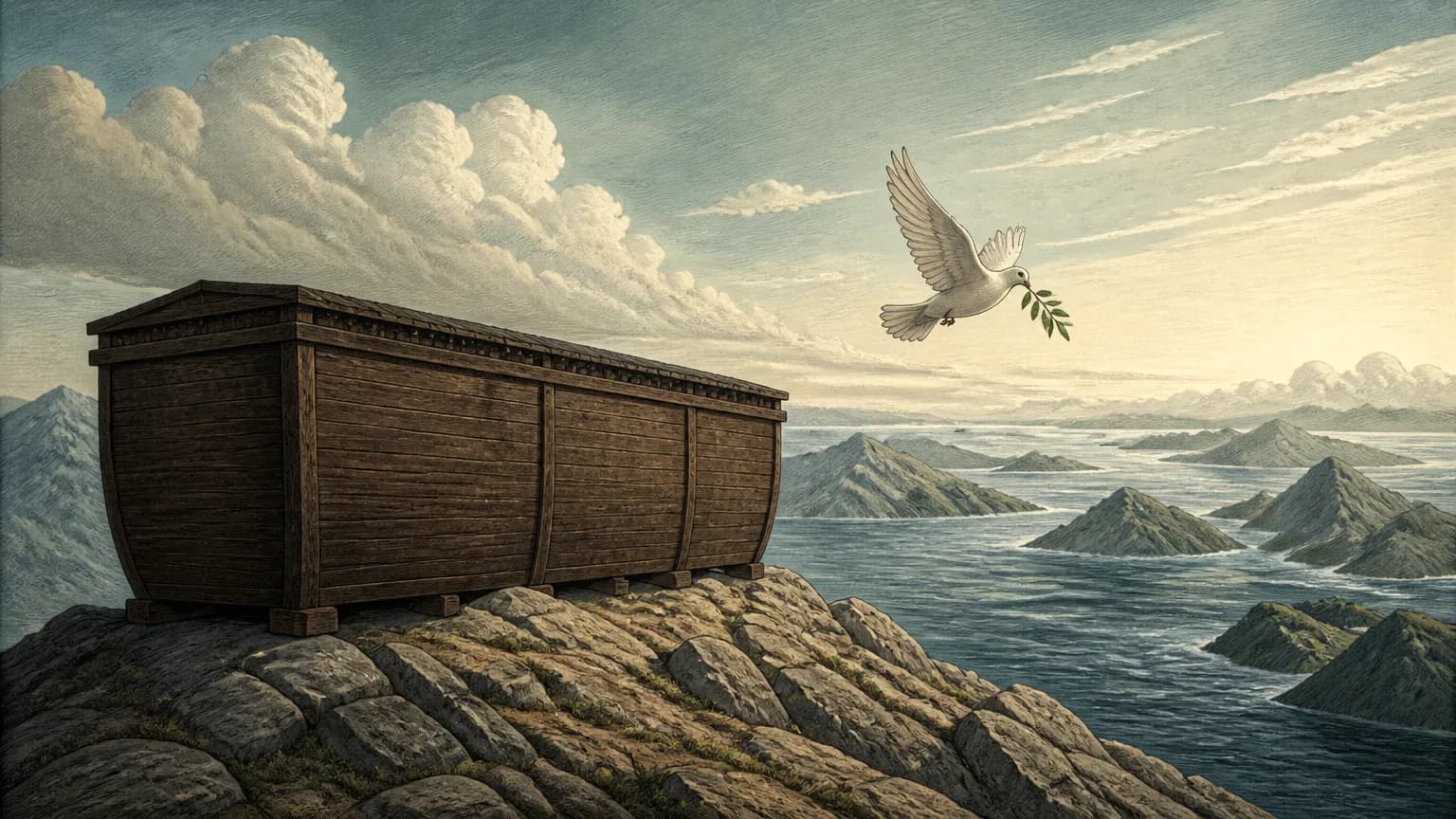
Then "God remembered Noach." A wind passes over the earth and the waters slowly retreat. The ark settles on the mountains of Ararat, and mountaintops appear. Noach sends out a raven, which flies back and forth. Then he sends a dove three times. The first time it finds no rest and returns to his outstretched hand. The second time it comes back with a freshly plucked olive leaf. The third time it does not return. More than a year after entering, Noach leaves at God's command. He builds a mizbeach, an altar of offering, and brings olot, offerings wholly burned, from the pure animals. God resolves never again to strike all life this way, and promises that seedtime and harvest, cold and heat, day and night will not cease.
The ark comes to rest on the mountains of Ararat as the floodwaters recede and a dove returns bearing an olive leaf.
Blood, the image of God, and the bow in the clouds
The blessing given at creation is renewed: be fruitful and fill the earth. But the order of the world has changed. Animals will now fear humans, and meat is permitted, though not flesh with its lifeblood still in it. Human blood carries a heavier weight. God will demand a reckoning for it from beast and from human, "of everyone for each other," because humanity was made in the image of God. Then God makes a covenant with Noach, his descendants, and every living creature. The rainbow in the clouds is its sign, a reminder that floodwaters will never again destroy all flesh.
A vineyard, a tent, and seventy branching nations
The story narrows to a single tent. Noach, a man of the soil, plants a vineyard, drinks, and lies uncovered. Cham sees and tells his brothers. Shem and Yefet walk backward with a garment and cover their father without looking. When Noach wakes he curses Canaan, Cham's son, to servitude, and blesses Shem and Yefet. These are the only words Noach speaks in the entire parashah. He dies at nine hundred fifty. A long genealogy follows, mapping the descendants of Yefet, Cham, and Shem into lands, languages, and nations. Among them stand out Nimrod, the mighty hunter who founded Babylon, and Peleg, "in whose days the earth was divided."
Babel scattered, and the long road to Avram
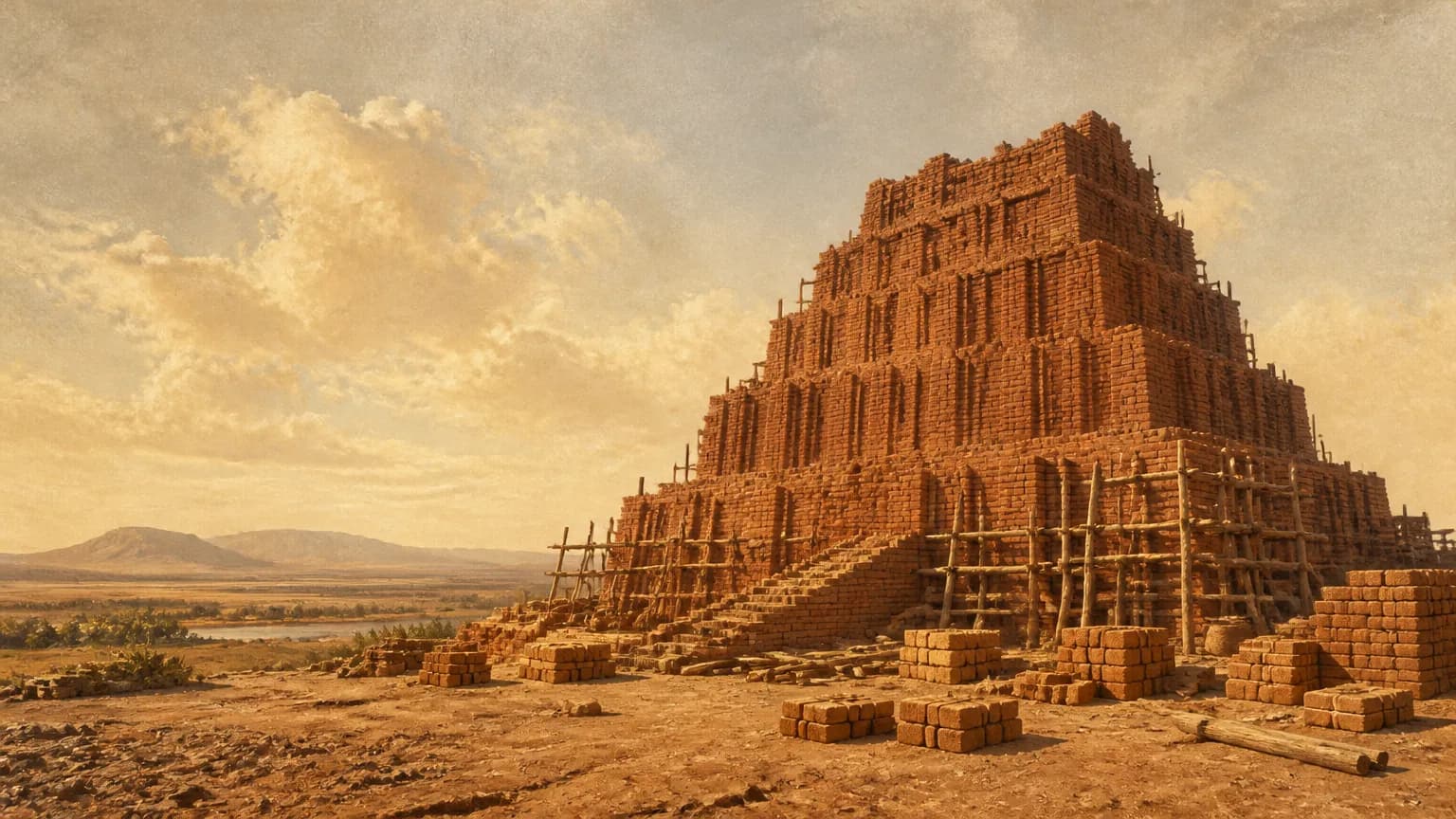
That division is then told as a story. All humanity shares one language. In the valley of Shinar they bake bricks and set out to build a city and a tower reaching heaven, "to make a name for ourselves, lest we be scattered." God confounds their speech, and they scatter. The place is called Bavel, after the confusion. No one dies. The line of Shem then runs ten generations, lifespans shrinking as it goes, down to Terah and his sons Avram, Nachor, and Haran. Haran dies young, and Avram's wife Sarai is barren. Terah sets out from Ur toward Canaan but stops in Haran, and the parashah closes on his death there. Measured against Avram's age when he later leaves Haran, the numbers show that Terah actually lived about sixty years more. The Torah simply finishes his account first, and leaves the reader with a childless couple halfway to an unnamed land.
In the valley of Shinar, an unfinished tower of baked clay bricks stands abandoned across the broad, empty plain.
Generated 10/11/2026
Analysis axes
They form the central interpretive thread and appear interspersed in the essay below, connecting the parashah's sequence to a unified reading shaped by Rashi.
1.A righteous man in a world filled with robberyבדורותיוRashi on 6:9
2.The ark, the rising waters, and a world erasedכי מלאה הארץ חמסRashi on 6:13
3.Raven, dove, and the promise of the seasonsומשם הפיצםRashi on 11:9
4.Blood, the image of God, and the bow in the cloudsוימת תרח בחרןRashi on 11:32
Interpretive Analysis4 Rashi axes at the turns of the reading
Parashat Noach is framed by two odd handlings of time. It opens by limiting a man's righteousness to "his generations." It closes by recording a father's death decades before it happened. These two details are a structural pair, and the frame they form is the key to everything between them. The parashah's verdicts on humanity are decided less by how people stand toward Heaven than by how they stand toward one another. It begins with a righteousness that seems sealed off from its world, and it ends with the Torah bending its own chronology to protect a son's standing among people.
Consider the decree. Before God speaks to Noach, the earth has already been called corrupt, and "all flesh had corrupted its way." A classic reading takes this as idolatry and sexual depravity. Yet when God gives the reason for the end, He names only chamas. The sages draw the sharp conclusion that the decree was sealed on robbery alone. Even a society rotten toward Heaven was not yet past saving. What made it unsalvageable was that no one's property, and eventually no one's life, was safe from his neighbor. The world rebuilt after the flood is ordered along exactly that fault line. Its central law is not about worship. It is a reckoning for human blood, demanded "of everyone for each other."
Babel tests the principle from the other side. Here the rebellion is aimed openly at Heaven: a tower to the sky, a name of their own making, a refusal to be spread across the earth as God had blessed. If guilt were measured toward Heaven, Babel should have suffered worse than the flood. Instead they are only scattered. The ancient answer is that they lived together in love and fellowship. Their "one language and the same words" was not only a shared tongue but a real harmony, and that harmony shielded even rebels from destruction. The sages draw the lesson: strife is hateful, and peace is great. The flood generation was united in nothing except taking from one another. The builders of Babel were united in everything, even in their mistake.
Against this background, Noach's qualified righteousness becomes a real question. The sages divided over whether "in his generations" praises him or limits him, and the parashah supplies quiet evidence for both. It also leaves something out. Before the flood, Noach never speaks a word, not to God and not to the generation he was spared from. He builds in silence, enters, and is shut in. His first and only recorded speech is a curse, spoken inside his own family after a failure of dignity in his own tent. His righteousness was enough to save himself and his household. Whether it was meant to reach further, the Torah does not say. The unresolved debate is the point: a person can be truly blameless and still leave a world unredeemed.
This is why the closing notice on Terah matters so much. The Torah moves Terah's death ahead of Avram's departure, an ancient reading explains, so that no one would say Avram left an old father behind. The Torah rearranges time to protect Avram's kibbud av, the duty of honoring a parent. The future Avraham, whose journey reshapes Bereshit, is introduced not by a miracle and not by a debate about idols. He is introduced by the Torah shielding his reputation as a son. Bereshit begins its chosen family where Noach's world collapsed, among people, and this reading resists the easier view that the patriarch's greatness was purely theological. Before Avram is told to go, the Torah makes sure he cannot be accused of having abandoned anyone.
Noach's dove came back to an outstretched hand, the one gesture of reaching out that he makes in the whole story. A flood generation that took from one another and a Babel generation that held together frame that hand. The next parashah will ask what it means for a man to be sent out into the world rather than shut in against it.
Generated 10/11/2026
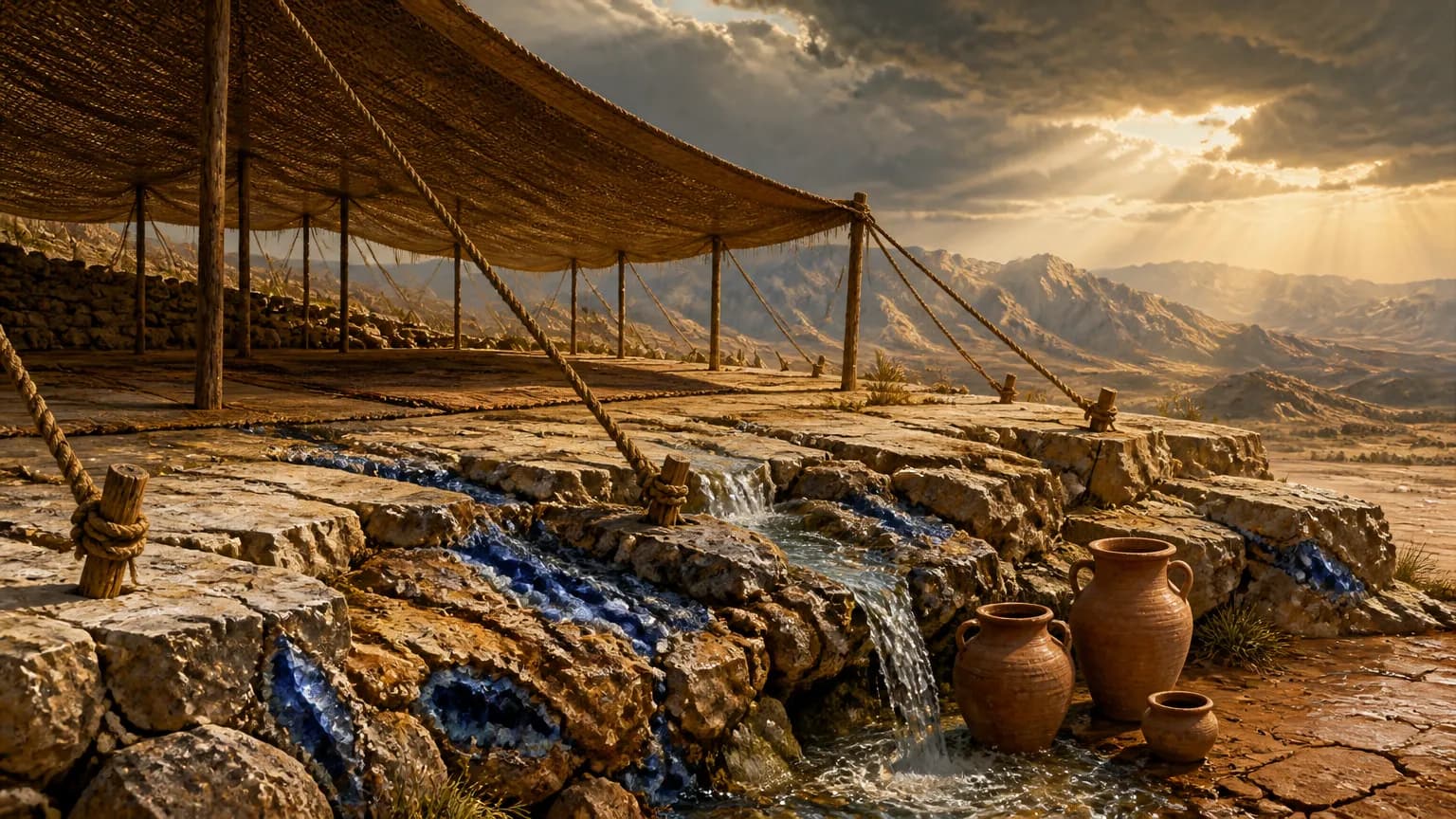
The expanding tent, living water in earthen vessels, and sapphire foundations embody God's unshakeable covenant of peace, transforming Jerusalem's desolate exile into an enduring, jewel-adorned homecoming.
Context
This Haftarah comes from the book of Yeshayahu, prophet in Jerusalem in the days of the kings of Yehudah, whose later chapters overflow with consolation. It is read on Shabbat Parashat Noach. Its link to the parashah lies in God's own words: just as He swore that the waters of Noah would never again cover the earth, so He swears never again to be angry with His people.
The prophet looks past the destruction toward the end of exile. He speaks to Jerusalem as a woman left alone, childless and shamed, and promises her a homecoming so complete that she will scarcely remember her grief.
Interpretation
The Haftarah Explained
"Shout, O infertile one": in exile, Jerusalem was like a barren woman who longs for children and cannot conceive. Yet she was never a widow. She was an abandoned wife whose husband still lives. Now she is told to widen her tent, lengthen its ropes and drive its pegs firm, for her children will be many. She will spread to the south and the north, her offspring will inherit nations, and the ruined towns will again be filled with Israel.
"Fear not, you shall not be shamed." She need not dread hardship on the way out of exile. The good awaiting her will be so great that she will forget the disgrace of her youth and the shame of seeming widowed. In exile the nations ruled over her as masters. Now her Maker, the God of Hosts, is her Husband and Redeemer. Can a man cast off the wife of his youth? A wife taken in later years may come to be despised, but the bride of one's youth is loved even in old age, because her husband remembers who came to him as a young woman. So too, a woman's heart rejoices fully only with the husband who married her as a maiden. When the days of Mashiach, the anointed king of the redemption, arrive with all their goodness, the long exile will seem to have lasted only the blink of an eye. As God swore after the Flood, He swears now: the mountains may move, but His oath will never move.
To the storm-tossed, uncomforted city He promises foundations of sapphire and gates blazing with precious stones. It is told that when Rabbi Yochanan, the great sage of the Land of Israel, taught that a Temple gate would be carved from a single gem, a student scoffed. Later he was shipwrecked and saw angels in the depths of the sea cutting that very stone. It is also said that in those days gems will be so plentiful that men will mark the boundaries of their fields with them, and debtors will settle their quarrels by paying with stones from Jerusalem's streets.
"All your children shall be disciples of God." Torah learned from Moshe, a mortal man, can be forgotten. Torah learned from the Holy One Himself, Who lives forever, will never be forgotten. Israel will stand firm through tzedakah, charity and just dealing. When Gog and Magog, the hostile nations of the end of days, gather against her, God declares that He never commanded it. He created the smith who fans the coals and forges the sword, and He can break both the craftsman and the weapon.
Then comes the call: "Ho, all who are thirsty, come for water." Thirst for Torah as for water, and learn even without money. Torah is the true bread, for no one lives without it, while other wisdoms feed neither body nor soul. Water flows down from the mountain to the valley, and Torah likewise flees the arrogant. Water, wine and milk keep well only in simple earthen vessels, never in gold. Whoever listens will receive an everlasting covenant, the kindness promised to David, and distant nations will run to Israel when they hear of the wonders God has done.
Interpretation
Message
The Haftarah teaches that exile is not divorce. God's anger was brief, and His love is the love a man holds for the wife of his youth: rooted in memory and stronger than the years. The same oath that guards the world from another Flood guards Israel from final abandonment. The restoration is described in jewels, but its true wealth is a people who learn directly from God and come to Him as the thirsty come to water.
The forsaken wife is called home, not to a new marriage but to the first one. Her Husband remembers her youth, and His oath is as sure as the rainbow after the Flood.