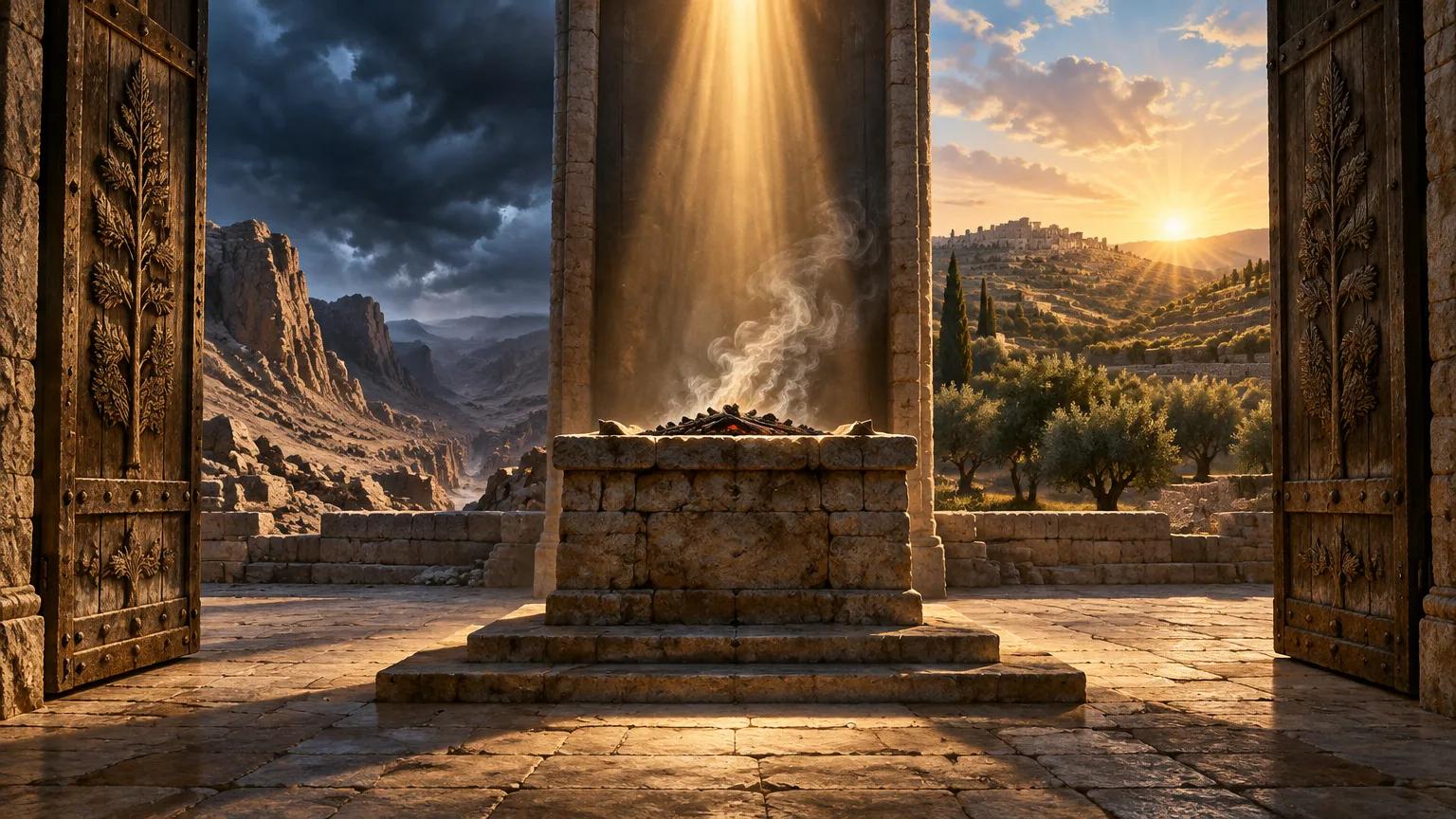
The Stolen Blessing and the One That Could Not Be Stolen
In Toldot, power can be bargained for, disguised, and divided, but the covenant of Avraham can only be knowingly given.
Summary
1 min
While earthly dominion can be bartered or seized through craft, the enduring covenant of Abraham can only be received through spiritual fitness and knowing conveyance.
Toldot, the one parashah centered on Yitzchak, son of Avraham, follows his twin sons, the hunter Esav and the quiet Yaakov, whose rivalry ends with Yaakov, disguised by his mother Rivkah, taking the blessing meant for his brother. It reads like a contest over one prize won by trickery, yet the inheritance is really two things: earthly dominion, which can be bargained for and stolen, and the covenant, which can only be given knowingly to someone fit to carry it. The birthright Yaakov buys for stew meant, before there were kohanim, bringing the family's offerings to God, and Esav, who scorns it, shows himself unfit. Yitzchak's stay among the Philistines of Gerar shows the covenant without dominion. He is barred from leaving the land and his wells are filled in, yet he is blessed, and their king comes seeking peace. The stolen blessing holds only dew, crops and mastery, and Esav receives much the same minutes later. Only when Yitzchak knowingly sends Yaakov away does he grant "the blessing of Avraham": descendants and the land.
In the haftarah, Malachi, the last of the prophets, speaks after the return from Babylon. God opens by declaring His love, shown in choosing Yaakov over his brother Esav. He then rebukes the kohanim, the priests of the rebuilt Temple, for accepting blind and lame animals as offerings. He holds up Pinchas, Aharon's faithful grandson, as their model.
Generated 11/08/2026
Parashah SynthesisBy topic
Toldot is the only parashah in which Yitzchak stands at the center of his own story. Yet even here he is surrounded by louder figures: a hunter son, a quiet son, a wife who acts decisively, and a Philistine king who watches from his window. Read slowly, and a family drama turns out to be a careful account of what can and cannot be handed from one generation to the next.
Synthesis topics
The Autoparashah methodology selected 6 topics to summarize the parashah's sequence.
The parashah opens with a genealogy that turns back on itself: "This is the story of Yitzchak, son of Avraham. Avraham begot Yitzchak." We are in Bereshit, in the second generation of the family God has chosen. The father who received the promises has passed from the scene, and the narrative turns to the son who must carry them. The opening is quiet and domestic. Yitzchak marries Rivkah at forty. She cannot conceive, and he prays for her. Within a few lines, though, the household is filled with a conflict that begins before anyone is born.
Twins in conflict, parents divided
Rivkah conceives, but the twins struggle inside her so violently that she asks what her life is for. She goes to inquire of God, and the answer frames everything that follows: two nations are in her womb, one will be mightier than the other, and "the older shall serve the younger." Esav emerges first, red and covered in hair. Yaakov follows, gripping his brother's heel, and his name, drawn from the word for heel, records that grip. The boys grow apart. Esav becomes a hunter of the open field, while Yaakov is a mild man who stays among the tents. The parents divide as well. Yitzchak loves Esav, whose game he enjoys, and Rivkah loves Yaakov.
A bowl of stew and the firstborn's place
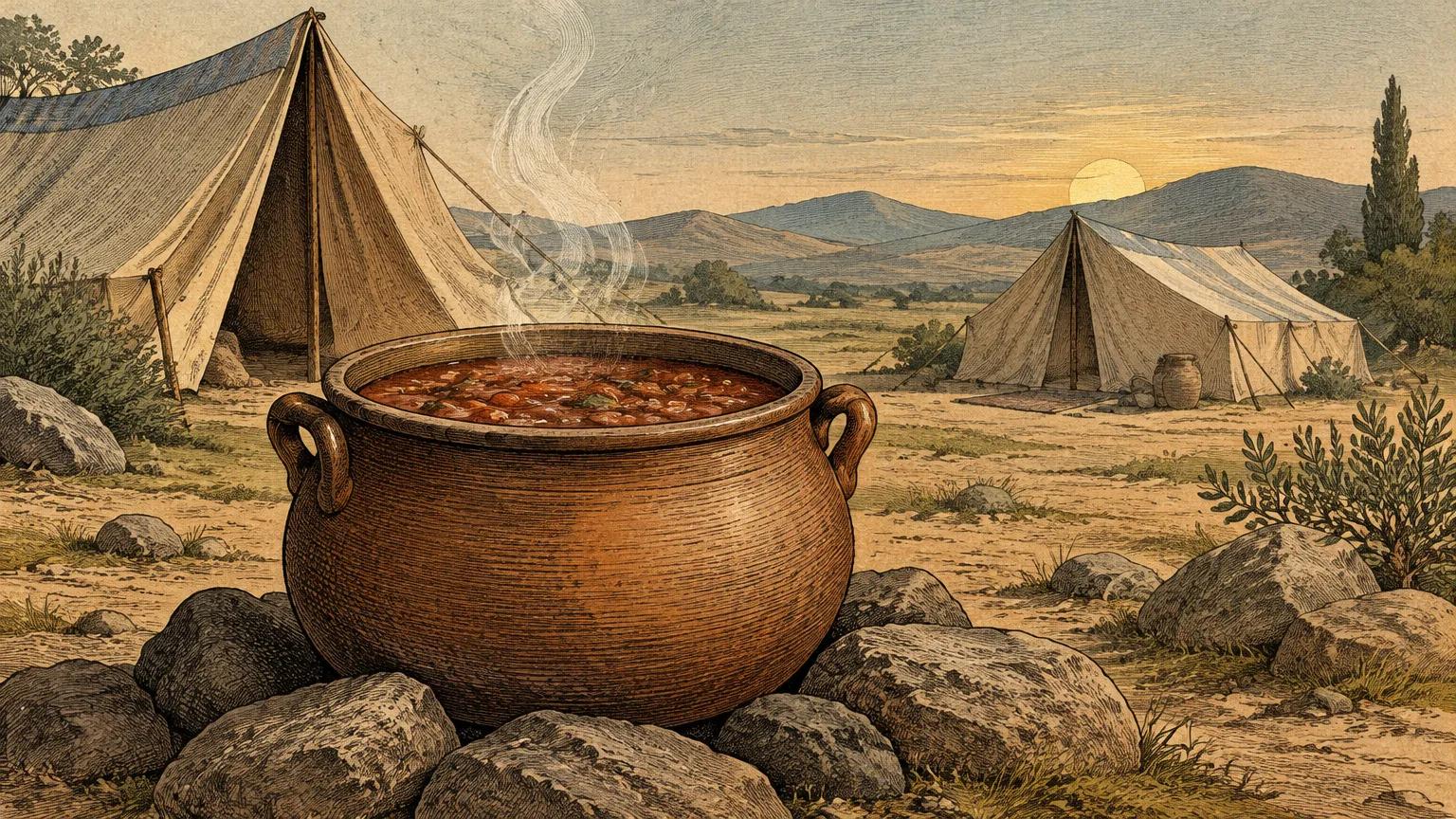
One day Esav comes in from the field famished and demands the red stew Yaakov is cooking. From that red food he receives a second name, Edom. Yaakov answers with a price: "First sell me your birthright." The demand only makes sense once we know what the birthright was. The firstborn held the leading place in the family, and in those generations, before there were kohanim, he was also the one who brought korbanot, offerings to God, on the household's behalf. Yaakov is therefore asking who will stand before God for the family. Esav's reply, "I am at the point of death, so of what use is my birthright to me?", treats it as worthless. He swears, eats, drinks, rises, and leaves. The Torah sums it up in its own verdict: "Thus did Esav spurn the birthright."
A pot of red stew stands by the tents, the meal for which Esav sells his birthright.
Yitzchak held in the land: famine, Gerar, and wells
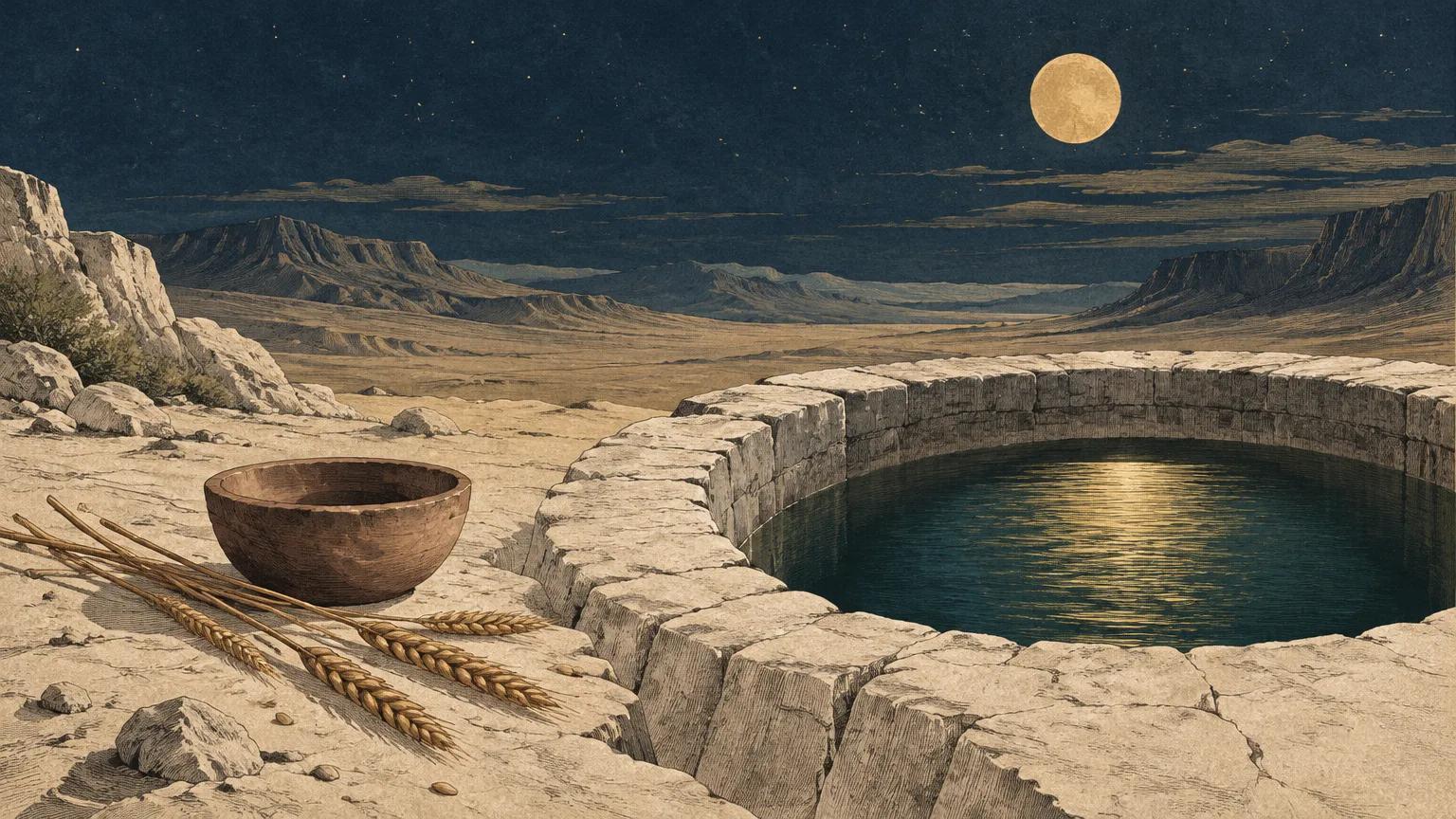
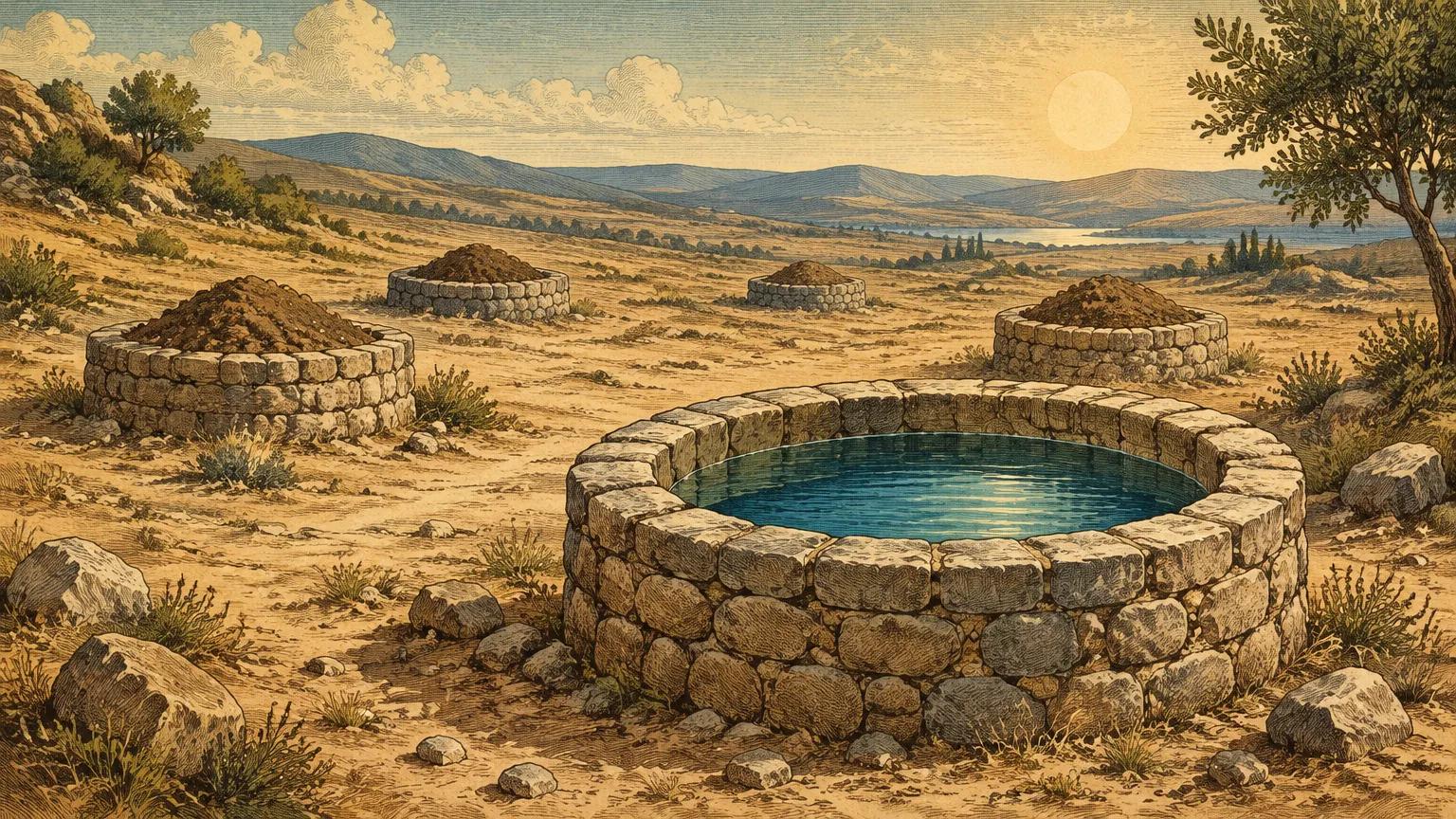
A famine strikes, and Yitzchak travels toward Gerar, the Philistine city. In an earlier famine Avraham had gone down to Egypt. Yitzchak is stopped: "Do not go down to Egypt; stay in the land." God then repeats to him the oath sworn to Avraham, which promises the land, countless descendants, and a blessing for the nations. In Gerar, Yitzchak calls Rivkah his sister out of fear. King Avimelech discovers the truth, rebukes him, and places the couple under his protection. Yitzchak sows and reaps a hundredfold. The Philistines grow envious, fill in Avraham's old wells, and the king sends him away. Yitzchak reopens his father's wells and gives them their old names. He then digs new ones, which are contested and named Esek and Sitnah, until a third, Rechovot, brings room at last. At Be'er Sheva God appears to him at night, and Yitzchak builds an altar. Avimelech arrives seeking a treaty, and that same day water is found. The section closes with Esav marrying two Hittite women, who bring bitterness to both parents.
Yitzchak reopens his father's filled-in wells, digs new ones, and at last a well holds water.
Disguise, blessing, and Esav's bitter cry
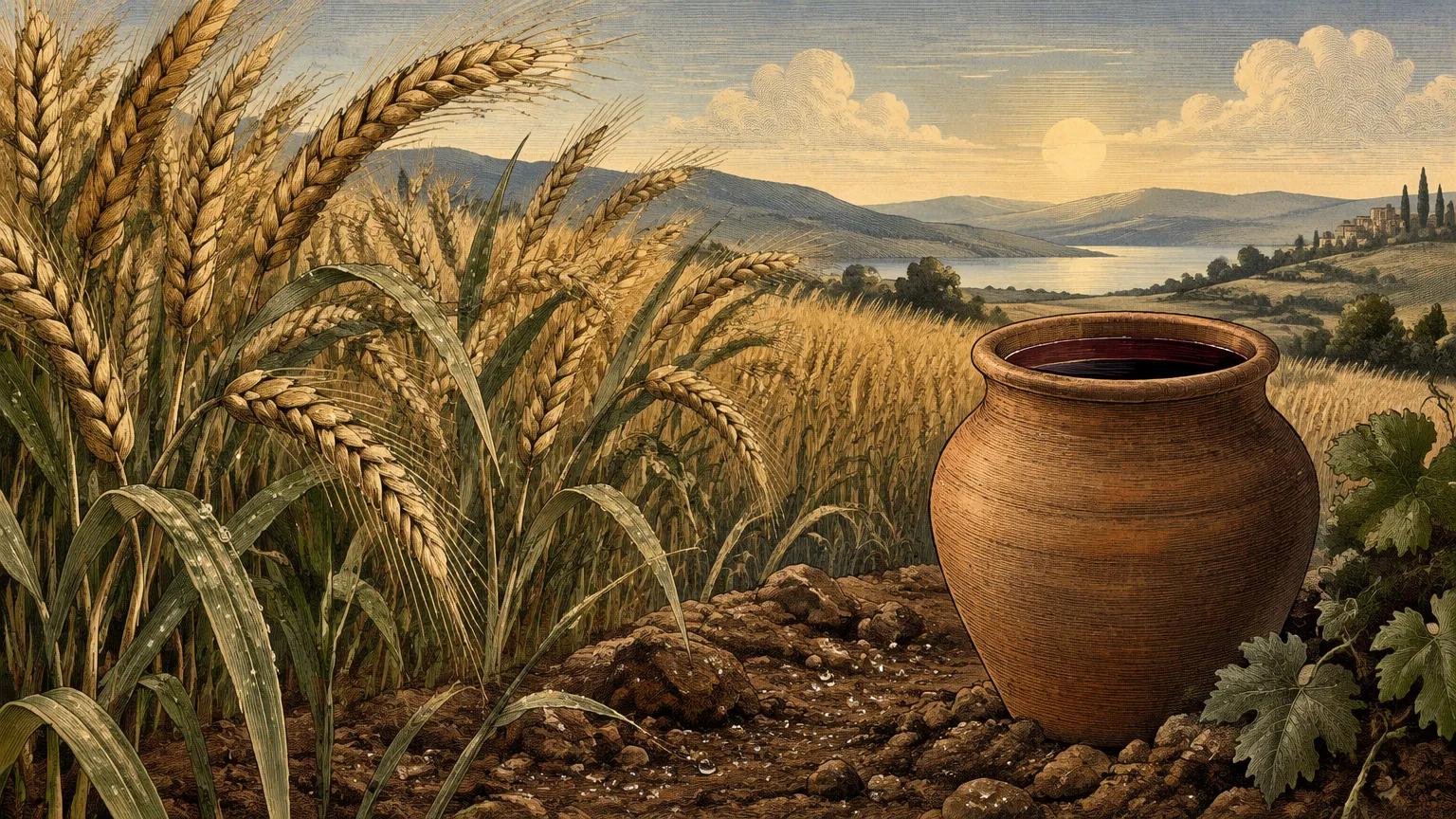
Old and blind, Yitzchak asks Esav to hunt game and prepare a dish so that he may bless him. Rivkah overhears. She sends Yaakov for two kids, cooks them as Yitzchak likes, dresses Yaakov in Esav's best clothes, and covers his smooth skin with goatskins. Yaakov fears a curse, and she takes it upon herself. Yitzchak hesitates: "The voice is the voice of Yaakov, yet the hands are the hands of Esav." Then he blesses him with dew, rich earth, grain and wine, the service of peoples, and mastery over his brothers. When Esav arrives, Yitzchak trembles violently and says of the one already blessed: "now he must remain blessed." He does not revoke the blessing. He confirms it. Esav sobs, accuses his brother of supplanting him twice, and pleads for a blessing of his own. He receives the fat of the earth, a life by the sword, service to his brother, and a future breaking of that yoke. Esav resolves to kill Yaakov once their father dies, and Rivkah urges Yaakov to flee to her brother Lavan in Charan.
Yitzchak's blessing names dew, rich earth, grain, and wine, and he leaves that blessing in place.
The second blessing and two roads apart
Rivkah gives Yitzchak a different reason for the journey: she cannot bear the thought of Yaakov marrying a Hittite woman. Yitzchak calls Yaakov and, this time knowing exactly whom he faces, blesses him again. He asks El Shaddai to make him fruitful and an assembly of peoples, and he grants him "the blessing of Avraham," which means possession of the land where he now sojourns. This is a different blessing from the first. That one spoke of crops and power, while this one carries the promises God made to Avraham. Yaakov departs for Paddan-aram. Esav watches, grasps that Canaanite wives displease his father, and marries Machalat, daughter of Yishmael, "in addition to the wives he had." The parashah leaves one brother on the road and the other at home with a new wife, their paths fully divided.
Generated 11/08/2026
Analysis axes
They form the central interpretive thread and appear interspersed in the essay below, connecting the parashah's sequence to a unified reading shaped by Rashi.
1.A household opens with prayer and struggleבכרתךRashi on 25:31
2.Twins in conflict, parents dividedאל תרד מצרימהRashi on 26:2
3.A bowl of stew and the firstborn's placeגם ברוך יהיהRashi on 27:33
4.Yitzchak held in the land: famine, Gerar, and wellsאת ברכת אברהםRashi on 28:4
Interpretive Analysis3 Rashi axes at the turns of the reading
Toldot reads like a contest over one prize, the blessing, won by the younger brother through stew and disguise. The chapter that seems to interrupt that contest is Yitzchak's sojourn in Gerar, with its famine, its wells, and its treaty. That chapter is in fact the key to the whole parashah. The inheritance at stake is not a single thing. It is two things that the parashah gradually pulls apart: earthly dominion, which can be bargained for, stolen, shared, and even lost again, and consecrated covenant, which can only rest on someone fit to carry it and can only be given knowingly. Yitzchak in Gerar is the living picture of the second without the first.
The first movement already points this way once the birthright is understood as service at the Mizbeach, the altar. Yaakov's sudden demand is not opportunism over a meal. It is a refusal to let a man who scorns holiness bring korbanot before God. Esav's reasoning gives him away. He measures the birthright by the needs of a body that is about to die, so a hungry man finds it worth less than lentils. The text records what Yaakov acquires, and it is not wealth. No flock or field changes hands. What changes hands is custody of the sacred, and the Torah's own verdict, that Esav "spurned" it, places the moral weight on contempt rather than on the price.
The Gerar chapter then shows what consecration costs. Avraham went down to Egypt in his famine without reproach. Yitzchak is forbidden. The reason lies in the Akedah, the binding of Yitzchak on Mount Moriah: having been laid on the altar, he became an olah temimah, an unblemished offering wholly given to God. Something consecrated does not leave sacred ground. So the son of the promise spends a famine confined among people who envy him. His wells are filled with earth, he is expelled, and his water is contested twice. He holds no dominion at all. Even so, every scene ends with him blessed: a hundredfold harvest, wells restored under Avraham's names, an altar at Be'er Sheva. And the king, the man of power, comes to the altar-builder to ask for peace, saying "we now see plainly that God has been with you." Dominion stays in Gerar. Blessing stays with Yitzchak.
Read the stolen blessing against that chapter and its contents become striking. Yaakov receives dew, fat earth, grain, wine, the service of peoples, and lordship over his brothers. Every item belongs to the earthly order. Land, offspring, and the name of Avraham are all absent. This is the kind of inheritance that disguise can capture, and it proves divisible: minutes later Esav receives the fat of the earth and the dew of heaven too, along with the promise that he will one day throw off his brother's yoke. Yitzchak's "now he must remain blessed" matters for a different reason. In trembling, he understands what has happened, and he ratifies the blessing of his own free will, so that no one could say Yaakov held it only through deceit. Even earthly mastery, once it belongs to the covenantal line, must finally rest on knowing consent.
That is why the parashah does not end at the tent flap. Yitzchak summons Yaakov with full knowledge, and only now does the phrase "the blessing of Avraham" appear. Its meaning is the promise that the great nation and the blessed seed will come from him, together with the land. This blessing was never on offer in the scene of disguise. It could not have been taken there, because it is not the kind of thing that can be taken. A structural inversion seals the point. The father, an offering bound to the land, could not leave it. The son who receives the covenant is sent out of it, so that the "assembly of peoples" can begin with a wife from Avraham's own kin. The father kept the covenant by staying put. The son extends it by going out to build a family.
The easier reading, that the clever son wins, does not survive Esav's final act. He too grasps that lineage matters, and he marries a daughter of Yishmael, from Avraham's family but outside the covenant's line. He adds her "in addition to the wives he had," which repeats how he once treated the birthright: as something to be gained by acquisition rather than by becoming fit to receive it. Throughout Bereshit the covenant passes neither by birth order nor by strength. In Toldot it passes from a father who was himself an offering to a son who cared for the altar. Dominion keeps changing hands. The blessing of Avraham does not.
Yitzchak named his reopened wells with his father's names. Then he dug new ones, and the first to go uncontested he called Rechovot, room. Yaakov now walks toward Charan carrying Avraham's name, and the open question is whether he too will find that room only after the contention has run its course.
Rashi's Axes
The four threads structuring this week's reading
Narrative logic
גם ברוך יהיה
Rashi on Bereshit 27:33
Rashi resolves why Isaac, after trembling violently upon discovering Jacob's disguise, declares that Jacob shall remain blessed, explaining that Isaac consciously reaffirmed the benediction of his own free will so that it would not be dismissed as invalid deceit.
Having just concluded his blessing over the disguised younger son and watched him leave, Isaac is suddenly confronted by Esau returning from the hunt with venison, exposing the imposture and throwing the blind father into convulsive dread. Instead of rescinding the stolen blessing or cursing the younger brother, Isaac unexpectedly seals the transfer with an absolute confirmation. Rashi's notice that Isaac purposefully ratifies what he initially imparted under deception opens a sharp interpretive difficulty: if the benediction was secured through misdirection, what does Isaac perceive in this moment that makes him endorse Jacob as its rightful owner?
Generated 11/08/2026
Confronting a careless priesthood, Malachi contrasts Edom's desolate ruin with God's enduring covenant, demanding that Israel restore reverence and honor to the sacred altar through pure and wholehearted devotion.
Context
This Haftarah comes from the book of Malachi, the last of the prophets. He spoke in the generation after the return from Babylon, when the second Beit HaMikdash stood rebuilt but its service had grown careless. It is read with Parashat Toldot, the parashah of Yaakov and Esav, and it opens with those two brothers.
The sages draw a remarkable teaching from the opening words, "the word of GOD to Israel through Malachi." Every prophet who would ever arise stood at Mount Sinai, and there the Holy One gave each soul the prophecies it would speak when its time came to be born. Malachi now delivers what was entrusted to him at Sinai: words of rebuke, spoken to call Israel back.
Interpretation
The Haftarah Explained
God begins: "I have shown you love." The people ask how, and God answers that Esav is Yaakov's brother, yet Yaakov was chosen. Like a father of two sons who gives the best field to the one he favors, God gives the good land to Israel. The hills of Esav, Mount Seir, his ancestral home, will lie desolate and never be properly settled, while Eretz Yisrael, now ruined and in exile, will be rebuilt in the days of Mashiach. That contrast will reveal God's love.
Edom may boast that it was poor but grew rich on the plunder of Yerushalayim and will rebuild with it. God replies: "They may build, but I will tear down." The Torah commanded Israel, "You shall not abhor an Edomite," and an upright Edom would have shown compassion in return. Instead it did Israel every harm and rejoiced at the destruction of Yerushalayim. A midrash adds that when a gentile objected to Rabbi Eliezer, a great sage of the Mishnah, that the nations' cities stand for centuries, Rabbi Eliezer explained that the "building" means the schemes the nations devise against Israel, which God undoes. The gentile agreed: every year they plot, and an old man, an angel sent by God, comes and overturns their plans.
Then the prophet turns to the kohanim. A son honors his father and a servant his master. Israel is both to God, so where is His honor? The kohanim protest that they have not scorned Him, but they called the altar "GOD's table" and wondered how blood and fat could belong on it, instead of asking why God commanded them. When people brought blind or lame animals, forbidden by the Torah, the kohanim said nothing. Would a governor accept such a gift and grant a favor in return? How much less the King of Kings. So too, whoever gives to tzedakah should give of his best.
How can such kohanim plead for Israel? Better that one good man lock the doors of the Beit HaMikdash than that fire be kindled on the altar for nothing. Even the nations who serve sun, moon, and stars know that God rules above them all, and their worship is ultimately directed to Him. Israel pleads poverty, "what a bother," and brings stolen and sick animals. Cursed is the one who hides the fine male of his flock and vows a blemished one instead.
The charge falls on the kohanim. If they do not take it to heart, their grain will be cursed, and measure for measure, the dung of their offerings will be spread on their faces. Yet the rebuke is meant to preserve the covenant with Levi. That covenant was first with Aharon and then with Pinchas, Aharon's zealous grandson, who was granted life and peace and lived three hundred years. He revered God, a Torah of truth was in his mouth, and the tribe of Levi did not worship the Golden Calf. For the lips of a kohen guard knowledge. He teaches Torah to Israel and serves within the inner sanctum like an angel of GOD.
Interpretation
Message
Malachi begins with love, and everything that follows flows from it. Because God has chosen Yaakov, Israel's service matters. A blemished offering is not a small lapse. It is a child withholding honor from a Father who gave him the best inheritance. The prophet's sharpest words fall on the kohanim, because they were meant to be guardians of knowledge and teachers of Torah. Their model is Pinchas, whose truth, reverence, and faithfulness kept his tribe from sin.
God asks for what is due to a loving Father and King: the best of the flock, offered by kohanim whose lips guard knowledge.