When the Covenant Passes From One Man to a Whole People
Moshe cannot enter the land, yet everything he does at its threshold teaches Israel how to carry the covenant without him.
Summary
1 min
The solitary threshold symbolizes the transition from Moshe’s external leadership to an internalized, portable covenant of love that guides the people home through generations.
Standing on the eastern bank of the Jordan, forbidden to enter the land he has spent his life approaching, Moshe delivers a sustained farewell address that folds memory, law, and warning into a single plea. The parashah's interpretive hinge is an act that looks like an interruption: after fierce warnings against idolatry, Moshe sets aside three cities of refuge—places where an accidental killer could flee for protection—even though they cannot yet function, since their counterparts inside the land await a conquest he will not live to lead. That empty gesture models a devotion indifferent to seeing its own outcome, and it frames the deeper problem Moshe faces. He is handing over a covenant he can no longer carry, to a generation that once begged him to stand between them and God's voice at Horeb, asking for a human intermediary rather than direct contact. The answer the parashah offers is the Shema—"the Eternal is our God, the Eternal alone"—and its command to love God with all one's heart, soul, and might. Love, unlike fear, needs no mediator; bound to the body and inscribed on the doorpost, the covenant becomes portable and internal, something an ordinary people can sustain once the extraordinary man who mediated it is gone.
In the haftarah, drawn from the prophet Yeshayahu, the tone turns from rebuke to consolation, assuring an exiled Yerushalayim that her term of suffering is complete and that God Himself will lead the people home. The comfort rests on the Creator's boundless power: the God who measured the world's waters in His hand will surely redeem Israel, gently, like a shepherd carrying his lambs.
Generated 07/19/2026
Parashah SynthesisBy topic
The parashah opens in the middle of a conversation between Moshe and God, on the far bank of the Jordan, with the land in sight and out of reach. What follows is Moshe speaking almost without pause, folding memory, law, and warning into a single sustained address to a people about to enter a place he will never see.
Synthesis topics
The Autoparashah methodology selected 6 topics to summarize the parashah's sequence.
Moshe's plea, God's refusal, and the turn to the people
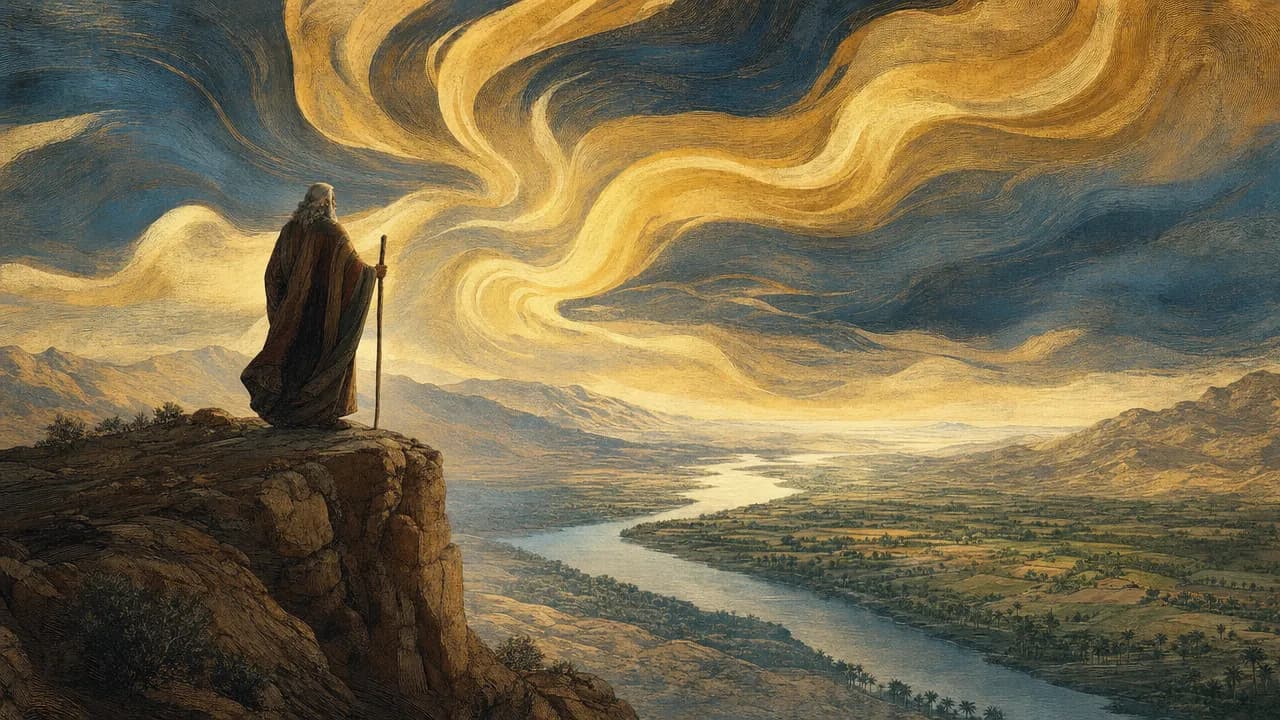
The parashah begins with Moshe recalling a prayer he had offered God. Having led Bnei Yisrael, the people of Israel, through the wilderness to the eastern edge of the Jordan, he asks to be allowed to cross and see the good land. God refuses, tells him to stop raising the matter, and instructs him instead to climb a height, look at the land in every direction, and prepare Yehoshua to lead the crossing in his place. The tone is set immediately: this is a leader at the end of his road, speaking to a generation whose road is only beginning.
The formless voice and the ban on images
From this personal disappointment Moshe turns directly to the people with an urgent appeal to keep the laws and rules God has given, neither adding to them nor subtracting from them. He anchors the appeal in memory. They themselves saw the punishment that fell on those who worshiped at Baal-peor, while those who held fast to God survived. Above all, he presses them to remember the day they stood at Horeb and heard God speak from within the fire. The crucial detail is that they saw no shape or form, only heard a voice. From this Moshe draws a sharp warning: precisely because no form was seen, they must never make any carved image, whether of human, animal, bird, or heavenly body, and never bow to the sun, moon, or stars. He warns that abandoning this will scatter them among the nations, yet promises that even from exile, sincere searching will bring them back to a God described as compassionate, who will not forget the covenant sworn to their ancestors.
Moses gazes at the Promised Land from afar, reminding Israel that their relationship with the Divine is rooted in hearing the formless voice of revelation rather than worshiping physical images.
Three cities set apart and the covenant restated
Moshe then interrupts his speech to perform a concrete act: he sets aside three cities on the eastern side of the Jordan to which someone who kills another person unintentionally may flee for protection. These cities cannot yet fully function, since the parallel cities in the land itself will only be designated after the conquest Moshe will not live to lead. Having done this, he gathers all Israel and restates the covenant of Horeb, insisting that it was made not merely with the ancestors but with the living generation standing before him. He rehearses the Ten Commandments in full, from the declaration that God brought them out of Egypt through the prohibitions of murder, theft, false testimony, and coveting.
The people's fear and the request for a mediator
Moshe recalls what happened at that revelation. The people, overwhelmed by the fire and the voice, came to him and begged him to draw close and listen on their behalf, promising to obey whatever he relayed. In recounting their words, the text uses an unusual feminine form when they say to Moshe "and you shall speak"—a shift in phrasing that marks how far the people were pulling back from direct contact with God, asking to hear the divine word only through a human intermediary. God approves their request, affirming that their reverence is good, yet the moment quietly records a retreat from the immediacy of standing before God themselves.
The Shema and the danger of prosperity
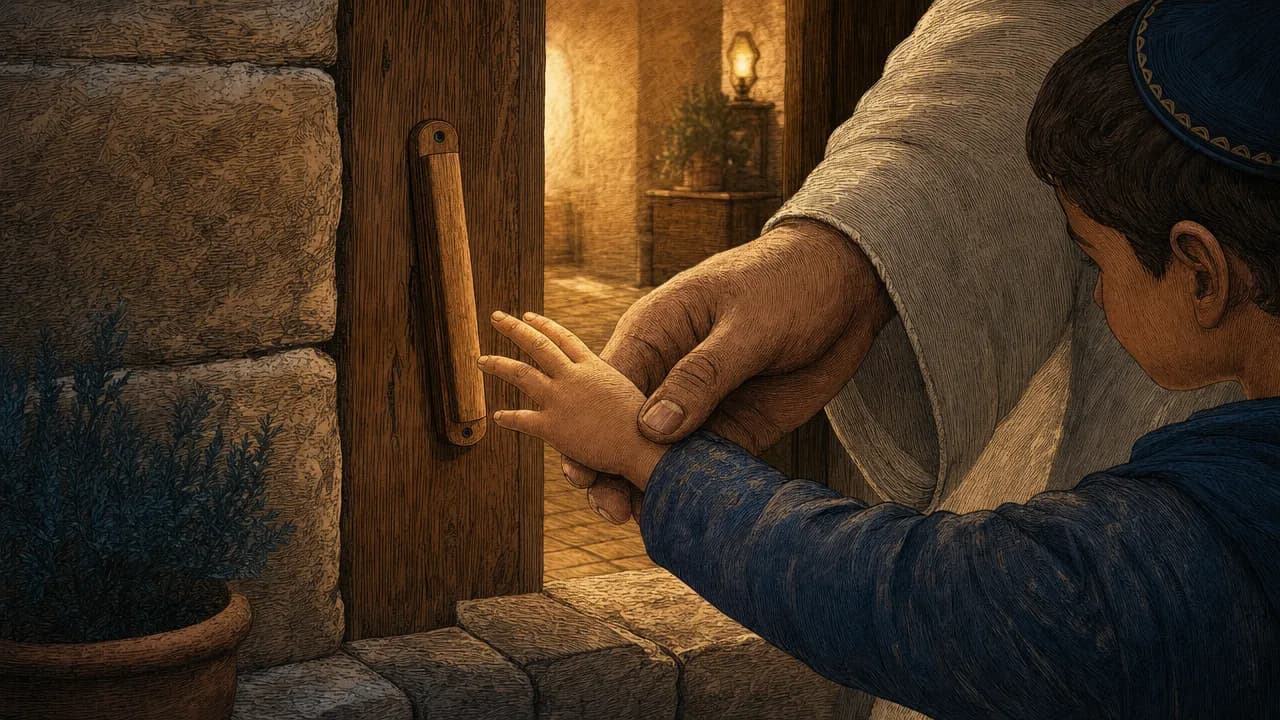
The address then reaches its center. Moshe delivers the words known as the Shema: "Hear, O Israel, the Eternal is our God, the Eternal alone." He commands love of God with all one's heart, soul, and might; the constant teaching of these words to children; their recitation at home and away, lying down and rising; and their binding as tefillin, the leather boxes worn on arm and head, and inscription as a mezuzah, the parchment fixed to the doorpost. He then names a specific danger: when Israel enters cities they did not build and eats from vineyards they did not plant, satisfied and secure, they may forget the God who freed them. He instructs parents how to answer a child who asks the meaning of the laws—by telling the story of slavery in Egypt and redemption, so that obedience is always understood as a response to being rescued.
The Shema commands Israel to weave the covenant into the fabric of daily life, securing their future by teaching the story of redemption to the next generation.
Chosenness, separation, and the faithful God
The parashah closes by looking ahead to the entry itself. Moshe commands that the seven nations of the land be dispossessed and their altars, pillars, and sacred posts destroyed, and forbids intermarriage with them, since it would draw Israel's children toward other gods. He explains that Israel was chosen not for its size—indeed it is the smallest of peoples—but out of God's love and the oath sworn to the ancestors. The section ends with a portrait of a faithful God who keeps covenant with those who love and obey across a thousand generations, but who requites those who reject the covenant, leaving Israel charged to observe the laws with which Moshe closes his words for the day.
Generated 07/19/2026
Analysis axes
They form the central interpretive thread and appear interspersed in the essay below, connecting the parashah's sequence to a unified reading shaped by Rashi.
1.Moshe's plea, God's refusal, and the turn to the peopleונשב בגיא וגו'Rashi on 3:29
2.The formless voice and the ban on imagesאז יבדילRashi on 4:41
3.Three cities set apart and the covenant restatedואת תדבר אלינוRashi on 5:24
4.The people's fear and the request for a mediatorה' אלהינו ה' אחדRashi on 6:4
Interpretive Analysis4 Rashi axes at the turns of the reading
Read the parashah again with one question in mind: why does Moshe pause his soaring warnings against idolatry to set aside three cities of refuge that cannot yet work? The placement looks like an interruption, but it is the hinge of the whole address. Moshe has just been told, definitively, that he will die outside the land. His response is not resignation but action: he performs the one mitzvah, one of the divine commandments, that lies within his reach, even though its purpose—protecting an accidental killer inside the conquered land—will only be realized long after he is gone. The cities on the eastern bank stand empty of function, and that emptiness is the point. Moshe is modeling a devotion that does not require living to see the outcome.
This act only becomes legible against the strange geographical note that opens the parashah. Just after God's final refusal, before the plea to obey, the text pauses to record that Israel dwelt in the valley opposite Beit-peor—the very site of the idolatry Moshe invokes as his central warning. The juxtaposition is deliberate and painful. Israel worshiped at Peor and was forgiven; they may still be told "and now, O Israel, hear the statutes," with everything before them. Moshe committed a single failure at the rock and was not forgiven his exclusion from the land. The parashah sets these two facts side by side and refuses to soften the asymmetry. The nation gets a future; its greatest leader gets a mountaintop view.
That asymmetry explains the urgency of Moshe's plea and the shape of everything that follows. He is not merely instructing a people; he is handing over a covenant he can no longer personally carry into its fulfillment. And so the covenant must be transformed from something anchored in his own towering, unyielding standard into something the collective can sustain on its own. This is why he insists, when he restates Horeb, that the covenant was made "not with our ancestors but with us, the living, every one of us who is here today." The living generation cannot lean on a mediator who will not cross with them.
But the parashah names, without disguising it, the flaw in the very generation being handed this responsibility. When Moshe recounts the people's plea at Horeb, the odd feminine form in "and you shall speak to us" registers a spiritual weakening: they shrank from approaching God directly, asking for a human buffer between themselves and the fire. Their fear was praised as reverence, yet it drained something from Moshe and from the nation's capacity for unmediated relationship. Here is the tension the parashah holds open. The people who requested a mediator are precisely the people who must now learn to live without one, because the mediator is dying. Fear-based distance is exactly what they can no longer afford.
The Shema is the answer the parashah offers to this problem, and its opening line quietly encodes the whole trajectory. To say "the Eternal is our God, the Eternal alone" is to declare two things at once: God is uniquely ours now, recognized by Israel while the nations do not yet know Him, and God will one day be acknowledged as the sole God by all humanity. The verse holds the particular and the universal in a single breath. What bridges them is the command that immediately follows—to love God with all heart, soul, and might. Love is the mode of devotion that fear cannot produce. The people who once shrank back are now told to bind God's words on their bodies and doorposts, to teach them relentlessly, to make the covenant portable and internal precisely so it no longer depends on standing at the foot of a burning mountain with Moshe between them and the voice.
Seen this way, the closing insistence that Israel was chosen for love and not for size is not a separate theme but the culmination. The empty cities of refuge, the forgiven idolaters at Peor, the feminine verb of retreat, and the double declaration of the Shema all press toward one reorientation: the covenant survives its founder only if the fear that made the people want a mediator becomes the love that lets them need none. Devarim, the book in which Moshe speaks his last words, is often heard as a book of warnings. It is at least as much a book about transmission—about how a thing carried by one extraordinary man must be set down gently into the hands of an ordinary people, and what that people must become to hold it.
Moshe stands between the people and the fire at Horeb, and by the end of his address he has spent his final energies teaching them to stand there without him. The three empty cities wait on the eastern bank for a conquest he will not join. What kind of love, the parashah leaves us asking, can a people learn only once the one who mediated it is gone?
Generated 07/19/2026
This illustration contrasts the fragile transience of human existence, symbolized by the grass, with the eternal, cosmic power of the Creator who levels mountains to guide His people home.
Context
This Haftarah is drawn from the book of Yeshayahu, the prophet whose words of both warning and comfort span the years of Yehudah's kings and its looming exile. Here the prophet turns from rebuke to consolation, speaking of how it will be in the days of the Mashiach, the anointed redeemer who will gather Israel from exile.
The passage addresses Yerushalayim directly, telling her that her term of service is over and her sins expiated. The prophet reminds us that Israel has endured two exiles, one in Bavel and the second the one in which we still find ourselves, both consequences of the great sins the people committed. Against that background, the opening cry of comfort carries its full weight.
Interpretation
The Haftarah Explained
A voice calls to clear a path in the desert, so that Israel may travel to Yerushalayim from their exile, and this same road becomes a highway for our God, who will be the leader guiding Israel home. In those days the road will be made level, so that the people will not tire in their walking as one does when climbing a mountain. Because the Holy One will provide all Israel's needs even in the desert, His glory will be revealed to all the nations, and the whole world will see that the prophecies have been fulfilled, for they came from God.
A prophetic voice then bids the prophet proclaim. Those who come with Gog and Magog will be destroyed like grass that quickly withers, and even their acts of kindness will not be remembered, for their sins are too many, while the word of our God endures. The prophet is told to ascend a high mountain, from which his voice carries far, and to bring good news to Zion and Yerushalayim, the primary cities of the land, that they in turn may announce the Redemption to the other cities and not be afraid.
Behold, the Lord comes in might, ruling by Himself, needing no help from any person or angel. His reward is with Him, for the one who relies on the Holy One in exile and believes He will bring him out will soon receive his reward for the good. Like a good shepherd who carries the small lambs in his hands and leads the mother slowly, so will God lead Israel gently out of exile.
Should the nations wonder how God can redeem Israel after so many years of captivity, the prophet answers that this is nothing new for Him. He measured the waters of the world in the hollow of His hand, created the heavens with a span, and divided the earth into three parts, and He weighed the mountains with proper measure. Who has ever advised or taught the Holy One how to create the world? Before Him the nations are like a drop in a bucket or a speck of dust one can blow away, and He can overturn them as easily as something thin and light.
The prophet warns the nations not to compare their foreign gods to our God. Their idol is shaped by a woodworker and overlaid with gold by a smith, or, for the poor person lacking silver, carved from a strong wood that will not rot, set firm so it should not topple. How can they be so mistaken? A person of intelligence can understand who is Lord of the world, who is enthroned on high, seeing everything from a distance while the earth's inhabitants seem as grasshoppers. He spreads the heavens like a tent and brings proud rulers to nothing, for they are neither rooted nor planted, and a wind blows them away like straw. Finally He bids us lift our eyes to the stars He created, knowing each one's number and calling each by name, for not one fails to appear.
Interpretation
Message
The heart of this Haftarah is comfort grounded in the boundless power of the Creator. The very God who measured the waters in the hollow of His hand and weighed the mountains on a scale is the God who will surely redeem Israel from the strong hands of the nations, for nothing before Him is difficult. It is a great mitzvah to rely on the Holy One during exile and to believe that He will bring us out of it, awaiting the day when His glory is revealed and all flesh, as one, will behold the fulfillment of His word.
The prophet's assurance stands firm: grass withers and rulers fade, but the word of our God endures forever, and He will gather His people home like a shepherd tending his flock.