When the Camp Began to March, the Cracks Began to Show
Israel leaves Sinai in perfect order and within days dissolves into craving, rebellion, and family rupture at its summit.
Summary
1 min
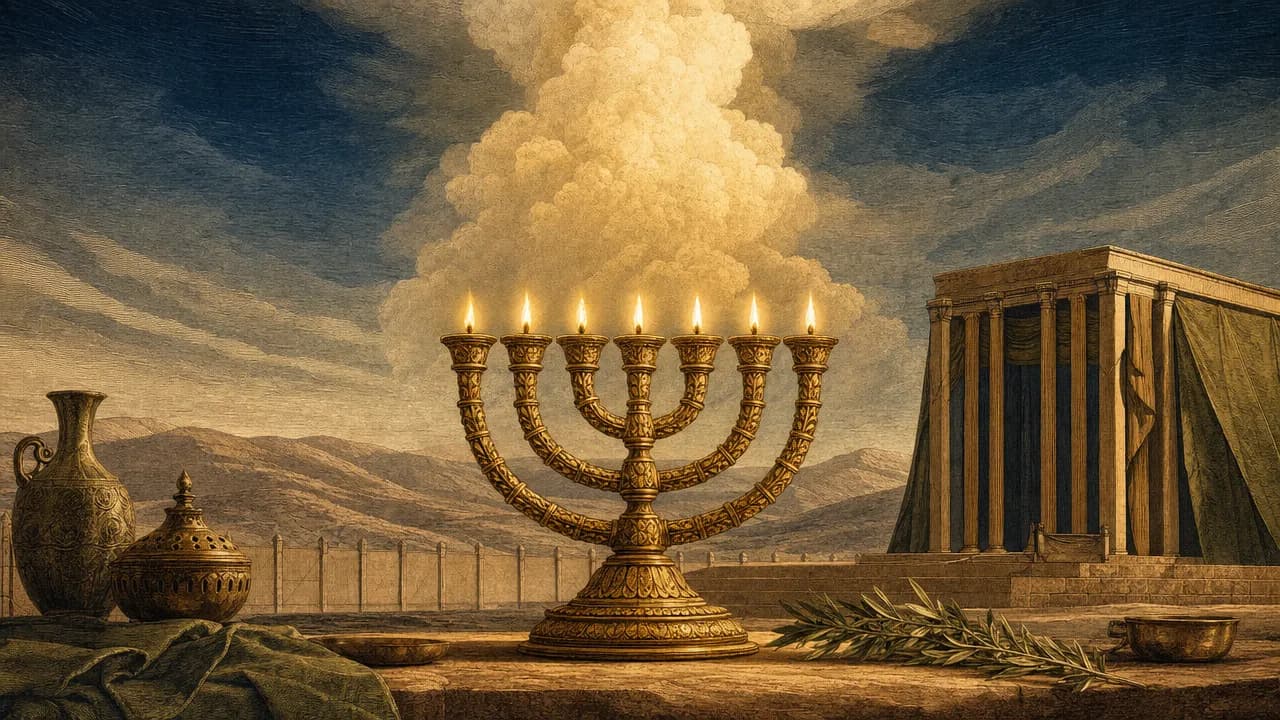
The enduring light of the menorah, sustained by the quiet spirit of the olive branch, symbolizes the divine presence that persists even when human journeys falter in the wilderness.
The parashah opens in the ordered world of the Mishkan—the Menorah lit, the Leviim purified and presented, the camp arranged for a sacred journey—and ends in a wilderness marked by graves and exile. The interpretive key lies in two textual anomalies that stage the collapse before narrating it. The Pesach is recorded out of sequence, displaced backward to the first month; the reading argues this conceals something shameful, for Israel offered the Pesach only once in forty years, and the lone faithful observance is set down out of order so the book does not announce the long silence. The two verses of the Aron's march—"Advance, O Eternal One"—are sealed off by inverted letters, fencing the ideal journey between the fire at Taverah and the graves of craving. The triumphant march survives only as a quarantined island. The complaints that follow are revealed not as protest against real suffering but as manufactured pretext for retreat from the divine presence. The descent then climbs to the leadership itself: Miriam and Aharon misread Moshe's unique prophecy—"mouth to mouth"—a nearness that cannot be shared even with kin.
In the haftarah, the prophet Zechariah addresses the fragile community returned from Babylon to rebuild the Beit HaMikdash. He is shown Joshua the Kohen Gadol on trial before the Accuser, "a brand plucked from the fire," his soiled garments removed and forgiveness granted, and a golden lamp filled by two olive trees without human hand—teaching that the work proceeds "not by might, nor by power, but through My spirit."
Generated 05/31/2026
Parashah SynthesisBy topic
The parashah opens in the close, ordered world of the Mishkan and ends in a wilderness scarred by graves and exile. Between those two points, a people that had been carefully arranged for a sacred journey begins to come apart. Read it as a single arc, and watch how quickly proximity to the holy turns dangerous.
Synthesis topics
The Autoparashah methodology selected 5 topics to summarize the parashah's sequence.
The Menorah lit and the Leviim consecrated for service
The parashah opens inside the sanctuary, with God instructing Aharon about the lighting of the Menorah, the golden lampstand, so that its seven lamps cast their light toward its face. We are deep in the second year after the Exodus, with the Mishkan, the portable dwelling for God's presence, newly built and the camp arranged around it. The tone is exact and liturgical: every act is measured, every detail conforms to the pattern shown to Moshe. From the Menorah the text turns to the Leviim, the tribe set apart for sanctuary work, who are purified by sprinkling, shaving, and laundering, then formally presented before God as a kind of living offering from the people. They replace the firstborn of Israel, who had been claimed by God at the smiting of Egypt's firstborn. Their term of service is fixed between the ages of twenty-five and fifty.
The Second Pesach, the guiding cloud, and the silver trumpets
Having established who serves, the text turns to a calendar event, and here the reader meets a deliberate jolt. The narrative steps back in time to the first month of the second year to record the offering of the Pesach, the festival sacrifice marking the Exodus. The book had already moved forward into the second month, so this is a return to an earlier date, recorded here for its legal substance rather than its chronological place. A real problem then arises within the story: certain men, impure through contact with a corpse, cannot bring the offering at its appointed time and protest their exclusion. The answer is a new institution, a Second Pesach a month later, for anyone impure or far away. The section then describes the cloud that covered the Mishkan by day and appeared as fire by night, governing every encampment and departure, and finally the two hammered silver trumpets used to summon the people, signal the march, and sound in war and on festivals.
The Menorah’s light and the guiding cloud represent the dual elements of precise ritual order and constant divine presence that define the early wilderness sanctuary.
Departure from Sinai and the order of the march
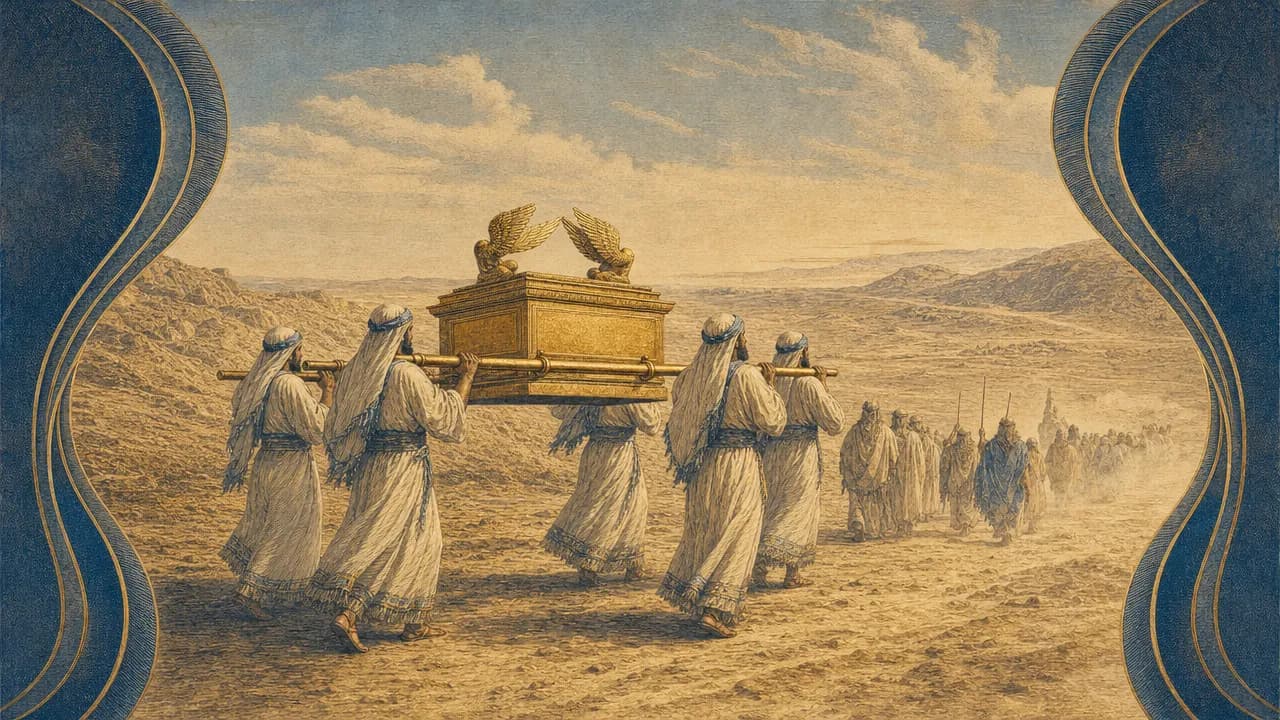
Now the camp actually moves. On the twentieth day of the second month the cloud lifts, and Israel sets out from the wilderness of Sinai toward the wilderness of Paran. The text lays out the march with great formality: the standard of Yehudah first, then the dismantled Mishkan carried forward, then Reuven, then the holy objects, then Ephraim, then Dan as rear guard, each division named by its leaders, troop by troop. Moshe urges his father-in-law, Hovav, to join them as a guide who knows the wilderness, promising him a share in the good God has promised Israel. As the Aron, the chest holding the tablets of the covenant, sets out before them, Moshe speaks two short verses of departure and rest: "Advance, O Eternal One, may Your enemies scatter," and on halting, "Return, O Eternal One." These two verses are set off in the scroll by inverted letters that bracket them on either side, marking the passage as something held apart from what surrounds it.
Framed by symbolic brackets like the Torah scroll itself, the Ark leads Israel forward, marking the transition from stationary revelation to the active journey of faith.
Complaints, the seventy elders, and the quail
The mood breaks immediately. The people take to complaining, and a fire of God burns at the edge of the camp until Moshe prays and it subsides; the place is named Taverah, from burning. Then the craving spreads: the mixed multitude among them longs for meat, and the people weep for the fish, cucumbers, melons, and garlic of Egypt, despising the manna that fell with the dew each night. Moshe, crushed by the weight of leading a people he did not bear, cries out that he cannot carry them alone and would rather die. God answers on two fronts. Seventy elders are gathered and given a share of the spirit resting on Moshe, so that they prophesy; two men, Eldad and Medad, prophesy within the camp itself, and when Yehoshua urges Moshe to stop them, Moshe wishes instead that all God's people were prophets. And God sends quail in overwhelming abundance—but while the meat is still in their mouths, a plague strikes, and the place is named Kivrot-HaTaavah, the graves of craving.
Miriam and Aharon speak against Moshe
The final movement narrows from the whole nation to Moshe's own household. Miriam and Aharon speak against Moshe concerning the Cushite woman he had married, and ask whether God has spoken only through Moshe and not also through them. God hears, and the text pauses to note that Moshe was exceedingly humble. The three are summoned to the Tent, where God declares the difference plainly: to other prophets He makes Himself known in vision and dream, but with Moshe He speaks mouth to mouth, openly. When the cloud withdraws, Miriam is stricken with snow-white scales. Aharon pleads with Moshe, Moshe cries out a brief, urgent prayer for her healing, and God answers that she must bear her shame outside the camp for seven days. The whole people waits, not marching, until she is brought back; only then do they journey on into the wilderness of Paran.
The entire nation halts its journey to wait for Miriam, illustrating how communal progress must pause to honor the dignity and restoration of its individual members.
Generated 05/31/2026
Analysis axes
They form the central interpretive thread and appear interspersed in the essay below, connecting the parashah's sequence to a unified reading shaped by Rashi.
1.The Menorah lit and the Leviim consecrated for serviceבחדש הראשוןRashi on 9:1
2.The Second Pesach, the guiding cloud, and the silver trumpetsויהי בנסע הארןRashi on 10:35
3.Departure from Sinai and the order of the marchכמתאנניםRashi on 11:1
4.Complaints, the seventy elders, and the quailותדבר מרים ואהרןRashi on 12:1
Interpretive Analysis4 Rashi axes at the turns of the reading
The parashah is built as a deliberate descent, and the way to read it is to notice that the text itself stages its own collapse before it narrates the events that collapse. Two scribal and chronological anomalies—the backward leap to the first month for the Pesach, and the inverted letters surrounding the Aron's two verses—are not curiosities at the margin. They are the structural hinges that turn an account of an ordered, sanctified camp into an account of its disintegration. The first section's perfect liturgical world is, on this reading, being quietly undermined by the very seams of the text.
Begin with the displaced Pesach. The book had already moved into the second month, and the Pesach belongs a month earlier; recording it here breaks the forward motion just as the camp is being readied to march. The displacement is purposeful. The Torah declines to open this book with this episode, because to lead with it would expose something shameful: in forty years of wilderness wandering, Israel offered the Pesach exactly once, at Sinai, and never again until they entered the land. The single faithful observance is set down out of sequence precisely so the book does not begin by announcing the long silence that followed. What looks like a tidy account of a community keeping its festivals is, beneath the surface, a record of a fidelity that will not be repeated.
The inverted letters perform the same work at the seam of the march. The two verses of the Aron's going forth—"Advance, O Eternal One"—describe the ideal journey, the camp moving as a single body behind the presence of God with its enemies scattering before it. The brackets that isolate these verses signal that this passage stands out of its place, and that its function is to separate one account of punishment from another. On one side lies the fire at Taverah; on the other, the graves of craving. The triumphant march exists in the scroll only as a quarantined island, fenced off by the scribe's own hand from the failures pressing in on both sides. The ideal is given to us framed and sealed, as though the text knew it could not survive contact with what actually happened.
Read this way, the complaint that erupts at Taverah is not a sudden lapse but the truth the brackets were holding back. The people are described as "like complainers"—an oddly tentative phrasing for what becomes a fire and a plague. The looseness of the word is the point: this was not protest against real suffering but a manufactured grievance, a pretext sought in order to distance themselves from the One in whose midst they were traveling. The craving for Egyptian fish and garlic is the alibi, not the cause. The same camp that had just been arranged with liturgical precision now searches for a reason to retreat from the very closeness that arrangement was built to sustain. Proximity to holiness, the parashah insists, does not stabilize a people; it raises the stakes of their refusal.
The descent then climbs, paradoxically, to the top of the leadership, and this is the parashah's most unsettling move. Miriam and Aharon's words against Moshe are not crude rebellion; they arise from a genuine misreading of his prophetic standing. They assume his prophecy is like theirs—occasional, compatible with ordinary family life—and so his withdrawal from his wife strikes them as a fault to be criticized rather than a necessity of his constant readiness to be addressed by God. God's correction is not that they were disloyal but that they were wrong about the kind of nearness Moshe lived in: with him alone, "mouth to mouth." The unique demand of supreme prophecy is precisely that it cannot be shared on equal terms, even with the seventy elders who had just received a portion of his spirit, even with the brother and sister who stood beside him from the beginning.
Set against the book it opens, this is a sobering reframing of the whole wilderness project. The march from Sinai was meant to be the short, clean passage from the mountain to the land, the camp moving as one behind the Aron. Instead the text fences off that ideal in inverted brackets, hides the lone faithful Pesach out of its proper year, and lets the real sequence run its course: fire, craving, graves, and a leader's own household fracturing over the meaning of his closeness to God. The fragile boundary between holy proximity and destructive alienation is not a theme the parashah illustrates. It is the line its own seams are drawn to mark.
The people wait at the edge of Paran while Miriam bears her seven days outside the camp, and the whole nation halts for her. A camp that could not wait for meat now cannot move without one of its own. What does it mean that the journey toward the land pauses, again and again, on the threshold of arrival?
Generated 05/31/2026
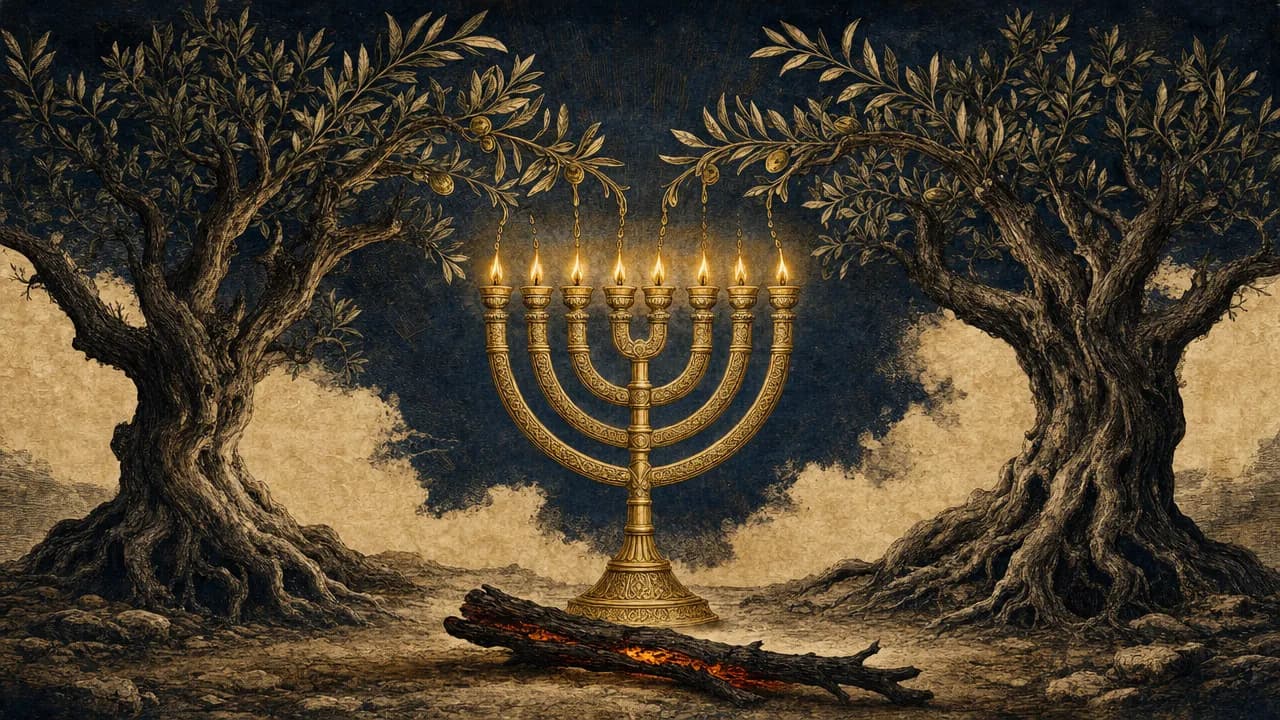
The self-replenishing menorah flanked by olive trees and the charred branch together symbolize that Israel's restoration and spiritual purification occur not through human strength, but by divine spirit.
Context
This Haftarah comes from the book of Zechariah, a prophet who spoke to the Jews who had returned from the Babylonian exile to rebuild the Beit HaMikdash in Jerusalem. His words are addressed to a fragile community whose enemies hoped to halt the rebuilding, and who needed reassurance that God had not abandoned them.
Two figures stand at the center of the passage: Joshua, the Kohen Gadol of the returning community, and Zerubbabel, who led the building of the second Beit HaMikdash. Through visions granted to the prophet, both men are shown that the future of the Jewish people and their sanctuary rests entirely in the hands of Heaven.
Interpretation
The Haftarah Explained
The passage opens with a promise of joy: "Shout for joy, fair Zion." When the Messiah comes, the Holy One will sing and rejoice over the city of Zion, for He will come and rest among her. Many nations will attach themselves to God on that day and become one people in whose midst He will dwell. Each Israelite will inherit his portion in the Holy Land, and Jerusalem will be chosen again. Then comes the call, "Be silent, all flesh, before the Lord" — all creation must fall silent, for God will rouse Himself from heaven. King David begged God to arise, yet the answer was that God arises in His own time: when He sees the poor treated unjustly and the needy crying out, then He acts, and then every person should stand in awe and be still.
The prophet is then shown Joshua the Kohen Gadol standing before the angel of God, with the Accuser at his right hand seeking to speak evil of him. The angel rebukes the Accuser: God who has chosen Jerusalem rebukes you, for this man is "a brand plucked from the fire." The tradition recalls how two false prophets, Zedekiah and Ahab, were cast into Nebuchadnezzar's furnace together with Joshua, who joined them hoping his merit might protect all three. The two were consumed, while Joshua emerged with only his garments singed — for when dry logs burn beside damp wood, even the wet log is scorched. Joshua was thus separated from the fire.
Joshua appears dressed in filthy garments, which represent transgressions that cling like stains — in his case, his failure to warn his children against marrying divorcees, which is forbidden. The angel orders the soiled clothes removed and assures him that God forgives his sins and will clothe him in beautiful garments. He is told that if he walks in God's ways he will rule over the House and Temple, and if he remains pious he will be granted a place among the angels who stand eternally before the Holy One. Joshua and his companions, men for whom God works wonders, are a sign of the coming Messiah, called Zemach. The single stone set before Joshua promises that Zerubbabel's Beit HaMikdash will stand, guarded by God as if by seven watching eyes, and that the schemes of the wicked will be undone and the land's sins removed in a single day.
The angel then wakes the prophet as one is roused from sleep and asks what he sees. He describes a golden candelabrum with a bowl above it holding oil, seven branches, and seven pipes feeding oil into each branch — and two olive trees, one on each side, supplying oil so that it never runs dry. When the prophet asks how the oil flows by itself into the bowl and on into each lamp with no human hand involved, the meaning is revealed: "Not by might, nor by power, but through My spirit, says the Lord." Just as the trees and lamp fill themselves, so the Beit HaMikdash will be built by God Himself, not by human strength.
Interpretation
Message
The heart of this Haftarah is the assurance that the rebuilding of the Beit HaMikdash does not depend on human power. To those facing enemies who seemed an unconquerable mountain, the word came that for Zerubbabel the righteous the work would be as easy as building on smooth ground — "Not by might, nor by power, but through My spirit." Just as the olive trees feed the lamp without any human hand, so God Himself sees His House completed. And just as the crowds once cried "Beautiful, beautiful" when the first stone was laid, so the whole structure would rise with His blessing.
Joshua, plucked from the fire and clothed anew, and the lamp that fills itself with oil together teach that redemption and rebuilding come not by human strength but by the spirit of God.