A double parashah where water, words, and curses fail to wound Israel, until Israel's own conduct opens the only wound that lands.
Summary
1 min
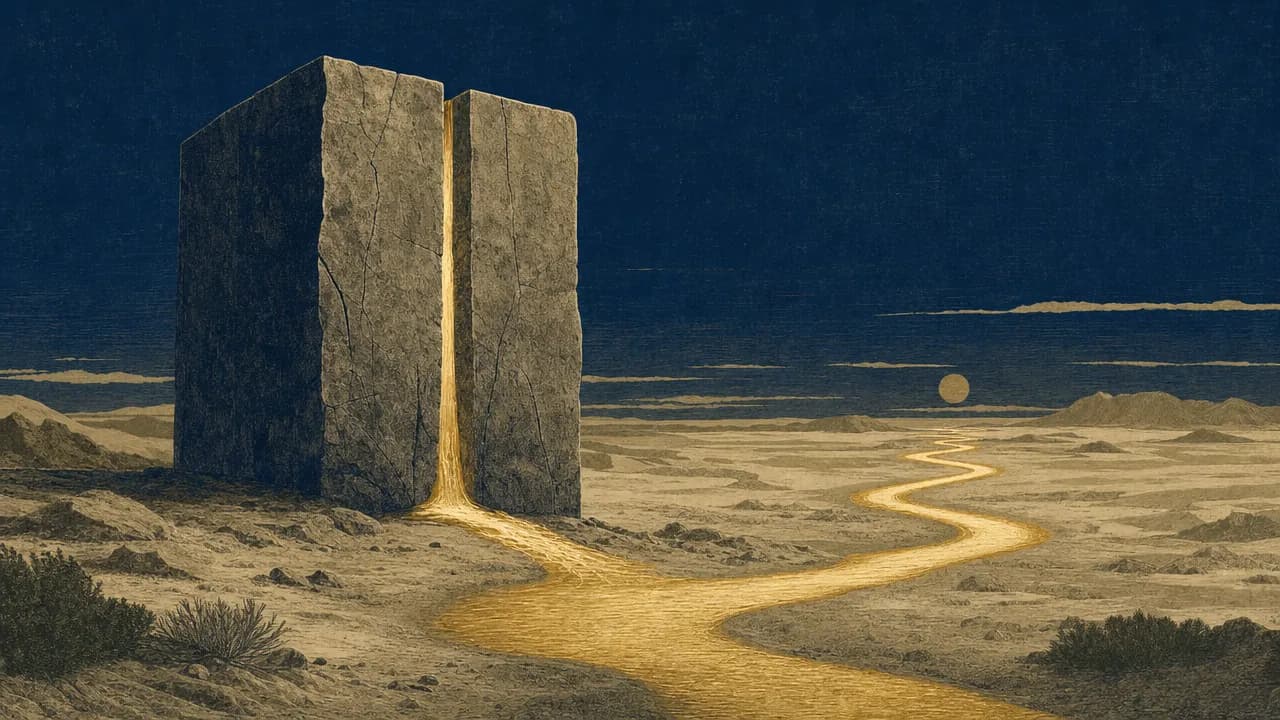
This illustration unites the water drawn from the rock with the humble path of justice, symbolizing how the power of speech must ultimately yield to a quiet, faithful walk with God.
Read twice, this double portion reveals a single argument about where Israel can and cannot be touched, and its hinge is the mouth. Speech is the medium through which Israel acts, the weapon enemies try to turn against it, and the faculty whose misuse undoes its own leaders. The opening law of the parah adumah, read as a mother atoning for the calf, binds death's impurity to the stain of idolatry at the very threshold. At Meribah Moshe is told to speak to the rock and instead strikes it, surrendering speech to force in the generation whose power lives in its mouth. Moav then diagnoses Israel correctly, hiring Bilam to fight a people of the mouth with a man of the mouth; every curse converts to blessing, and even the donkey speaks truth the seer cannot. The portion proves no external word can wound Israel, then shows the one breach that works at Baal-Peor, opened from within by Israel's own appetite, halted only by Phinehas with twenty-four thousand graves behind it.
In the haftarah, Micah looks first to the war of Gog and Magog and the redemption that follows, when Israel will need no horses or fortified cities and the evil inclination itself is removed. God then summons Israel to judgment, recounting His kindnesses and asking, in the end, only for justice, love of kindness, and a humble walk before Him.
Generated 06/21/2026
Parashah SynthesisBy topic
The text opens not with a story but with a law so strange that the reader is asked to accept it before understanding it. From there it moves through thirst, death, war, a hired prophet, and a final catastrophe that arrives from an unexpected direction. What follows is meant to let you read the whole sweep without stumbling, and then to read it again with a sharper eye.
Synthesis topics
The Autoparashah methodology selected 7 topics to summarize the parashah's sequence.
The parashah begins mid-journey, with Bnei Yisrael long in the wilderness, and it opens by setting down a ritual rather than telling a story. God instructs Moshe and Aharon in the law of the parah adumah, the red cow without blemish that has never borne a yoke. The animal is slaughtered outside the camp, burned entirely together with cedar, hyssop, and crimson wool, and its ashes are gathered and stored. Those ashes, mixed with fresh water, become the means of purifying anyone who has touched a corpse. The ritual carries a built-in paradox the text states plainly: the same waters that cleanse the impure render impure those who prepare and handle them. The reader is being given the camp's defense against the contamination that death spreads.
The elements of the red heifer ritual symbolize the delicate, paradoxical boundary between purity and impurity as the community confronts the reality of death.
Loss of water and the rock at Meribah
The narrative then resumes, and it resumes with death. Miriam dies at Kadesh, and immediately the community is without water and turns on its leaders, wishing aloud that they had died earlier. God tells Moshe to take his staff, gather the people, and speak to the rock so that it yields water. Moshe instead rebukes the people as rebels and strikes the rock twice. Water gushes out and the people drink, but God tells Moshe and Aharon that because they did not trust Him enough to sanctify Him before the people, neither of them will bring the congregation into the land. The failure is not the water, which came; it is that a command to produce water by word alone was answered with force.
Edom's refusal and the death of Aharon
Israel, now near the edge of settled territory, asks Edom for safe passage along the main road, promising to touch no field, vineyard, or well. Edom refuses and comes out armed, and Israel turns aside rather than fight a kinsman nation. The people travel to Mount Hor, where God tells Moshe that Aharon, too, will die for the same episode at the waters. In full view of the community Moshe strips Aharon of the priestly garments and dresses Eleazar, Aharon's son, in them; Aharon dies on the summit, and all Israel mourns him for thirty days.
Serpents, songs, and victory over kings
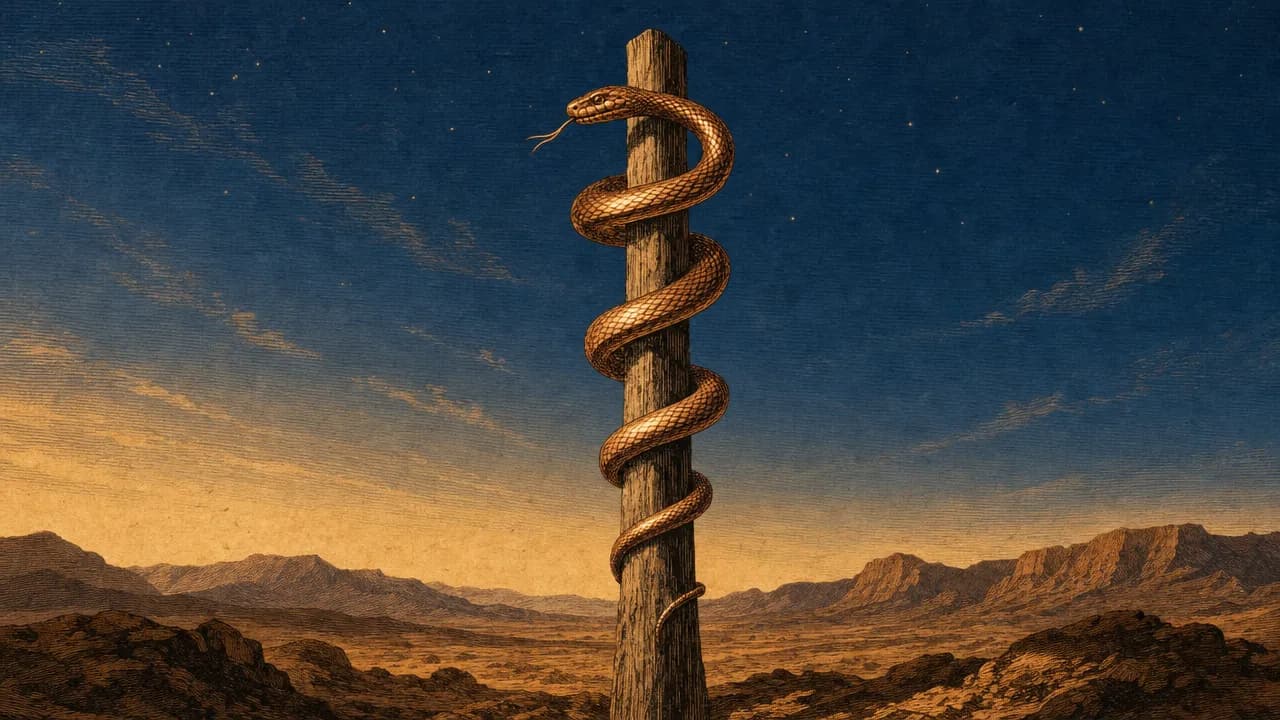
The journey grows harder. After a battle with the Canaanite king of Arad ends in an Israelite vow and victory, the people again complain of no bread, no water, and food they loathe. God sends venomous serpents, and many die; when the people confess, Moshe is told to fashion a copper serpent on a pole, and whoever was bitten and looked at it lived. The text then carries Israel through a string of encampments, a well that the people greet with song, and two decisive wars: against Sihon king of the Amorites, who refused passage and attacked, and against Og of Bashan. Both kings are defeated and their lands taken, and Israel encamps in the plains of Moav, across the Jordan from Jericho.
The copper serpent raised in the wilderness represents the transformation of a deadly threat into a focal point of healing and faith when lifted upward.
Balak's fear and the talking donkey
Now the scene shifts entirely away from Israel's own camp. Balak son of Tzippor, king of Moav, sees what Israel did to the Amorites and is gripped by dread. He turns to the elders of Midyan and then sends to Bilam son of Beor, a renowned diviner, asking him to come and curse this people, since whomever Bilam curses is cursed. God first forbids Bilam to go; a second, grander delegation comes, and this time God permits him to go but only to speak what God commands. On the road God's anger flares, and an angel with a drawn sword stands in the path. The donkey sees the angel three times and turns aside; Bilam, who cannot see it, beats her, until God opens the donkey's mouth to protest and then opens Bilam's eyes to the angel. The renowned seer is shown to be blinder than his animal.
Blessings against the curse-maker
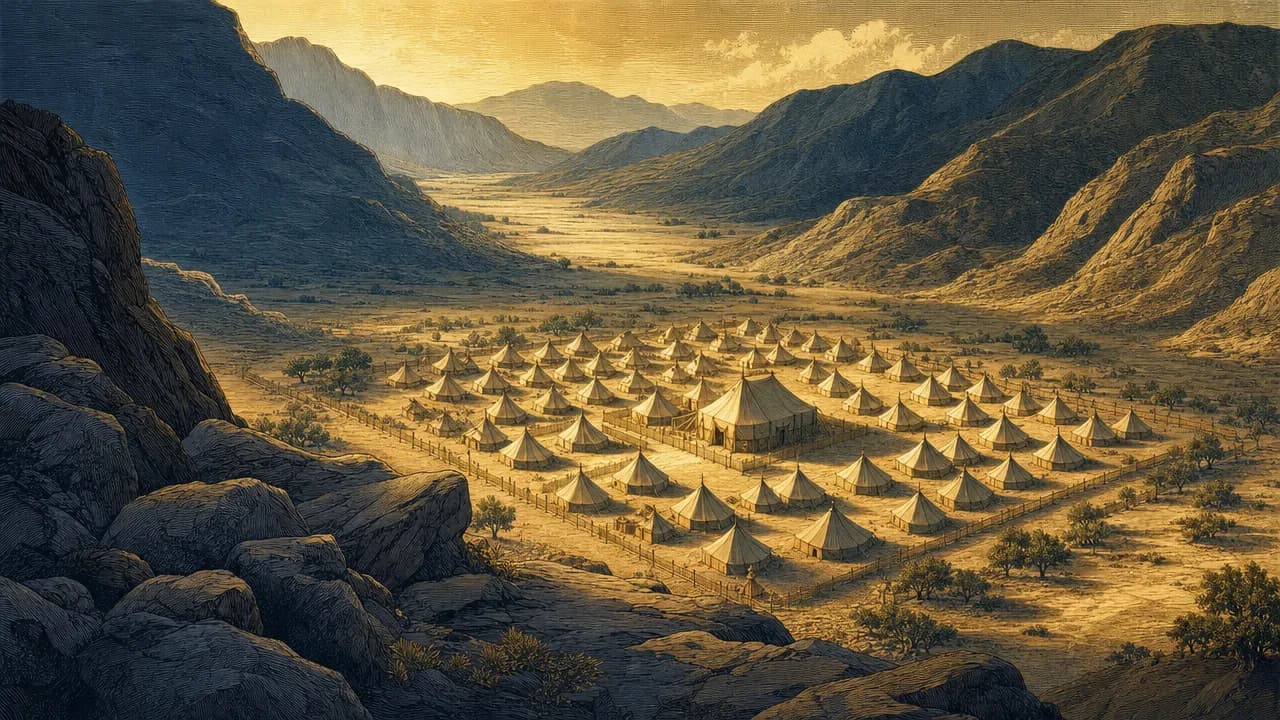
Balak takes Bilam to three vantage points overlooking the camp, building seven altars at each and offering bulls and rams, expecting a curse. Each time the word placed in Bilam's mouth is blessing. He declares Israel a people that dwells apart, too numerous to count; he insists God is not a man who lies or changes His mind, and that no augury or divination works against Jacob. The third oracle praises the beauty of Israel's tents and its lion's strength, and a final vision foresees a star rising from Jacob and the downfall of Moav, Edom, Amalek, and others. Balak, enraged, sends Bilam off unpaid, and Bilam returns home.
Viewed from the heights, the orderly arrangement of Israel's tents reveals a harmonious beauty that disarms external curses and evokes divine blessing.
The collapse at Baal-Peor
The parashah ends with a blow that no enemy delivered. While Israel stays at Shittim, the men begin consorting with Moabite women, who draw them into sacrifices and the worship of Baal-Peor; God's anger burns and a plague breaks out. As Moshe and the people weep, an Israelite man openly brings a Midianite woman to his companions. Phinehas, grandson of Aharon, takes a spear, follows the pair, and runs them both through. The plague halts, but only after twenty-four thousand have died. The reader is left with the camp still standing, but freshly wounded from within.
Generated 06/21/2026
Analysis axes
They form the central interpretive thread and appear interspersed in the essay below, connecting the parashah's sequence to a unified reading shaped by Rashi.
1.Opening with the law of the red heiferפרה אדמהRashi on 19:2
2.Loss of water and the rock at MeribahלהקדישניRashi on 20:12
3.Edom's refusal and the death of Aharonאל זקני מדיןRashi on 22:4
4.Serpents, songs, and victory over kingsלכה איעצךRashi on 24:14
Interpretive Analysis4 Rashi axes at the turns of the reading
Read once, the two halves of this double portion feel like separate worlds: a wilderness chronicle of thirst and war, then a foreign court intrigue with a comic donkey. The reading worth making is that they are a single argument about where Israel can and cannot be touched, and the hinge of that argument is the mouth. Speech is the medium through which Israel is meant to act, the weapon their enemies try to turn against them, and finally the faculty whose misuse undoes their own leaders. The parashah is built to show that every external assault by word fails, so that the one wound that lands can come only from within.
This is why the opening ritual is not the dead weight it first appears. The parah adumah answers corpse impurity, and the natural question is why the remedy must be a female animal. The oldest answer reads it as a mother sent to clean up after her child: the calf that Israel made and worshiped left a stain, and the cow comes to atone for the calf. That single move reframes the whole law. Physical impurity from death and moral failure from idolatry are bound together at the parashah's threshold, and the rite that purifies the camp is quietly a rite that addresses Israel's deepest internal betrayal. The book opens its double portion by naming, in code, the vulnerability it will spend chapters dramatizing.
Meribah then translates that code into the lives of the leaders. The charge against Moshe is precise: he was told to speak to the rock and instead struck it. Had he spoken, an inert stone obeying a word would have sanctified God before the people far more than force ever could, teaching that even mute nature answers the divine word. The whole drama of Israel's strength is the strength of speech, and at the decisive moment the man who carries that strength reaches for the staff instead. The penalty is severe because the failure is exactly thematic: speech surrendered to force, in the very generation whose power is supposed to live in its mouth.
When the scene crosses over to Moav, the enemy diagnoses Israel correctly where Moshe faltered. Moav's turn to the elders of Midyan, an odd alliance of rivals, is a search for intelligence: where does this people's power lie? The answer they receive is that Moshe's power is in his mouth, and so they resolve to fight a people of the mouth with a man of the mouth, hiring a curse-maker whose word is said to wound. The entire Bilam saga is therefore not a digression but the experiment the first half set up. Can speech be weaponized against a people whose covenant runs through speech? Seven altars, three vantage points, repeated attempts, and every curse converts to blessing in his throat. The talking donkey is the joke that carries the thesis: even an animal's mouth, opened by God, speaks truth the great seer cannot, and the word remains God's possession, never the diviner's.
The cruelest stroke is the seam between Bilam's triumphant blessings and the collapse at Baal-Peor, which the surface reading leaves as an abrupt jump. The gap is filled by a parting counsel: before he goes home, Bilam tells Balak how to do what cursing could not. The God of this people detests unchastity; do not attack their speech, corrupt their conduct, send the women. The line is exact and devastating. Having proven that no external word can curse Israel, the narrative immediately shows the one breach that works, and it is opened from inside, by Israel's own appetite. Phinehas halts the plague with a spear, an act of force at last legitimate precisely because the threat is now internal rather than verbal.
Set against the whole of Bamidbar, this reading refuses the comfort it seemed to offer. The triumphant oracles tempt us to think Israel is simply protected, sealed against harm by a blessing too strong to reverse. The parashah dismantles that comfort by ending not with the star rising from Jacob but with twenty-four thousand graves. Bilam's blessings were real, and they held; what they could never guarantee was that Israel would not hand its enemies the only weapon that works. The portion that began with ashes for a sin of idolatry closes with a fresh sin of idolatry, and the circle it draws is the argument: the camp's true frontier was never the road from Moav. It was always the integrity of what Israel does, and says, among itself.
The portion opens with a remedy for a calf long dead and closes with the smoke of a new altar at Peor. Between them, every curse aimed at Israel turns to praise, and the only blow that draws blood is the one Israel deals itself. What remains open is whether a people whose strength is its mouth can keep that mouth, and its conduct, its own.
Generated 06/21/2026
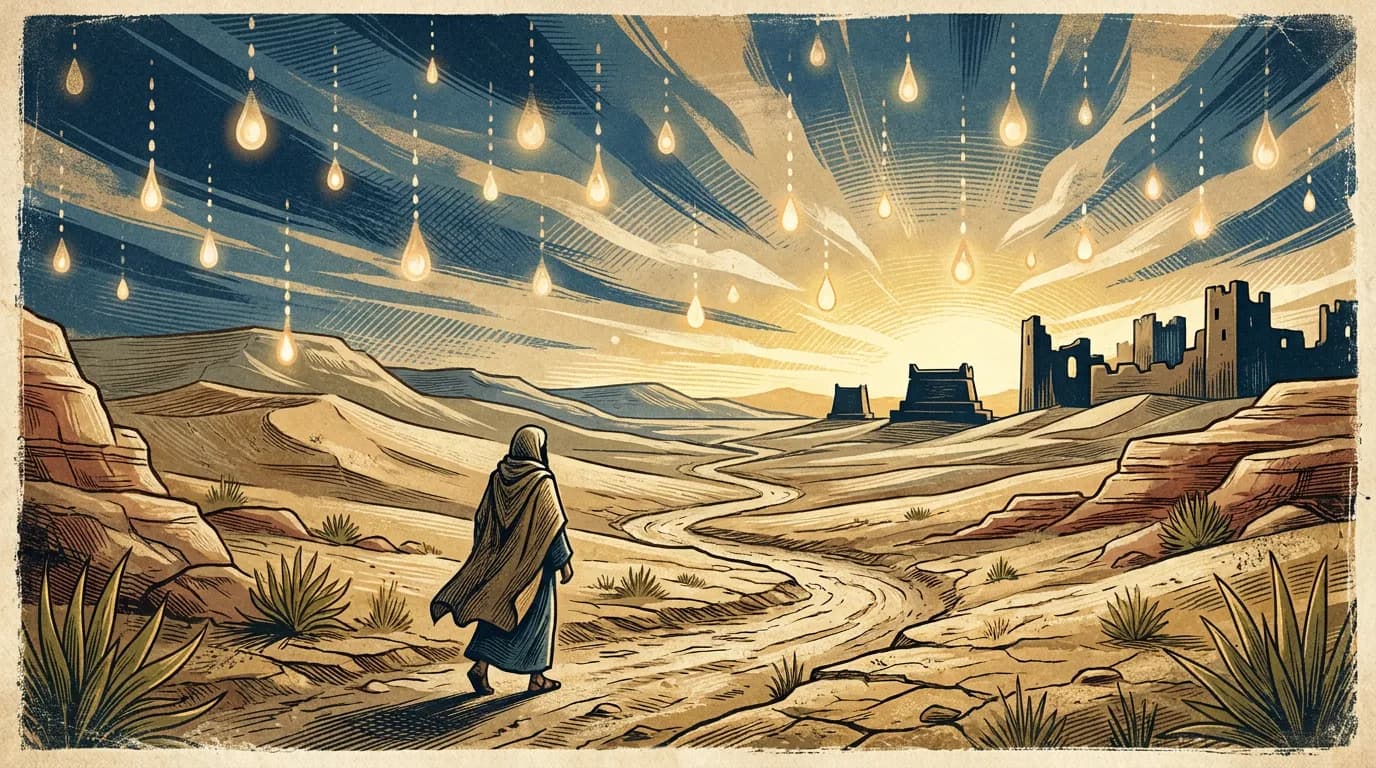
The illustration contrasts the heavy, abandoned monuments of outward sacrifice and war with the quiet, dew-kissed path of walking modestly, doing justice, and loving kindness before God.
Context
This Haftarah is drawn from the book of Micah, one of the twelve minor prophets whose words were spoken to Bnei Yisrael, the people of Israel, in the era of the kings. It is paired with Parashat Balak, since the prophet himself recalls the episode of Balak, king of Moav, and Bilam, who was hired to curse Israel and could only bless them.
The passage moves through two horizons. First it gazes far ahead, to the great war of Gog and Magog and the redemption that follows it. Then it draws close, presenting a kind of courtroom scene in which God Himself sets out His case before Israel, recalling the kindnesses He has done and asking what He requires in return.
Interpretation
The Haftarah Explained
The prophet opens with a vision of the end of days. When Gog and Magog come and Israel suffers great troubles, falling captive among the nations, those who endure will believe in God and in the Mashiach, and their suffering will purify them of sin like pure silver. The remnant that survives will be "like dew from God"—for Israel places its hope in the Holy One alone and not in any human helper, and through this merit they will be redeemed. Yet that same remnant will also be "like a lion among beasts of the wild," for Israel found itself among nations so numerous and so strong that no one could rescue them from their grasp, as a cow caught among lions cannot be saved.
Then the tide turns. God need only raise His hand against the vast nation of Gog and Magog, and they are cut down and destroyed. A great peace follows the war: Israel will no longer need horses for battle, nor walled and fortified cities, for their open towns will be secure. God promises also to remove sorcery from their midst—indeed, to remove the evil inclination itself in the days of the Mashiach—so that there is peace not only from the nations but peace within the body, where the good and evil inclinations once warred. The idols will be cut down, and the nations that did not heed God's commands will be visited with anger and wrath.
Now the scene shifts to judgment. "Hear what God is saying"—God calls Israel to a reckoning, summoning heaven and earth, and the avot and imahot, Avraham, Yitzchak and Yaakov, Sarah, Rivkah, Rachel and Leah, to hear who is in the right. "My people, what have I done to you?" God asks—what wrong, what hardship, what burdensome mitzvot have wearied you of Me? On the contrary: "I brought you up from the land of Egypt," sending Moshe to teach Torah, Aharon to atone for Israel, and Miriam to teach the women.
God continues to recount His kindnesses: remember how Balak sought to have Bilam curse you, and how Bilam was compelled instead to bless you; and remember that even after the sin at Shittim, when Israel deserved destruction, the punishment was lightened. God brought them across the Yarden on dry land and dealt with them only in charity and kindness.
The closing verses raise the great question. With what should a person approach God to find favor—with burnt offerings, with calves a year old, with thousands of rams, with rivers of oil, even with his own firstborn child for his sins? The answer cuts through all of it: God does not desire your flocks and herds or your oil, but that you be faithful and keep His mitzvot—"to do justice," to love kindness and charity, to recognize and love God in your heart, and to walk modestly with your God.
Interpretation
Message
The heart of this Haftarah lies in its final answer. A person might imagine that God's favor must be purchased with grand and costly offerings, even at unthinkable price. But what God truly asks is within reach of every soul: to act justly, to love kindness, and to walk modestly with Him. Our sages explained that walking modestly means escorting the dead to burial and leading a bride to the chuppah—and more inwardly still, that true teshuvah is the quiet regret of the heart, which God accepts even when no other person knows of it.
God recounts every kindness He has shown, and then asks for so little in return: justice, kindness, and a humble walk before Him.