Context
This Haftarah opens the book of Yeshayahu, the prophet in Jerusalem who spoke through the reigns of several kings of Yehudah, the southern kingdom. His words were addressed to Israel and to Jerusalem alike, rebuking the people for their transgressions so that they might turn back and be pious, and so that the holy city would not be destroyed.
Yeshayahu himself descended from Tamar, the daughter-in-law of Yehudah, who was so modest that Yehudah did not recognize her. Our sages teach that a woman who is chaste is worthy that kings and prophets should come from her, and indeed King David and Yeshayahu both descended from Tamar.
The Haftarah Explained
The prophet calls out, "Hear, O heavens, and give ear, O earth." Heaven and earth are summoned as witnesses because they are eternal: a person cannot flee from them, and they will always be found to testify. They are also the very relatives of the human being, for the soul was given from heaven and the body is taken from the earth. There is a difference between Yeshayahu and Moshe: Moshe, who was close to heaven, said to it "understand," while Yeshayahu, being far from heaven, cried out "hear me" — for one who is distant must shout. And the witnesses come to punish first: if Israel sins, the heaven withholds its dew and rain, and the earth refuses to bring forth its yield.
God laments, "I reared children and brought them up." He raised Israel with Torah and good deeds, as one raises a child, and elevated them with His Shekhinah, yet they abandoned His Torah and angered Him. The rebuke sharpens with the ox and the donkey: an animal with no understanding still recognizes the master who feeds it, yet Israel, blessed with every good thing, refuses to recognize its Maker. The root of all this is that they did not want to study Torah. So the animals that know their owner will one day repay the one who did not acknowledge his own Master's goodness.
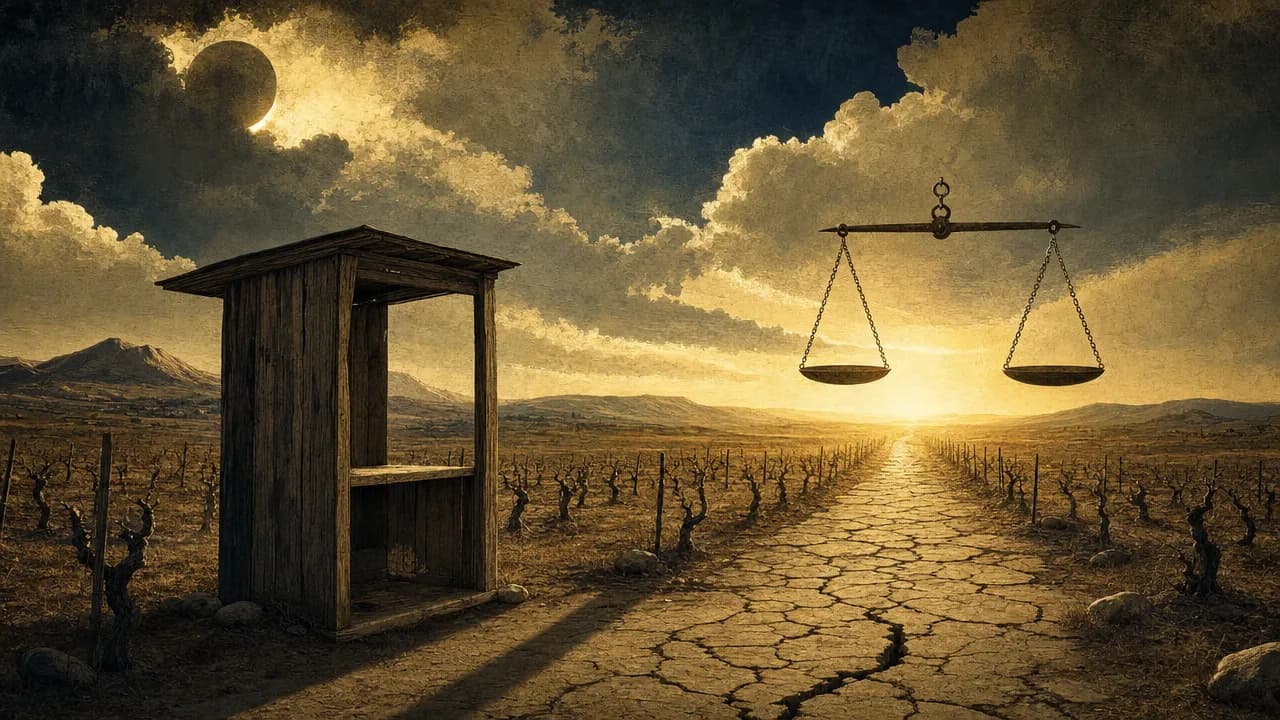
Because Israel would not be pious, the prophet warns that the land will be laid waste and strangers will devour its goods, and Jerusalem will be left "like a booth in a vineyard" — like the hut that stands empty and desolate once the wine has been gathered. Yet the Holy One, who desires Israel below on earth as He desires the angels above, allows a remnant to survive.
Then God asks what the offerings are worth when the heart's intention is not good: "What need have I of all your sacrifices?" Who asked the people to crowd His courts with empty ritual? He calls instead to "wash yourselves clean," to cease doing evil and learn to do good, to uphold the orphan and defend the widow. The faithful city that was once filled with justice — where, our sages say, no one passed a night bearing a sin, since the evening korban forgave the day's failing and the morning korban the night's — has become full of murderers. Her silver has turned false and her wine is cut with water, and her judges take bribes to rule falsely, so that the orphan is not heard and the widow's cause never reaches them.
Message
The prophet's central plea is that recognition of God is measured not by the volume of offerings but by honest justice. A judge who lets gold cover silver, who wears down the poor man until his money is spent before his case is heard, and who leaves the widow to turn away in despair, empties the city of the righteousness that once dwelled in it. But the closing promise remains open: when Israel dispenses proper justice to the poor as to the rich, and gives charity, then "Zion shall be saved in the judgment," and Israel will enter the redeemed city once more.
The animals know their Master; the challenge set before us is to know Him too — and to prove it through justice for the orphan, the widow, and the poor.