The Heel of the Covenant: How Small Duties Hold a Whole Land
As Bnei Yisrael leave miracle behind for a land of rain, the covenant rests on the smallest, most easily neglected acts.
Summary
1 min
This illustration pairs the portable devotion of the tefillin with the daily bread of the wilderness, symbolizing how small, faithful acts sustain the covenant through transition and exile.
On the plains before the Jordan, Moshe addresses a generation about to enter the promised land, and the parashah reads at first like a movement from the grand to the small — from conquering giants to binding little boxes of parchment on the arm. Its argument, though, runs the other way. The opening word, eikev, means the consequence that follows obedience, but it is also the word for heel, and it points to the lighter mitzvot, the commandments a person is tempted to tread over as too minor to bother with. On these, Moshe insists, the whole life in the land depends. The wilderness memory trains the same lesson: the manna, food that could not be stored and had to be received fresh each day, taught a dependence on what God decrees daily rather than gratitude for the dramatic. The danger of a good land, then, is not grand idolatry but the quiet forgetting that comes with full barns. The closing charge seals this by making the commandments portable — tefillin bound on the arm, mezuzah inscribed on the doorpost — declared, even under threat of exile, the survival mechanisms that outlast the land itself.
In the haftarah, drawn from the second half of Yeshayahu, Zion cries that God has forsaken and forgotten her, and God answers with the tenderness of a mother who cannot forget her nursing child. Exile is real but not a final divorce; there is no bill of divorce, only a debt of sin that teshuvah, turning back, can repay.
Generated 07/26/2026
Parashah SynthesisBy topic
Moshe is still speaking, on the plains before the Jordan, to a generation that will cross where their parents could not. What follows is not new law so much as a sustained argument for why the coming life in the land will hang on things they might barely notice.
Synthesis topics
The Autoparashah methodology selected 5 topics to summarize the parashah's sequence.
The reward that follows obedience, and the fear of Canaan's giants
The parashah opens mid-address, with Moshe pressing a promise upon Bnei Yisrael, the people of the covenant. If they listen to and keep the mishpatim, the ordinances just given, then God will keep faith with the oath sworn to the avot: fertility of womb, field, and flock, protection from illness, and victory. The word that governs this opening, eikev, carries the sense of consequence, of what comes on the heel of obedience — a small, easily overlooked word that ties enormous blessing to steady attention. Moshe anticipates the obvious fear: these Canaanite nations are larger and stronger. He answers by pointing backward to Egypt, to the plagues and the outstretched arm they saw with their own eyes, and forward to a gradual conquest, nation by nation, lest the emptied land fill with wild beasts. The section closes with a sharp command: burn the idols, and do not covet the silver and gold upon them, for such spoil is a snare that would make the taker himself something to be destroyed.
Forty years of manna and the discipline of a good land
Moshe then turns the people's memory toward the wilderness. The forty years of wandering were a test, meant to reveal what lay in their hearts. God let them hunger and then fed them with manna, food neither they nor the avot had known, to teach that a person does not live by bread alone but by whatever God decrees. Their clothing did not wear out; their feet did not swell. This was discipline, Moshe says, the way a father disciplines a son. Now they enter a land of streams and wheat and olives and iron-bearing rock, a land where they will eat their fill. Precisely here lies the danger: satisfaction breeds forgetting. When the fine houses are built and the herds and silver have multiplied, the heart may grow proud and say, 'My own strength won this.' Moshe insists they remember that God is the one who gives the power to make wealth, and warns that a forgetting people will perish like the nations before them.
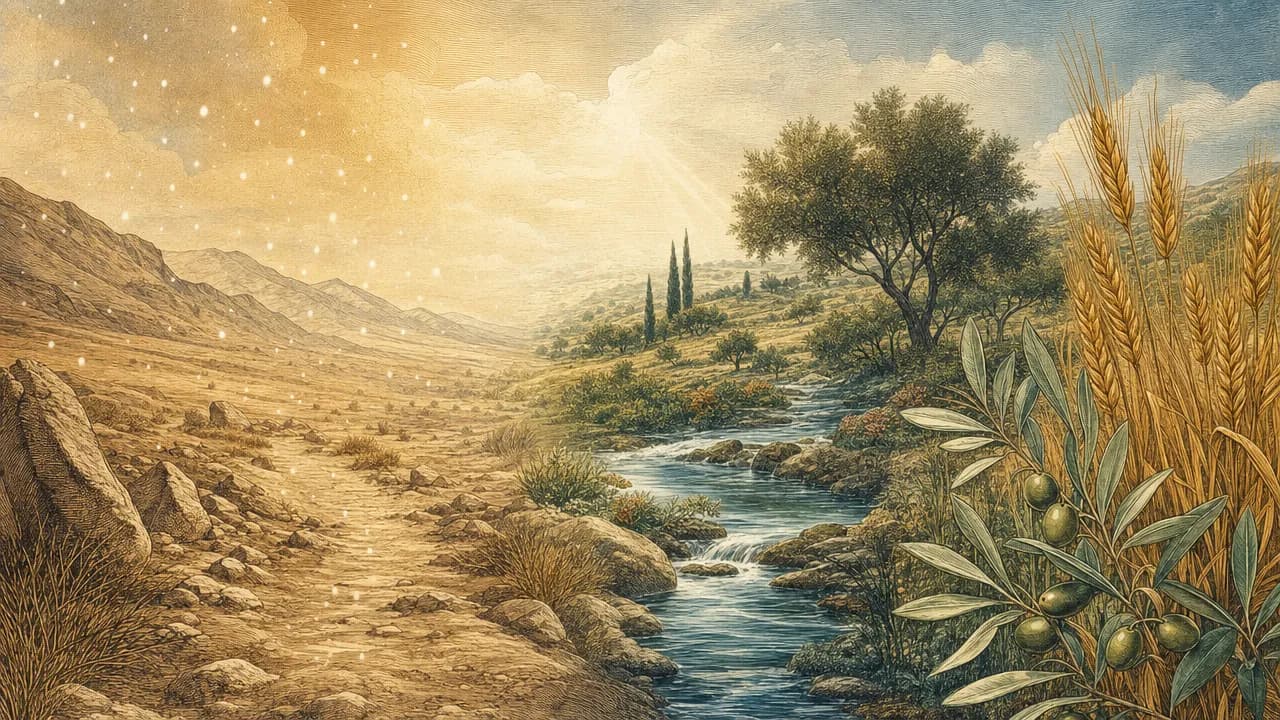
This illustration contrasts the humbling dependence of the wilderness with the material abundance of the Promised Land, warning against the spiritual danger of self-satisfied pride.
Not by your merit: rebellion, the calf, and the second tablets
The third movement confronts self-congratulation directly. As they prepare to dispossess the Anakim, a people of legendary height, Moshe warns them not to imagine the land is a reward for their own righteousness. It is given because of the wickedness of those nations and because of the oath to Avraham, Yitzchak, and Yaakov — and, he adds bluntly, because they are a stiff-necked people. He recounts their rebellions, above all the golden calf at Chorev, where he had gone up for forty days without food or water to receive the tablets and came down to find the molten calf. He smashed the tablets, threw himself down for another forty days of prayer, and interceded until God relented, for the people and for Aharon. He then narrates the second set of tablets, carved at God's command, and the building of an Aron, a wooden chest to house them. A brief itinerary interrupts here, noting Israel's journey and Aharon's death at Moserah — a jarring detour into travel and mourning set inside the account of covenant repair, marking how the loss of a leader unsettled the people even after the tablets were restored. Moshe also records that the tribe of Levi was set apart to carry the Aron and to serve, receiving no land-portion because God himself is their portion.
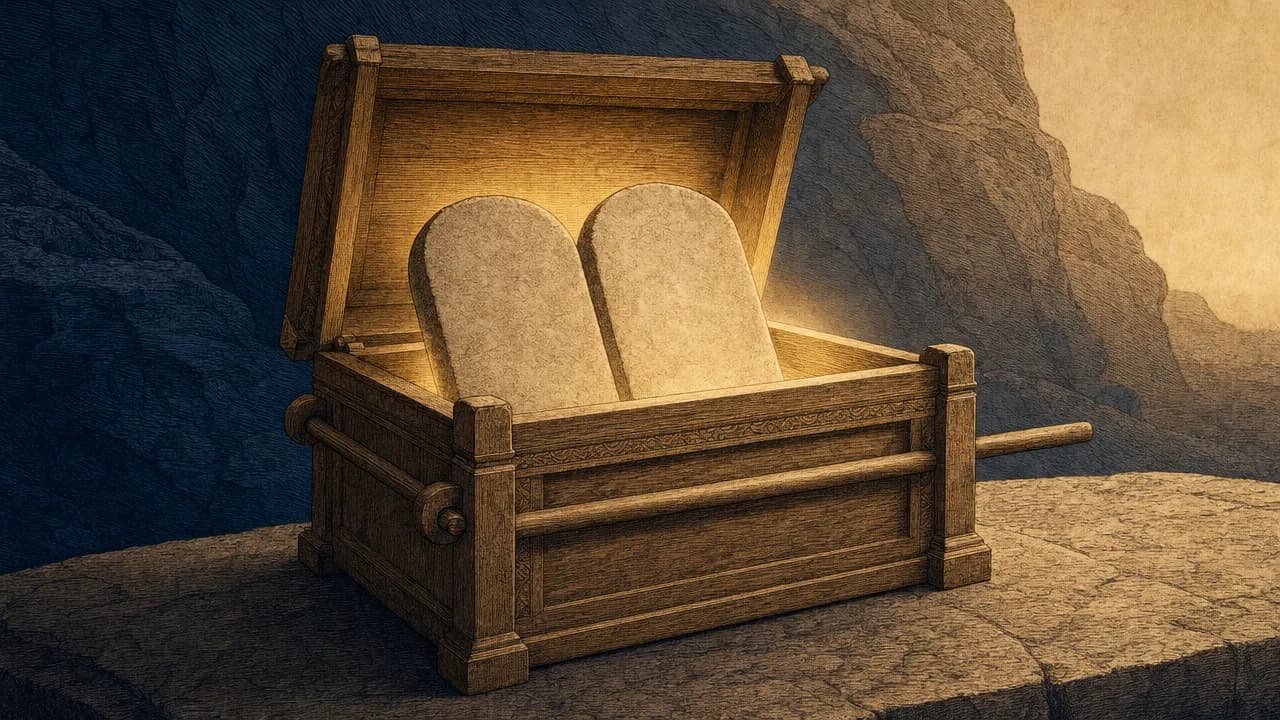
The wooden Ark housing the second set of tablets symbolizes the quiet restoration of the covenant, offering a physical home for divine law after national failure.
What God asks: reverence, love, and the heart's own circumcision
Having reviewed the failures, Moshe distills the demand into its essence: what does God ask? To revere him, to walk in his ways, to love and serve him with all one's heart and soul, and to keep his mitzvot. He calls on them to 'circumcise the foreskin of the heart' — to cut away the hardness that dulls devotion — and to stop being stiff-necked. He describes God as supreme over all powers, who takes no bribe yet defends the orphan, the widow, and the stranger; therefore Israel too must love the stranger, remembering their own strangerhood in Egypt. He recalls that seventy souls went down to Egypt and became a people as numerous as the stars, and he charges this generation especially, since it was they, not their children, who witnessed the great deeds firsthand.
A land of rain, the choice set before them, and words bound close
The final movement describes the land itself. Unlike Egypt, watered by human labor drawing from the Nile, this land drinks from the rain of heaven; God's eye is upon it from year's start to year's end. That very dependence sets the terms of the covenant plainly: obedience and love bring the early and late rains, grain, wine, oil, and grass for the cattle; turning to other gods shuts the sky, ends the harvest, and drives them from the land. Moshe then repeats the charge to set these words on the heart, bind them as tefillin upon hand and between the eyes, teach them to the children, and inscribe them on the doorposts as a mezuzah — so that days may lengthen upon the land. The parashah ends on the sweep of the promise: every place their foot treads will be theirs, from the wilderness to the Lebanon and the great River to the sea, with the dread of them cast over the land.
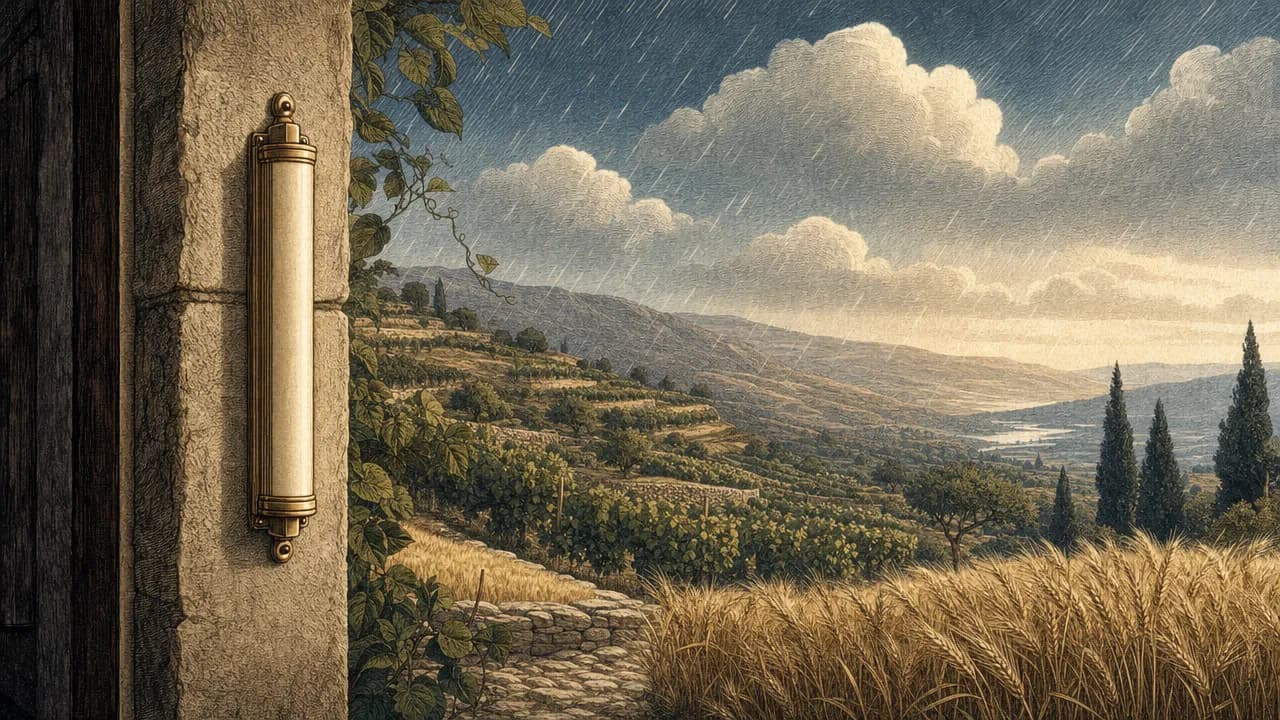
Representing the land's reliance on heavenly rain, this image links agricultural abundance to the internal devotion of keeping the commandments on the heart and doorposts.
Generated 07/26/2026
Analysis axes
They form the central interpretive thread and appear interspersed in the essay below, connecting the parashah's sequence to a unified reading shaped by Rashi.
1.The reward that follows obedience, and the fear of Canaan's giantsוהיה עקב תשמעוןRashi on 7:12
2.Forty years of manna and the discipline of a good landובני ישראל נסעו מבארת בני יעקן מוסרהRashi on 10:6
3.Not by your merit: rebellion, the calf, and the second tabletsלא כארץ מצרים הואRashi on 11:10
4.What God asks: reverence, love, and the heart's own circumcisionושמתם את דבריRashi on 11:18
Interpretive Analysis4 Rashi axes at the turns of the reading
Read straight through, the parashah seems to move from the grand to the small: from conquering giants to binding little boxes on the arm. The deeper structure runs the other way. The whole address is built to argue that the small is where the grand is decided — that the covenant lives or dies not in the spectacular but in the almost-invisible act a person is tempted to step over. The opening word sets this in motion. Eikev means the consequence that follows obedience, but it is also the word for heel, and it points precisely to the lighter mitzvot that a person treads on with his heels, the duties too minor to seem worth the effort. Moshe is not saying the land is won by piety in the abstract. He is saying it hangs on what you are inclined to overlook.
This reframes the wilderness memory that follows. The manna was not merely miraculous food; it was a training in a specific dependence — that life comes 'by whatever God decrees,' received fresh each day, incapable of being stored or mastered. The clothing that did not wear and the feet that did not swell were the same lesson worn on the body. What was being formed over forty years was not gratitude for the dramatic but attentiveness to the daily. And so the warning against pride lands with exact force: the danger of the good land is not that the people will worship idols in some grand apostasy, but that full barns will quietly erase the memory of who fills them. Forgetting is a small act too — a heel-act, performed by inattention rather than rebellion.
The strangest feature of the parashah, its abrupt swerve into travel notes and Aharon's death right in the middle of the covenant's repair, belongs to this same argument rather than interrupting it. Moshe has just described smashing and then re-carving the tablets, the very restoration of the broken bond. Into that account he drops the panic and retreat that followed Aharon's death, equating the loss of a righteous man with the shattering of the tablets themselves. The point is unnerving precisely where we expected reassurance: the tablets can be rewritten, but the people's fragility cannot be re-carved. Restore the object, and a single loss still collapses them backward. The covenant, it turns out, is not secured by the grand artifact in the Aron. It is secured, or endangered, by the steadiness of a people who keep panicking at the edges.
The land's own geography is recruited into the same claim, and here the parashah performs a quiet inversion of what a reader would expect. Egypt, with its Nile drawn up by human labor, is the land of self-sufficiency and predictable abundance — and it is presented as the inferior land. Israel, dependent on rain it cannot summon, exposed to a sky that may shut, is called better precisely because of its vulnerability. You may sleep on your bed while God waters the field, and that is the blessing: not control, but a relationship that must be tended. This is why the covenant's terms are stated as weather. Rain is the daily-renewed manna made agricultural — the same lesson of dependence, now stretched across a whole national economy.
The closing move seals the argument by making the mitzvot portable. Immediately after threatening exile from the land, Moshe repeats the command to bind these words as tefillin and inscribe them as mezuzah — and the repetition is pointed. These are to be kept even in exile, so that they will not feel like novelties when the people return. This is startling: a set of laws we might have read as land-bound civic duties are declared survival mechanisms for landlessness, markers of identity carried across space and time. The heel-mitzvot, the small acts a person steps over, turn out to be the very things that outlast the land itself.
What emerges is a book teaching a generation how to hold a covenant once the miracles stop. The parents lived on open wonder — sea and fire and cloud. This generation is being handed rain, bread, houses, and small boxes of parchment, and told that these unspectacular things now carry the entire weight. Devarim does not lower the stakes by turning from the miraculous to the mundane; it relocates them. The covenant that was written in fire on a mountain is now to be written on doorposts and worn on an arm, kept alive by people who could, at any moment, simply not bother.
The parashah begins with a foot treading on overlooked duties and ends with a foot treading across a promised land — 'every place on which the sole of your foot treads shall be yours.' The same heel that might step past a small mitzvah is the one that inherits the territory. Whether the ground holds may depend on what that foot was willing not to step over.
Generated 07/26/2026
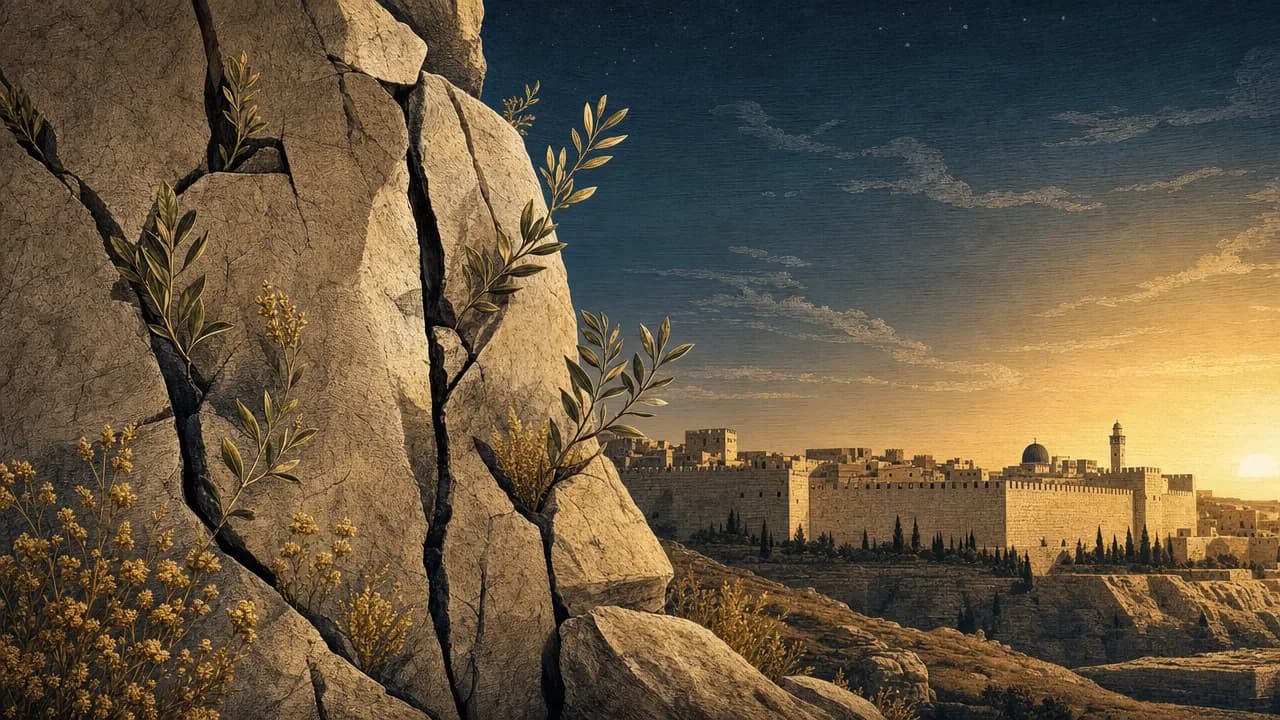
This illustration visualizes the promise of consolation, depicting the barren 'rock' of Israel's ancestry blossoming into a rebuilt Zion, proving that God's covenant is enduring and never forgotten.
Context
This Haftarah comes from the second half of Sefer Yeshayahu, the book of the prophet Yeshayahu, who prophesied in Jerusalem during the era of the Assyrian threat. These chapters look forward past destruction and exile toward consolation, addressing a people who fear they have been cast off forever.
The passage opens with the voice of Zion herself — the city of Jerusalem — lamenting and mourning her children who were driven into a long exile and, she fears, forgotten. What follows is God's answer: a series of reassurances that the exile is neither permanent nor a sign of abandonment, but a temporary condition that will give way to an extraordinary ingathering.
Interpretation
The Haftarah Explained
When Zion says that God has forsaken and forgotten her, the Holy One responds with the image of a mother and her infant. Can a woman forget her nursing baby, whose small child fills all her thoughts, so that she can hardly even eat? And even if some rare woman might forget, God insists, I will never forget you. To make the point unmistakable, He declares that Zion is engraved upon the palms of His hands, so that He sees her and remembers her always, and the devastated walls of the Beit HaMikdash, the Temple in Jerusalem, are ever before Him.
God then turns to the future. The sinful children who caused the house to be destroyed will soon be gone, while Zion's true children come streaming in from every side, so beautiful that she will wear them like a bride wears her jewels. Her ruined and desolate places will one day be so crowded that her returning children will say the city is too tight — move aside a little and let me sit. Astonished, Zion will ask who bore all these for her, since she had been left alone, exiled, and finished; from where did all these come? God answers that He will raise His hand and lift His banner to the nations, who will carry her sons in the folds of their garments and her daughters upon their shoulders back to Jerusalem, while kings and their wives tend and nurse her children and bow low before her.
The nations then object: how could Israel be taken from us, mighty warriors who captured them justly? God replies that He is far stronger than they, that they seized Israel not justly but through robbery, and that He will fight those who fight against His people and make the oppressors consume their own flesh and drink their own blood. He then addresses a deeper fear — that the long exile is a final divorce. Show Me the bill of divorce, God says, or the creditor to whom I sold you. There is none. You were sold only for your sins, and just as sin was the price of your exile, teshuvah, the turning back to God, will be the price of your redemption.
God insists that the delay lies with the people, not with any weakness in Him. He came seeking even one person ready to return and found no one; He called and none responded. Yet His arm is not too short: with a rebuke He dried the Sea of Reeds so Israel could cross, He turned the Jordan to dry ground, and He clothed the very skies in darkness over Egypt. The prophet then speaks in his own voice, telling how God gave him a skilled tongue to reprove the people and woke him each morning to his task. Though he offered his back to those who would beat him and his cheeks to those who would tear his beard, he did not hide his face, for he knew God would help him and he would not be shamed. Those who oppose him will wear away like a moth-eaten garment.
Finally the prophet calls to those who fear God to leave their dark ways and return, warning that those who kindle the fire of God's wrath will lie down in mourning and sickness. He points the people back to their origins: look to the rock you were hewn from — to Avraham and Sarah. Avraham was one, alone and childless when God called him, yet God blessed him and made him many. So too Israel should not despair; as childlessness gave way to abundance for Avraham, exile will give way to redemption.
Interpretation
Message
The heart of this Haftarah is the refusal of divorce. Exile is real and painful, but it is not abandonment and not a final severing; God has no bill of divorce to show, only a debt of sin that teshuvah can repay. The example of Avraham and Sarah seals the promise: the God who turned one childless man into a great nation can surely restore a scattered people. The Sages found this tenderness even in daily life, teaching that when the Holy One comes to the synagogue and finds no minyan, or when a faithful person who came every day is absent, God asks after him with the same care of the mother who cannot forget her child.
Zion is engraved upon God's very hands, never forgotten and never divorced, and the same power that split the sea and made Avraham many stands ready to gather her children home.