When the Earth Opened: How Korach's Revolt Anchored the Kehunah
A localized grudge becomes a national uprising, and the priesthood that survives it emerges anchored in the order of creation itself.
Summary
1 min
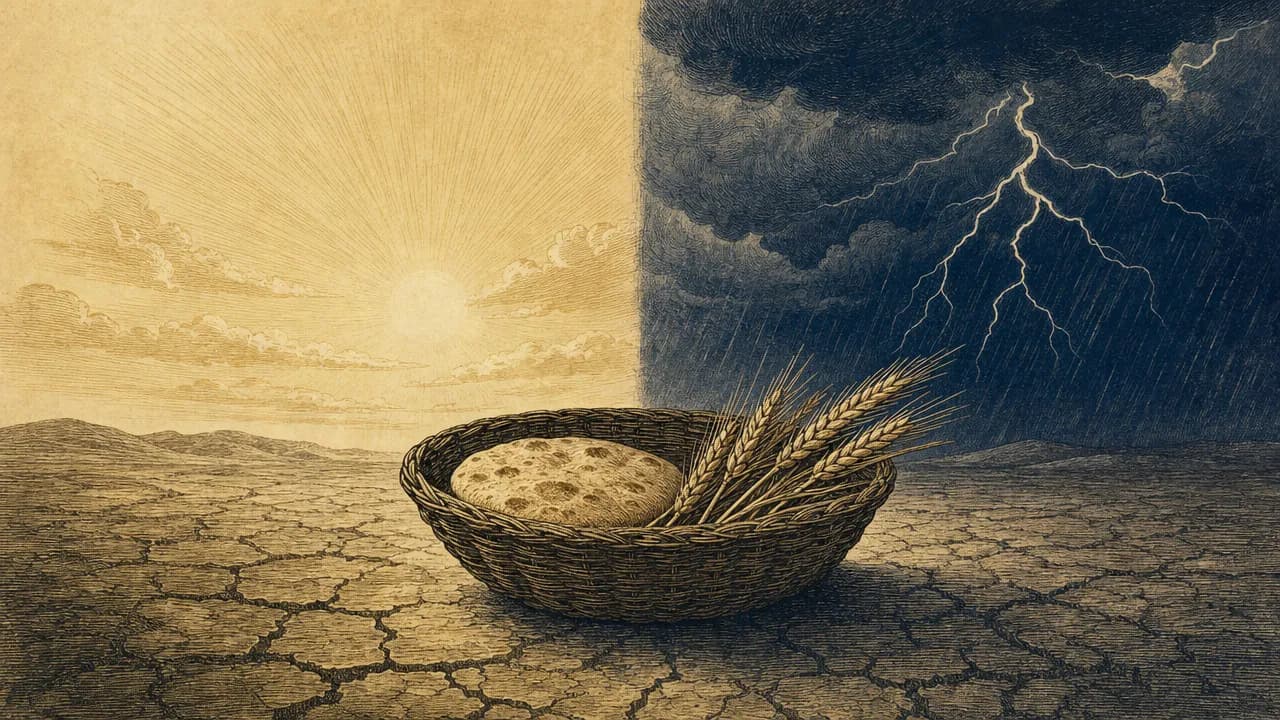
The split sky and sustaining harvest basket symbolize the divine boundaries of leadership, contrasting the destructive desire to take with the life-giving order of sacred stewardship.
Korach's revolt turns on a single reversal that runs from the parashah's first word to its last: it opens with an illegitimate taking and closes with an irrevocable giving. Korach, a Levite already consecrated, seizes for himself the kehunah reserved for Aharon, cloaking his grasp in the language of equality — "all the community are holy." The text withholds his motive, leaving envy over a cousin's elevation and the contagious proximity of disaffected Reuvenites to expose a claim grounded in resentment and adjacency rather than anything that could anchor an office before God. Moshe's answer is the single word morning: the priestly boundary is as fixed as the line between day and night, a feature of creation rather than a social arrangement. The incense proves it — lethal to the two hundred and fifty who chose themselves, saving in Aharon's hands as he halts the plague. The closing inventory of priestly gifts is therefore no appendix but the keystone, converting a perilous boundary into a sustaining presence: the office that opened a chasm in the earth now opens its hands to receive Israel's bread.
In the haftarah, from Sefer Shmuel, the aging prophet steps aside at Shaul's coronation in Gilgal and demands a public reckoning: whose ox or donkey has he taken, whose judgment has he bent. Vindicated as guiltless, he recounts God's kindnesses, rebukes Israel for demanding a king, and summons thunder and rain in the dry harvest season. His message is enduring: though they have sinned, they must not fear, for God will never abandon His people for the sake of His great name.
Generated 06/14/2026
Parashah SynthesisBy topic
The wilderness narrative has settled into a rhythm of law and journey, and then, without warning, the ground beneath the community begins to shake — first with words, then with the earth itself. What follows is a story about who may stand close to the holy, and what happens to those who reach for it uninvited.
Synthesis topics
The Autoparashah methodology selected 5 topics to summarize the parashah's sequence.
The narrative opens with an abrupt act of taking: Korach, a Levite of distinguished lineage, gathers to himself Datan and Aviram and On, men of the tribe of Reuven, along with two hundred and fifty chieftains — men of standing, summoned by name in the assembly. They confront Moshe and Aharon with a charge that sounds almost pious: "You have gone too far, for all the community are holy, every one of them, and Hashem is in their midst. Why then do you raise yourselves above the congregation of Hashem?" Beneath the egalitarian language lies a demand to dissolve the distinction between the kohanim, the priestly servants of the Mishkan, the dwelling-place of God among the people, and everyone else.
Moshe answers with a test set for morning
Korach is a Levite, already set apart for sacred service, yet he reaches for more — the kehunah, the priesthood reserved for Aharon and his sons. His grievance is bound up with rank within his own family: another cousin had been elevated over him to lead the Kehati clan, and resentment found a cause. The Reuvenites joined for reasons of proximity as much as principle; their encampment sat beside Korach's, and discontent spreads to those who dwell nearby. When Moshe hears the accusation he falls on his face, then rises and proposes a test. Korach and his company are to take fire pans, place incense upon them, and bring them before Hashem in the morning; the One whom God chooses will be made known. The delay until morning is itself an argument: just as God fixed the boundary between day and night and no one can overturn it, so the boundaries of the priesthood are fixed and beyond human revision.
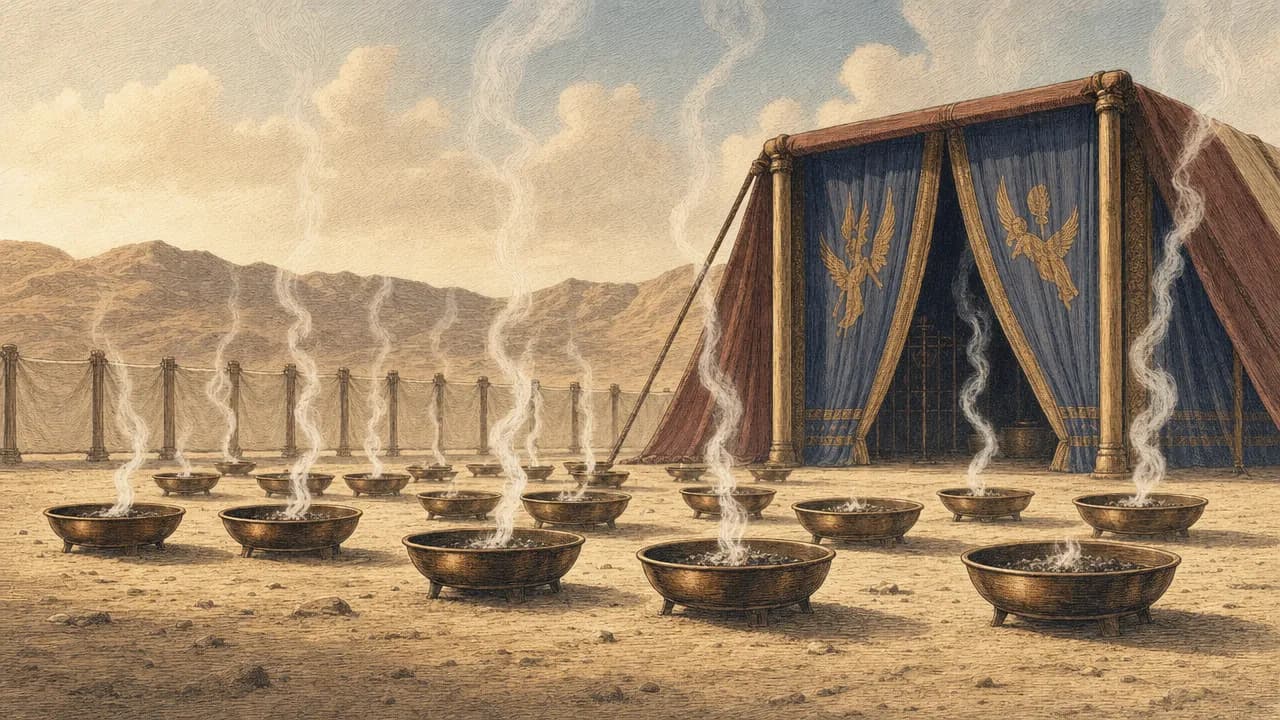
The assembly of identical bronze fire pans represents the human challenge to divine order, testing the boundaries of sacred service before the Mishkan.
The earth and the fire deliver judgment
Moshe summons Datan and Aviram separately, but they refuse insolently, accusing him of having dragged them from a land flowing with milk and honey only to let them die in the desert. The confrontation moves toward its climax at the entrance of the Mishkan, where the two hundred and fifty assemble with their fire pans. The glory of Hashem appears, and God tells Moshe and Aharon to stand apart so that the community may be consumed in an instant. They fall on their faces and plead: "Shall one man sin, and You be angry with the whole congregation?" God relents and instructs the people to withdraw from the tents of Korach, Datan, and Aviram. Moshe declares that if these men die an ordinary death, he was not sent by God — but if the earth opens its mouth and swallows them alive, then they have spurned Hashem. The words barely leave him before the ground splits, swallowing the men, their households, and all that belonged to them, while a fire goes out from before Hashem and consumes the two hundred and fifty who offered the incense.
The people rebel again, and Aharon halts the plague
The fire pans, having been brought before God, retain their sanctity even after their bearers perish. Elazar, Aharon's son, is commanded to gather them and hammer them into plating for the Mizbeach, the altar — a permanent reminder that no outsider may approach to offer incense. Yet the lesson does not take hold. The very next day the whole community turns on Moshe and Aharon: "You have killed the people of Hashem!" A plague breaks out. Moshe tells Aharon to take his fire pan, place incense upon it, and run into the midst of the people to make atonement. Aharon does so, standing between the dead and the living, and the plague is checked — but not before fourteen thousand seven hundred perish. The same incense that had killed the rebels now halts death, proving that the offering itself is neutral: an instrument of God's will, lethal to the presumptuous and saving in the hands of the one truly chosen.
Aharon's staff blossoms and the gifts are granted
To settle the matter beyond further dispute, God commands a final sign. A staff is taken from each of the twelve tribal chieftains, with Aharon's name inscribed on the staff of Levi, and all are placed in the Tent before the Aron HaBrit, the ark of the covenant. By morning Aharon's staff alone has sprouted, blossomed, and borne ripe almonds. The staff is kept as a lasting testimony against rebels. But the people, rather than reassured, are seized with dread: "Behold, we perish, we are lost, everyone who draws near the Mishkan of Hashem dies!" In answer, God turns directly to Aharon and lays out the structure of sacred service — the kohanim guard the sanctuary and the priesthood, the Leviim are given to assist them, and to the priests are granted the twenty-four gifts: portions of the offerings, the first fruits, the firstborn redemptions. Because they receive no portion of land, God Himself is declared their portion, and the Leviim in turn give a tenth of their ma'aser, the tithe of Israel, to the kohanim. The parashah closes with the priesthood not merely vindicated but provisioned, its place in the life of the nation set down as law for all time.
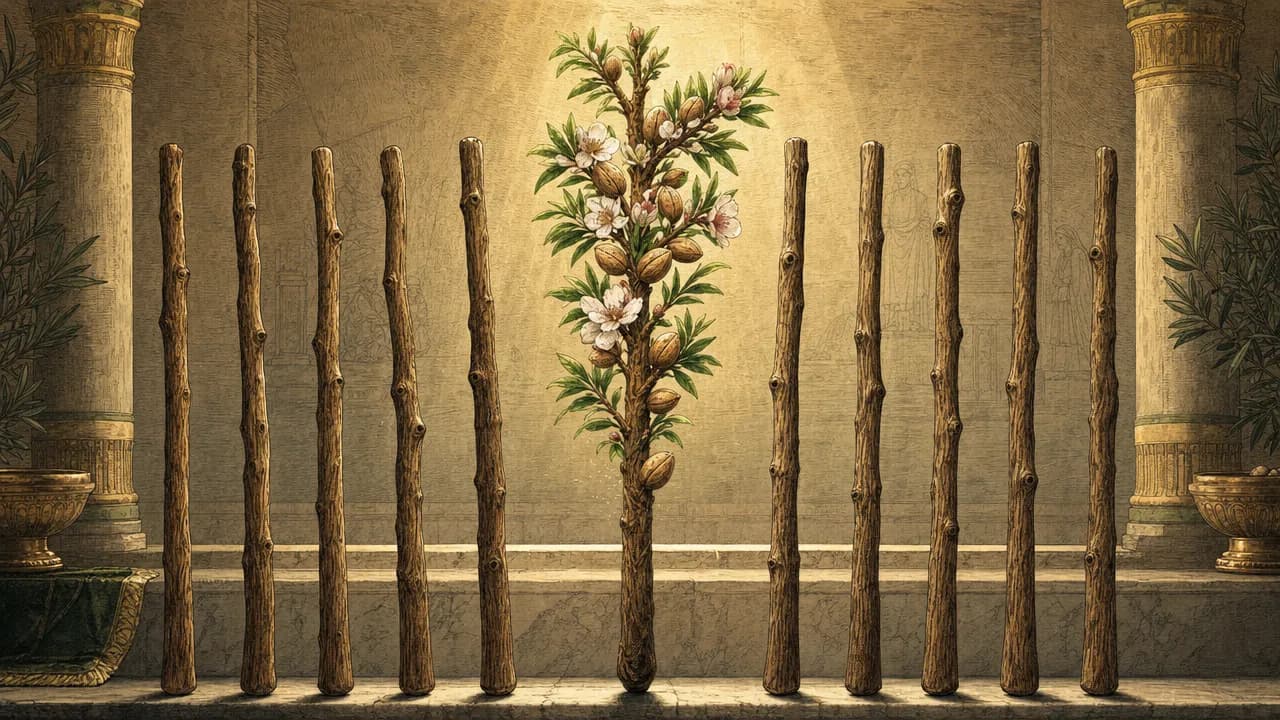
Aharon’s miraculously budding staff stands as a living testament to divine election, transforming a symbol of authority into one of life and fruitfulness.
Generated 06/14/2026
Analysis axes
They form the central interpretive thread and appear interspersed in the essay below, connecting the parashah's sequence to a unified reading shaped by Rashi.
1.A sudden mutiny erupts against Moshe and Aharonודתן ואבירםRashi on 16:1
2.Moshe answers with a test set for morningבקר וידע וגו'Rashi on 16:5
3.The earth and the fire deliver judgmentויעמד בין המתים וגו'Rashi on 17:13
4.The people rebel again, and Aharon halts the plagueואני הנה נתתי לךRashi on 18:8
Interpretive Analysis4 Rashi axes at the turns of the reading
Read the parashah from its first word to its last and a deliberate reversal comes into view: it begins with a taking that is illegitimate and ends with a giving that is irrevocable. Korach "takes" — he seizes for himself a status not granted — and the entire mutiny is an act of grasping at what was never offered. The closing chapter answers in the opposite grammar: "And I, behold, I have given to you." The verb of the rebellion is human appropriation; the verb of the resolution is divine bestowal. The priesthood that survives is precisely the one that did not take but received. This inversion is the spine of the whole, and it explains why a story of fire and earthquake should conclude with what looks like a dry inventory of tithes and portions.
The opening verse withholds the one thing a reader most wants: a motive. We are told who joined Korach and from which tribes, but not why a man already consecrated for the holy work of the Mishkan would risk everything. The silence is filled by what we know of his circumstances — envy over a cousin's elevation within his own Levite clan, and the contagious nearness of disaffected neighbors from Reuven, camped at his side. The point of locating the rebellion in personal grievance and physical proximity is not gossip. It exposes the rebellion's foundation as social and accidental — a matter of who outranked whom and who lived next door. A claim built on resentment and adjacency is a claim built on nothing that could possibly anchor an office before God.
Against that shifting ground Moshe sets a single word: morning. To postpone the contest at the height of a crisis seems almost reckless, until one hears the analogy folded into it. God assigned boundaries in His world; you cannot turn morning into evening, and just so you cannot abolish the line drawn around the priesthood. The dispute is thereby lifted out of the arena of politics, where majorities and reputations matter, and placed in the order of creation, where they do not. Korach argues that holiness is evenly distributed and therefore the distinctions are arbitrary. Moshe answers that the distinction is as fixed as the rotation of day into night — not a social arrangement open to revision but a feature of how the world is built.
The incense carries the argument forward in a way the people themselves force into the open. After the two hundred and fifty are consumed, the community concludes that the incense is a deadly poison and that Aharon and Moshe have weaponized the sanctuary against God's people. The text's answer is devastating in its economy: Aharon takes the identical offering and runs it into the heart of the plague, and where it had killed it now saves. The instrument is shown to be neutral. What determines whether the incense brings death or life is not the substance but the standing of the one who bears it — whether he was chosen or merely chose himself. The crisis of legitimacy and the crisis over the incense turn out to be one crisis, resolved by one demonstration.
This is why the closing list of priestly gifts is not an appendix but the keystone. The people's final cry is not rebellious but terrified: everyone who draws near the Mishkan dies. The danger they had refused to believe in they now believe in too much. The twenty-four gifts answer that terror by converting the priesthood from a perilous boundary into a sustaining presence woven through the ordinary economy of the nation. The kohanim, who hold no land, are fed by the offerings, the first fruits, the firstborn — the people's own produce flowing toward them as a standing covenant of salt, an unbreakable bond. The same office that opened a chasm in the earth now opens its hands to receive Israel's bread.
Bamidbar is a book of the people learning, painfully, what it means to live around the holy in their midst — to camp around it, march behind it, and not be destroyed by it. Korach's revolt is the sharpest test of that lesson, and its resolution refuses the comfortable reading the rebels offered. "All the community are holy" sounds generous, but it would erase the very structure that lets the nation survive proximity to God. The parashah does not soften the priestly boundary in the name of equality; it deepens it, grounds it in creation, proves it with both death and rescue, and finally secures it not as a privilege seized but as a charge given — and provisioned for all time.
The fire pans that the rebels brought before God become plating for the very altar they sought to storm, and the staff that budded is laid up beside the ark as a witness. What was raised against the priesthood is folded into its furniture. One question lingers past the last verse: the people feared the nearness that kills — and were answered with the nearness that feeds.
Generated 06/14/2026
This illustration captures the tension of Israel’s transition to monarchy, where the sudden harvest rain witnesses both the people's straying and God's enduring covenantal presence.
Context
This Haftarah comes from Sefer Shmuel, the book recording the transition of Israel from the era of the Shoftim, the judges who led before Israel had a king, to the age of the monarchy. Shmuel, the last of those judges and the prophet who anointed Israel's first king, stands at the very hinge of that change.
The immediate setting is the coronation of Shaul, the first king of Israel. Many Israelites had earlier scorned Shaul, asking what such a man could do for them. But after he rescued Israel from Nachash, king of Ammon, the people gathered at Gilgal and accepted him as their rightful king, bringing korbanot, offerings of thanksgiving, and rejoicing greatly before God.
Interpretation
The Haftarah Explained
With the monarchy now established, Shmuel addresses the people. He has done their will and given them a king who can lead them; he himself, he says, has grown old and gray. Our sages teach that Shmuel was only fifty-two when he died, but the Holy One made him prematurely gray so that the people would think of him as old. Otherwise they might wonder how so righteous a prophet could die young and assume he had sinned. In truth, Shmuel had prayed to die so as not to witness Shaul's death in his lifetime, and the gray hair was God's response.
Shmuel then makes his great public reckoning: "Here I am. Testify against me." Whose ox have I taken, whose donkey, from whom have I stolen or taken a bribe to bend my judgments? If anyone is ashamed to speak before him, let them tell others, and he will repay everything. The people answer plainly that he has defrauded no one and taken nothing. Shmuel calls upon God and upon King Shaul to bear witness that he has done no injustice — for he is about to remind Israel of their wrongdoing, and it would not be just for a man with evil deeds of his own to rebuke others.
Shmuel recounts God's kindnesses. Yaakov came to Egypt, the people cried out, and God sent Moshe and Aharon to bring Israel from exile into the holy land. When they forgot God, they fell into the hands of Sisera, the Philistines, and Moav; when they cried out and confessed serving foreign gods, God sent deliverers — Gideon, Shimshon, Yiftach, and Shmuel himself — to protect them. Our sages note that Scripture lists these lesser figures alongside the towering Moshe and Aharon, teaching that whoever the Holy One raises over a community is worthy of honor; no judge or leader should be dismissed as insignificant beside those who came before.
Yet when Nachash of Ammon threatened them again, the people demanded a king — though God in Heaven was already their true King. Shmuel tells them that if they revere God and keep His commandments, they and their king will endure before Him forever; if they do not listen, God's hand will strike them. To seal his words, he calls for a sign: though it is the season of the wheat harvest, when rain does not fall, he will pray and God will send thunder and rain. The rain comes, and the people, awestruck, beg Shmuel to pray that they not die for the sin of asking for a king.
Interpretation
Message
Shmuel's reply is the heart of the Haftarah: "Do not fear." Though they have indeed done wrong, they must not turn away from God but serve Him with their whole heart, refusing the worthless idols that can neither help nor protect. For the sake of His great name, God will never abandon His people. When Israel are in exile, the nations claim their God cannot help them; therefore the Holy One redeems them, displaying His strength and His wonders. Outside the land He does not abandon Israel because they are His people; within the land He keeps them for the sake of His holy name.
Even when Israel falters, God's faithfulness holds firm — and so we pray that He will never abandon us, but redeem us with the Mashiach.