From “Go for Yourself” to “And You Shall Keep”: Lech Lecha
Lech Lecha begins with a journey for Avram's own good and ends with that promise kept in his flesh.
Summary
1 min
The covenant matures from a one-sided divine promise into an exacting mutual bond, transforming a journey of personal blessing into the solemn obligation to answer God through active duty.
Lech Lecha follows Avram, later renamed Avraham, from God's command to leave his homeland through twenty-four years of promises, until the covenant is cut into his own flesh. The analysis reads the portion as a promise turned around. It opens with lecha, "for yourself," a journey aimed at Avram's own good, and closes with ve-atah, "and as for you," which ties God's pledges to Avraham's duty. In between, the man who receives everything learns what he may not take. When the herdsmen of Lot, Avram's nephew, graze in other people's fields, a classic midrash has them reason that the land promised to the childless Avram will pass to Lot anyway. The Torah's note that Canaanites still lived there answers that a grant not yet arrived gives no right to a neighbor's field. Later Avram trusts God about offspring but asks how he will know he will possess the land. The analysis reads this as distinguishing a pure gift from a hold on the land that depends on merit. At the end, circumcision attaches a duty even to the gift of offspring. Earlier, in a covenant ceremony, God alone passed between halved animals while Avram slept. Now Avraham must take the knife himself.
In the haftarah, drawn from the prophet Yeshayahu's prophecies of consolation, Israel in long exile complains that God has forgotten them. The prophet answers that God never grows weary. His delay comes from a wisdom beyond human grasp, and He gives strength to those who trust Him. He recalls rousing Avraham from the east to defeat four kings, and tells Israel, Avraham's seed, not to fear.
Generated 10/18/2026
Parashah SynthesisBy topic
A man of seventy-five is told to leave everything familiar for a land no one will name for him yet. Over twenty-four years, through famine, war, quarrels and a long childlessness, he receives promise after promise. This week's reading follows that man, Avram, until his name and his body are both changed.
Synthesis topics
The Autoparashah methodology selected 7 topics to summarize the parashah's sequence.
The parashah opens at the end of a genealogy. Terah, Avram's father, has just died in Haran, a city far to the north, and the family seems to have come to rest. Then, without preface, God speaks. The opening words, lech lecha, literally mean “go, for yourself.” Leave your land, your birthplace and your father's house for a land not yet named. The extra word “for yourself” turns the command toward Avram's own good, and promises follow at once: a great nation, a great name, and a blessing that will reach all the families of the earth. Avram goes. He takes Sarai his wife, his nephew Lot, their wealth and “the persons they had acquired,” the household that had gathered around them.
Altars in Canaan, famine, and Sarai in Pharaoh's palace
In Canaan, Avram passes through Shechem. There God promises the land to his offspring, and Avram builds a mizbeach, an altar, at Shechem and again near Bethel, calling on God's name. The text adds quietly that “the Canaanites were then in the land”: what is promised is not yet possessed. Famine drives Avram down to Egypt. He fears the Egyptians will kill him to take his beautiful wife, so he asks Sarai to say she is his sister. She is taken into Pharaoh's palace and Avram is enriched with flocks and servants. Then God strikes Pharaoh's house with plagues, and Pharaoh returns her and sends them away.
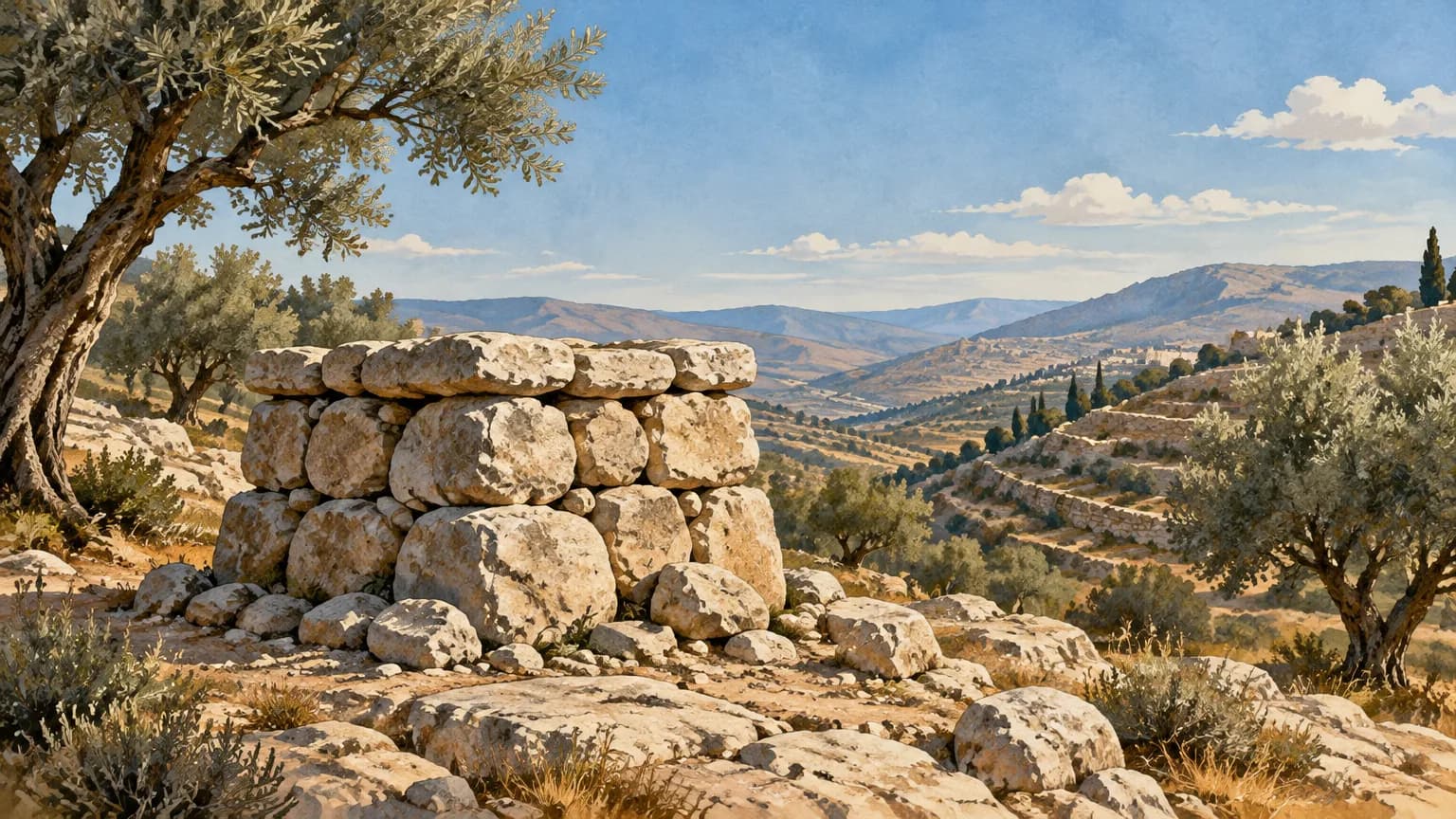
Avram journeys through Canaan and builds stone altars near Shechem and Bethel, calling on the name of God in the land.
Herdsmen quarrel and Lot chooses the plain of Sodom
Back at his first altar near Bethel, Avram finds that he and Lot are now so wealthy the land cannot hold them both, and their herdsmen quarrel. The repeated note that the Canaanites and Perizzites were living there explains the friction. The pastures belonged to others, so grazing freely meant trespassing on fields that were not theirs. Avram proposes that they separate and lets Lot choose first. Lot sees the well-watered Jordan plain, “like the garden of GOD,” and pitches his tents near Sodom, whose people the text at once calls very wicked. Only after Lot leaves does God tell Avram to look in every direction and walk the land's length and breadth, promising him all of it and offspring like the dust of the earth. Avram settles at Mamre, in Hebron.
The war of the kings and the refused sandal strap
Then the wider world breaks in. Four kings from the east crush a revolt of five local kings, plunder Sodom and carry off Lot. Avram musters three hundred eighteen trained men of his household, pursues the invaders north, strikes at night and brings back everyone and everything. Melchizedek, king of Salem and priest of God Most High, meets him with bread and wine and blesses him, and Avram gives him a tenth. The king of Sodom offers Avram the recovered goods. Avram swears he will take neither a thread nor a sandal strap, so that Sodom can never claim to have made him rich. His allies may take their share.
Stars, a question about the land, and the covenant between the pieces
God then tells Avram, “Fear not; your reward shall be very great.” Avram answers that he is childless and his steward Eliezer will inherit. God leads him outside: count the stars, so shall your offspring be. Avram trusts, and God counts it to his merit. When God then promises the land, Avram asks, “How shall I know that I am to possess it?” The question does not undo his trust. The trust concerned offspring, and the question concerns the land. The answer is a covenant ceremony. Avram splits animals and lays the halves opposite each other, then drives off the birds of prey. A deep sleep and a great dread fall on him, and God tells him the future. His descendants will be strangers and slaves for four hundred years, their oppressors will be judged, and they will return in the fourth generation, once “the iniquity of the Amorites” is complete. A smoking oven and a flaming torch pass between the pieces, sealing the grant from the river of Egypt to the Euphrates.
Outside beneath the open night sky, God directs Avram to count the countless stars as the measure of his future offspring.
Hagar's flight and the God who sees
Ten years in Canaan pass without a child. Sarai gives Avram her Egyptian maid Hagar, hoping to be “built up” through her. Hagar conceives and looks down on her mistress. Sarai blames Avram, he leaves the matter in her hands, and she treats Hagar harshly until Hagar flees. An angel finds her at a desert spring and tells her to return. He promises her countless descendants and a son named Yishmael, “God heeds,” who will be a wild, untamed man. Hagar names God El-roi, the God who sees. Avram is eighty-six when Yishmael is born.
New names, the sign of circumcision, and a son still to come
Thirteen years later God appears as El Shaddai and tells Avram to walk before Him and be blameless. Avram becomes Avraham, father of a multitude. God lays out His side of the covenant: nations, kings, an everlasting bond and the land. Then, with “and as for you,” He turns to Avraham's side. Every male must be circumcised, at eight days old in future generations, including slaves, and anyone left uncircumcised is cut off. Sarai becomes Sarah, and a son is promised through her. Avraham falls on his face laughing and pleads for Yishmael. God blesses Yishmael but sets the covenant with Yitzchak, to be born within the year. That same day Avraham circumcises himself, Yishmael and every male of his house. The parashah closes with the sign already in their flesh and the promised son still unborn.
Generated 10/18/2026
Analysis axes
They form the central interpretive thread and appear interspersed in the essay below, connecting the parashah's sequence to a unified reading shaped by Rashi.
1.A sudden command at the end of a family lineלך לךRashi on 12:1
2.Altars in Canaan, famine, and Sarai in Pharaoh's palaceויהי ריבRashi on 13:7
3.Herdsmen quarrel and Lot chooses the plain of Sodomוהאמין בה'Rashi on 15:6
4.The war of the kings and the refused sandal strapואתהRashi on 17:9
Interpretive Analysis3 Rashi axes at the turns of the reading
Two very small words frame this parashah, and they point in opposite directions. It opens with lecha, “for you”: the journey is aimed at Avram's own benefit. The old reading puts it sharply: there you will merit children, and here you will not. It closes with ve-atah, “and you,” whose single connecting letter ties God's pledges to Avraham's duty. The reading I want to propose is a structural inversion. Lech Lecha is the story of a promise being turned around, from something given to Avram into something Avram must keep. Between those two poles, the man who receives everything is taught, again and again, what he may not take. The benefit promised at the start is never withdrawn. It is disciplined.
The quarrel of the herdsmen is where this first becomes visible. The classic midrashic reading gives Lot's shepherds an argument rather than mere greed. They grazed in other people's fields and said: the land was given to Avram, he has no heir, Lot will inherit, so this is not robbery. This is the opening “for you” heard as license, the promise turned into a present entitlement. The Torah's own aside answers them: “the Canaanites and Perizzites were then dwelling in the land.” A grant that has not yet arrived does not make a neighbor's field yours. The sequence of verses then makes the point by itself. The fullest land promise, “raise your eyes… walk about the land,” comes only after Lot has gone, and it comes to the one who refused to take ahead of time. Lot had also raised his eyes. He saw an Egypt-like garden and chose it for himself.
The war of the kings looks like a digression, but it works as a test of that lesson. The same Avram who left Egypt rich “because of her” now has a fair claim to spoils won by his own sword, and he refuses even a sandal strap. His refusal is not self-denial for its own sake. He separates wealth that God brings him from wealth that Sodom could claim to have granted. The covenant scene then extends the principle to God's own conduct. The land is withheld from Avram's descendants because “the iniquity of the Amorites is not yet complete.” Even the divine grant waits until the present inhabitants have lost their moral standing. The land is not seized. It is waited for.
Read this way, the seam between “he put his trust in GOD” and “how shall I know?” stops looking like a lapse of faith. The classic reading draws a line through the scene. Avram asked no sign about offspring, yet he asked about the land, and in its sharper form he meant: tell me by what merit my children will endure in it. Offspring is pure gift, received without condition. Remaining in the land is a different question, one of tenure, and tenure depends on merit. The answer arrives in two parts. One is a covenant of split animals, the very kinds later brought on the Mizbeach. The other is a prophecy of four hundred years of exile, which shows that possession can be suspended. Avram's question was the right one, and its answer is sobering.
Then the inversion completes itself in a place no reader expects. The promise of seed was the one thing Avram accepted without a sign. In the final chapter it receives a sign after all, and Avraham must perform it on the organ of descent itself. God says “As for Me, this is My covenant with you,” and the joining letter of “and as for you” makes the keeping inseparable from the gift. The opening “for you” has become “in your flesh.” The household Avram once carried out of Haran as acquired persons is now marked, slave and son alike, as people under a covenant. They are no longer only possessions.
The parashah refuses two easier readings it seems to invite. One is pure entitlement, the land as an inheritance already in hand, which is exactly the shepherds' theology. The other is a pure contract, in which keeping earns the land and failing forfeits the covenant. In the covenant between the pieces, only the torch and the oven pass between the halves. God walks that covenant alone while Avram sleeps. Yet in the final chapter Avraham must take the knife himself. Bereshit holds both scenes side by side and never collapses one into the other. That is the inheritance each of the avot will receive: a promise that is truly theirs, given on the condition that they never treat it as already theirs to take.
The parashah began with Avram taking “the persons they had acquired” out of Haran, and it ends with every one of them circumcised alongside him. Yitzchak, the son for whom all of this was promised, has still not been born. The covenant has been inscribed before its heir arrives, and the next reading must show what it means to receive a son on those terms.
Rashi's Axes
The four threads structuring this week's reading
Wording choice
לך לך
Rashi on Bereshit 12:1
Noting the seemingly redundant reflexive preposition 'to you' (lecha) following the command 'go' (lech), Rashi explains that God directs Abram to leave his homeland for his own benefit and good, where alone he will be granted offspring and spiritual renown.
Right after the genealogy of Terah concludes with Terah's death in Haran, the narrative abruptly introduces God's imperative summoning Abram to abandon his birthplace for an unspecified destination. Because an absolute divine call would standardly demand selfless submission, Rashi's insistence that this rupture is commanded for Abram's personal benefit creates an immediate tension between pious self-renunciation and self-realization. The journey of faith begins by questioning whether Abram's obedience is an act of blind self-abnegation or the indispensable pathway toward his own flourishing.
Generated 10/18/2026
By pairing the unwearied ascent of the eagle with the windblown threshing of desolate stone, the prophet reminds a tired exile that divine renewal outlasts the hollow might of towering empires.
Context
This Haftarah comes from the book of Yeshayahu, prophet in Jerusalem during the Assyrian threat. In these later chapters his words reach beyond his own generation to a people sunk in long exile. The section opens the great prophecies of consolation that follow the cry "Comfort, comfort My people." The prophet speaks to Bnei Yisrael at a moment when the suffering has gone on so long that faith itself has grown tired.
It is read alongside Parashat Lech Lecha, and the connection is unmistakable. At its heart stands Avraham, called out from the east, victorious over kings, named by God "My friend." What God did for the father, the prophet insists, He will do for the children.
Interpretation
The Haftarah Explained
The prophet begins by repeating Israel's own complaint: "My way is hid from GOD." The exile has lasted so long, they say, and the judgment due to the nations who tormented them has never come. God answers with a question of His own: "Do you not know? Have you not heard?" Your own understanding should tell you, and if it falls short, the sages have taught you, that God created the whole world and judges it truly. He "never grows faint or weary," so it cannot be that He lacks the strength to act. If He delays, it is because "His wisdom cannot be fathomed." We cannot grasp His reasons, but He knows them well.
Meanwhile He "gives strength to the weary," sustaining Israel through the hardship of exile. The "youths" who stumble are the nations, strong as young men, whose strength will be taken from them. But those who trust in God "shall renew their strength as eagles grow new plumes." Just as the eagle renews its feathers again and again, Israel will be strong and will not tire.
God then summons the nations to court: "Stand silent before Me, coastlands." Let them listen, gather their arguments, and then speak. He offers His own testimony: "Who has roused a victor from the east?" It was God who awakened Avraham to leave Aram, a house of idols, and who made him fearless before kings. With a handful of men Avraham defeated four kings. When Eliezer, Avraham's faithful servant, was asked how, he answered that the dust his master threw became swords and the straw became arrows. Avraham pursued his enemies along a road he had never traveled and came home in peace. The Sages also read the verse as speaking of Avraham's mazal, his astrological fortune, and taught that God Himself turned it, for Israel is not bound by the stars. "Who has wrought and achieved this?" Only God, first and last, who will stand by Avraham's children at the end of days as well.
The nations saw these wonders and trembled, yet they did not turn to God. Instead they urged one another on: "Take courage!" The woodworker hurries the smith, the smith beats the metal thin to plate the wooden idol, pronounces the joint "good," and nails it fast so it will not topple.
"But you, Israel, My servant" are not like them. You are the seed of Avraham, who came to know God through love. God chose you from among nobles and kings and did not reject you as He rejected Eisav. "Fear not, for I am with you." Your enemies will vanish so completely that you will search for them and not find them. "Fear not, O worm Jacob." A worm's strength lies in its mouth, and so does Israel's, in Torah study and in prayer. Israel will become "a new thresher, with many spikes," grinding mighty nations like mountains into chaff for the wind to scatter.
Interpretation
Message
The Haftarah answers despair not with argument alone but with memory. The God who created the world, who lifted Avraham out of idolatry and gave him victory against all odds, has not grown tired. His delays belong to a wisdom beyond our reach, and His strength flows to those who wait for Him. The Sages compared this to wheat and straw quarreling over whom the field was sown for. The wheat simply answered that threshing time would tell. When it came, the straw blew away and the grain was gathered in.
The nations may claim the field, but threshing time will come, and Israel will "rejoice in GOD, and glory in the Holy One of Israel."