Context
This Haftarah is drawn from the later chapters of Yeshayahu, the prophet who spoke in Jerusalem in the era of the Assyrian threat, and whose words reach far beyond his own generation to the exile and the redemption that follows it. It is the seventh and final of the shiv'ah d'nechemta, the seven haftarot of comfort read between Tishah B'Av and Rosh Hashanah, and it is read on the Shabbat of Nitzavim, at the very edge of the new year.
The chapters here are spoken to a Jerusalem that lies desolate and to a people scattered among the nations. The prophet's voice moves back and forth between the city speaking of her own joy, God speaking of His refusal to keep silent, and a vision of the Holy One returning from battle against the nations. Everything in the passage looks toward the days of the Mashiach, the anointed king who will gather in the exiles.
The Haftarah Explained
The Haftarah opens with the voice of Jerusalem and of Israel together: "I greatly rejoice in God." We rejoice in the Holy One when we go out from exile, for He has clothed us in garments of salvation and a robe of righteousness — His lovingkindness, which is compared to a fine garment. He has robed us in honor "like a bridegroom adorned with a turban," like a kohen dressed in his beautiful vestments, like a groom in his finest clothes. Then the prophet compares redemption to a seed. A man throws seed into the ground and sometimes despairs of it, certain it has been lost in the earth — and so Israel were scattered and seemingly lost in exile for long generations. But the seed sprouts. So Israel in the days of the Mashiach will be like a garden that has been sown, and God will make righteousness and love grow up before all the nations.
"For the sake of Zion I will not be silent." Israel are in exile on account of God's own city, and He declares that He Himself wishes to redeem them and will not hold His peace. Her righteousness will go forth like light, her salvation like a burning torch seen from far off; the nations will see her justice and the kings her glory, and she will be given a new name that God Himself will make known. She will be a crown of beauty in His hand, strengthened by Him always. No longer will her land be called forsaken or desolate. A ruined land empty of people is like a woman with no husband — and therefore her land will be espoused, for the Holy One desires her. And just as a young man is a fitter match for a young woman than an old man, so it was that when the nations dwelt in the land it was like an old man taking a maiden; when Israel return to their land, it will be a youth espousing a maiden, and God will rejoice over her as a bridegroom over his bride.
Upon the walls God sets watchmen — angels who plead that He rebuild Jerusalem. Unlike ordinary guards who watch by day and sleep at night, these never fall silent, for the meaning is that the Holy One places His own supervision over the city. And the exiles too are addressed: do not sleep and do not be still; keep praying and praising until the walls and the city are established. God swears by His right hand that strangers will no longer eat the grain and drink the wine for which Israel labored. Those who harvest and gather will themselves eat and drink and praise Him in His sacred courts — the tithes and the fruits of the fourth year, which are eaten in Yerushalayim.
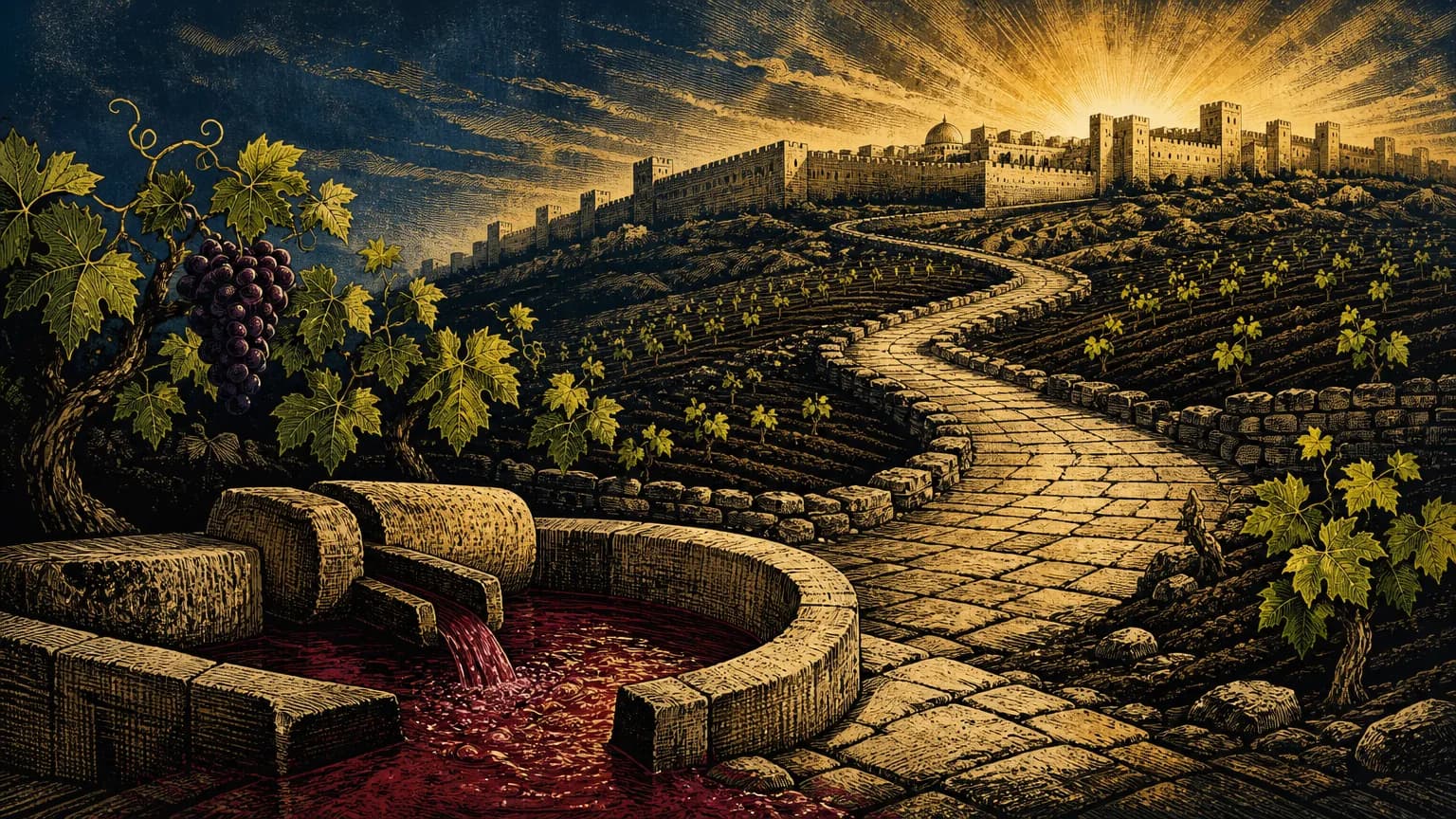
Then the road is prepared: pass through from city to city, clear the path by which Israel will travel to Jerusalem, raise the banner high so that all Israel scattered among the cities can see it. God proclaims to the ends of the earth that the Mashiach is coming, and the reward He has prepared is with Him — payment for all the suffering Israel bore in exile for His name. Finally the prophet sees the Holy One as a mighty warrior returning from Edom, from the great city of Bozrah, His garments stained red with the blood of those He has struck down. The nations are like grapes in a winepress: "I trod out a vintage alone." No merit of Israel's accomplished this, and no nation stood at His side; He looked and found none to help Israel, and His own arm and His own wrath against the nations wrought the victory. The Haftarah closes gently — the prophet recalling God's kindnesses, His declaration that Israel are His people who will not deal falsely, and the assurance that Israel's troubles are loathsome to Him, that He redeemed them in love and pity and raised them up all the days of old.
Message
There is a parable about a queen whose husband, son, and son-in-law all traveled to a distant land. Word comes that her son is returning, and she says: let my daughter-in-law rejoice. Word comes that her son-in-law is returning: let my daughter rejoice. But when she is told that her husband is coming home, she says — now the joy is complete. So the prophets said to Jerusalem, your children are coming from afar, and she answered, let Mount Zion rejoice. Your daughters are coming: let the daughters of Yehudah exult. But when the prophets said, your King is coming, she said, now my joy is full: "I greatly rejoice in God."
That is the note on which the seven weeks of consolation end. The return of the exiles, the rebuilding of the walls, the harvests eaten by those who planted them — all of these are real and promised. Yet the deepest joy of this Haftarah is not in any single gift but in the Giver: a Jerusalem crowned in God's own hand, a land espoused because He desires her, and a redemption He insists on accomplishing Himself, refusing to keep silent for Zion's sake.
Israel entered these seven weeks in mourning and leaves them dressed as a bride. The comfort is not merely that the exile ends, but that the One who ends it is coming Himself.