From the Spear to the Census: How Israel Learns to Endure
A violent moment of zeal gives way to censuses, inheritance law, succession, and a fixed calendar of offerings that outlast any single leader.
Summary
1 min
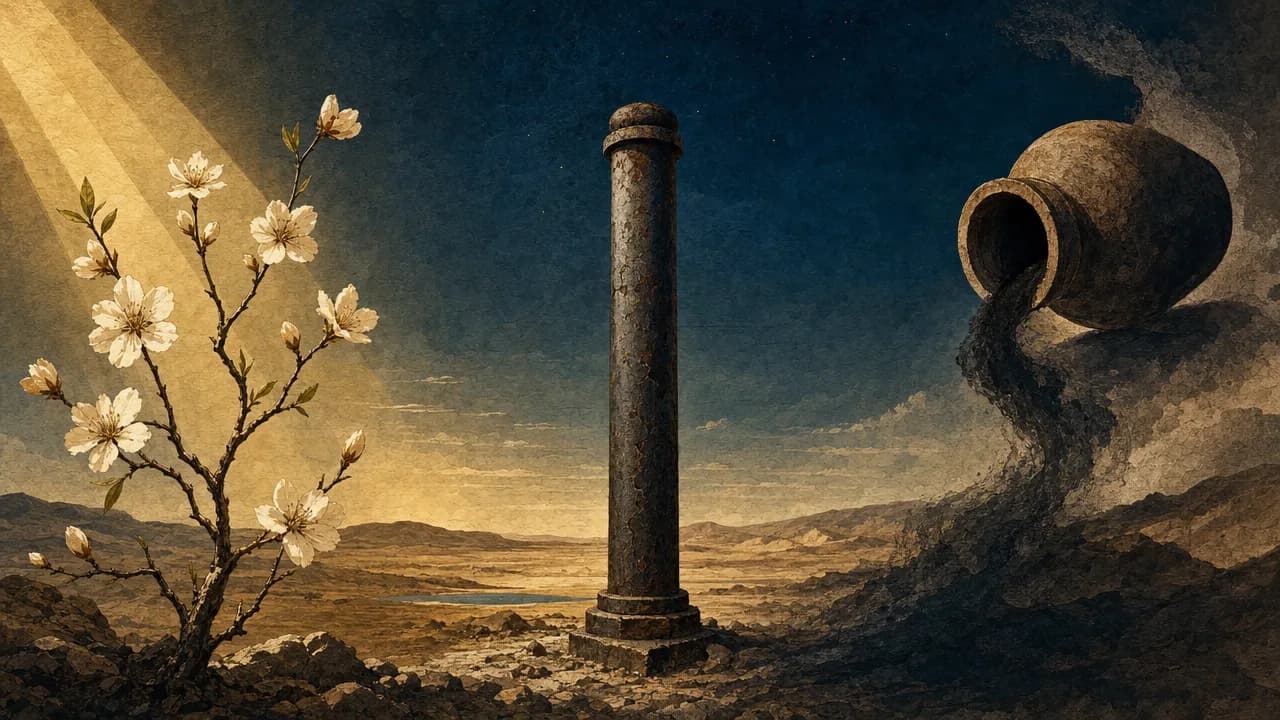
The image contrasts the enduring, structured stone of communal ritual with the organic bloom of prophetic calling, illustrating how Israel's devotion transitions from individual zeal to institutional continuity.
Opening just after a plague that struck Bnei Yisrael for idolatry with the women of Midian, the parashah moves from a single violent act to a fixed calendar of communal service, and the reading argues that this descent from the personal to the institutional is its real subject — how Israel learns to endure without depending on the next hero. It begins with Pinchas, grandson of Aharon the kohen, who halted the plague with a spear and is rewarded not with license for further zeal but with a covenant of peace and a permanent place in the priesthood; his genealogy quietly folds raw passion into a stable office, and afterward he vanishes from the page. The same logic governs the daughters of Tzelophchad, five sisters who, after a census closes the generation that died in the wilderness, demand a portion in the Land and reshape inheritance law through their attachment to it; and Yehoshua, appointed successor with deliberately diminished authority, bound to the kohen rather than speaking with God directly. The closing schedule of daily and seasonal offerings is the resolution: devotion secured in unglamorous repetition that no leader's death can interrupt.
In the haftarah, which opens the book of the prophet Yirmiyahu, God consecrates him before birth and, dismissing his protest that he is only a boy, places divine words in his mouth. Two visions — an almond branch and a tipping pot — promise swift judgment from the north, yet the passage closes by recalling Israel's youthful devotion and enduring holiness.
Generated 06/28/2026
Parashah SynthesisBy topic
The parashah opens in the immediate aftermath of catastrophe and arrives, by its close, at a quiet and orderly rhythm of daily and seasonal service. Between those two points stands an entire generation poised at the edge of the Land it will finally enter.
Synthesis topics
The Autoparashah methodology selected 5 topics to summarize the parashah's sequence.
A plague has just torn through Bnei Yisrael, the people of Israel, after they were drawn into idolatry and immorality with the women of Midian. A single man, Pinchas, the grandson of Aharon the kohen, has taken a spear and killed an Israelite chieftain and the Midianite woman with him, and the plague has stopped. The parashah begins with God's response to that act. Pinchas is named with his full lineage — son of Elazar, son of Aharon the kohen — and is granted a covenant of peace and an eternal pact of priesthood, because he acted out of zeal for God and turned divine wrath away from the people. The text also identifies by name the two who were killed, Zimri and Cozbi, and then commands Moshe to treat the Midianites as enemies, for they had deliberately led Israel astray in the affair of Peor.
Counting a new generation for the Land
Once the plague is over, God commands Moshe and Elazar the kohen to take a census of all the men from twenty years old and up who can bear arms. What follows is a long, careful tribe-by-tribe tally, clan by clan, with totals for each tribe and a grand total of 601,730. Woven into the lists are brief reminders of the past: the sons of Korach, who rebelled, did not die; Datan and Aviram were swallowed by the earth. The point of this counting is practical and forward-looking — the Land is about to be divided, and the text states the principle plainly: larger tribes receive a larger portion and smaller tribes a smaller one, with the allotment also decided by lot. The Leviim are counted separately, since they receive no territorial inheritance. The list closes with a striking note: not one man counted here had been counted in the earlier wilderness census, except Yehoshua and Calev, for the generation that left Egypt had died in the wilderness as decreed.
The census and the casting of lots prepare the new generation of Israel to transition from wandering to inheriting their designated portions of the Promised Land.
The daughters of Tzelophchad claim their father's portion
Out of this transition steps a specific case. Five sisters — Machlah, Noah, Choglah, Milcah, and Tirtzah, the daughters of a man named Tzelophchad — come before Moshe, Elazar, the chieftains, and the whole assembly. Their father died in the wilderness, they explain, not as part of Korach's rebellion but for his own sin, and he left no sons. They ask not to let his name be lost and request a holding of land among their father's kinsmen. Moshe brings their case before God, who declares their plea just: the daughters shall inherit. From this case God establishes a general order of inheritance — to a son, and if there is none to a daughter, then to brothers, then to the father's brothers, then to the nearest relative — fixing it as binding law for Israel.
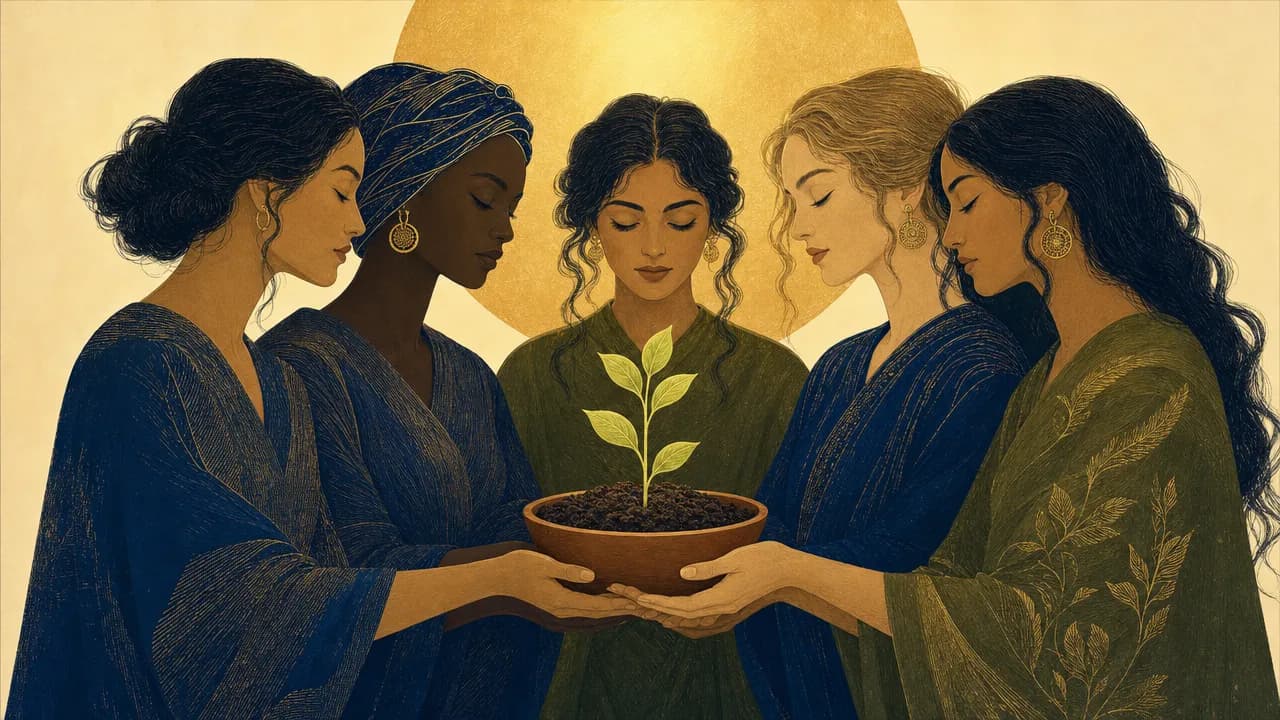
By courageously claiming their father's inheritance, the five daughters of Tzelophchad establish a landmark precedent of justice, ensuring their family's legacy remains rooted in the land.
Moshe sees the Land and secures a successor
God then tells Moshe to ascend the heights of Avarim to see the Land he will not enter, reminding him that at the waters of Merivah he had failed to sanctify God before the people. Rather than protest, Moshe turns immediately to the future of the nation. He asks God to appoint a man over the community who will lead them out and bring them in, so that Israel will not be like sheep without a shepherd. God designates Yehoshua, a man of spirit, and instructs Moshe to lay his hand upon him, to stand him before Elazar and the whole assembly, and to invest him with some of his own authority so the people will obey. Yehoshua's leadership is now bound to the kohen, who will seek guidance through the Urim. Moshe does exactly as commanded.
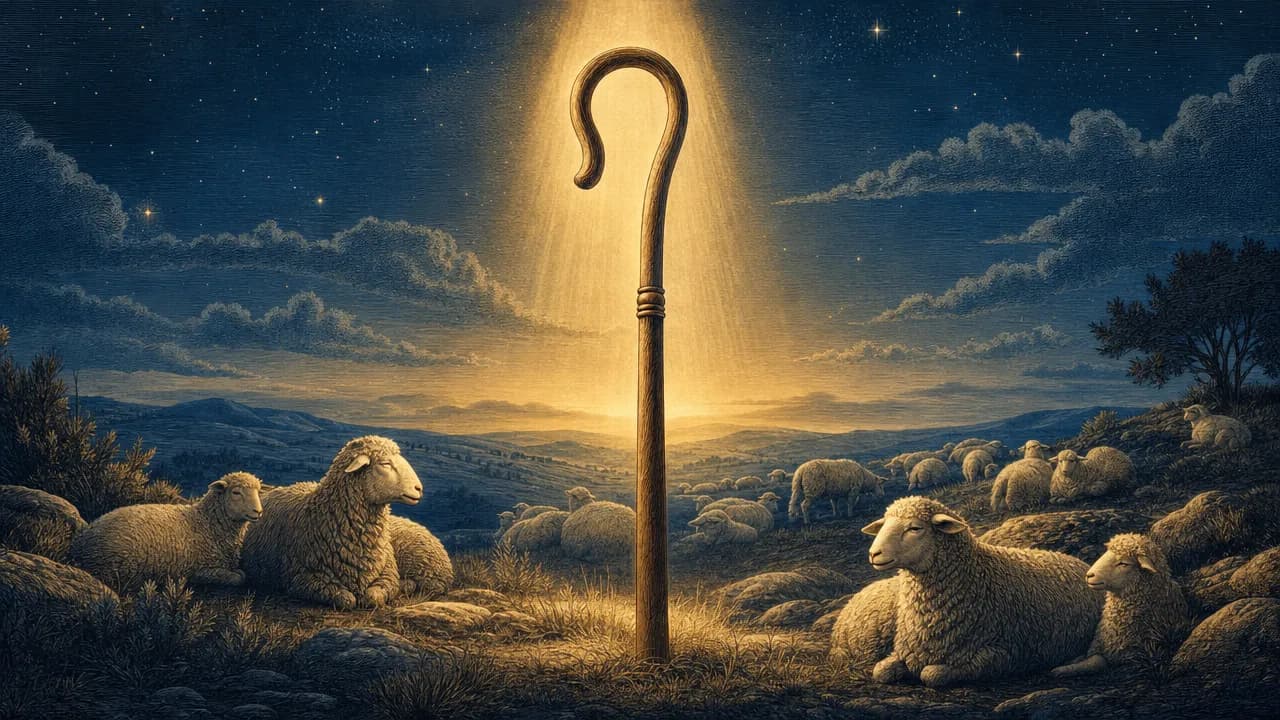
The appointment of Joshua as leader ensures that Israel will transition smoothly into the future, guided by a dedicated shepherd who will care for the community.
The fixed calendar of communal offerings
The parashah then turns, with no narrative bridge, to a detailed schedule of communal korbanot, the offerings brought on the nation's behalf. It begins with the daily olah — two lambs, one in the morning and one toward evening, each with its grain offering and wine libation. From there it builds outward in widening circles of time: the added offerings of Shabbat, the offerings of Rosh Chodesh with its bulls, ram, lambs, and a goat for a chatat, an offering that clears wrongdoing. Then come the festivals in order — Pesach with its week of matzah, the day of first fruits that is Shavuot, the first of the seventh month when the shofar is sounded, the fast of Yom Kippur, and the seven days of Sukkot with their descending count of bulls, followed by the eighth day's solemn gathering. The parashah ends quietly: Moshe spoke to Bnei Yisrael exactly as God had commanded him.
Generated 06/28/2026
Analysis axes
They form the central interpretive thread and appear interspersed in the essay below, connecting the parashah's sequence to a unified reading shaped by Rashi.
1.A covenant of peace after the plagueפינחס בן אלעזר בן אהרן הכהןRashi on 25:11
2.Counting a new generation for the Landובאלה לא היה איש וגו'Rashi on 26:64
3.The daughters of Tzelophchad claim their father's portionיפקד ה'Rashi on 27:16
4.Moshe sees the Land and secures a successorצו את בני ישראלRashi on 28:2
Interpretive Analysis4 Rashi axes at the turns of the reading
Read once through, the parashah looks like a sequence of unrelated units — a reward, a census, a lawsuit, a succession, a sacrificial calendar. The deeper movement is a single deliberate descent: the parashah opens with the most individual act imaginable, one man with a spear, and closes with the most impersonal possible institution, a calendar of offerings that runs whether or not any particular person is present to feel zeal. The text is teaching Israel how charisma becomes continuity — how the energy of a single moment is converted into structures that will outlast every actor in the story.
The first hinge is hidden in Pinchas's own name. Scripture does not merely call him a zealous man; it carefully traces him back through Elazar to Aharon the kohen. The genealogy answers something unspoken — the tribes had been mocking Pinchas, sneering that this grandson of an idol-priest on his mother's side had spilled blood. By tying him explicitly to Aharon, the lover of peace, the text makes a claim about institutions: raw passion is not rejected, but it is only legitimated when it can be located inside a lineage of peace. Pinchas's reward is not more license for zeal but a covenant of peace and a permanent place in the priesthood. The violent act is absorbed into a stable office, which is precisely how the parashah will treat every other charged moment that follows.
The census carries the same logic at the scale of a whole generation. Its closing line — that not one man counted here remained from the earlier count — marks the death of the generation that refused the Land. Yet the very next scene is five women stepping forward to demand a portion in it. The contrast is exact and intended: the men who were counted to enter had once wept to return to Egypt, while these daughters press to be included in an inheritance their father never lived to claim. Their love for the Land is what reshapes the law. The transition from wilderness to Land is not only a change of generation but a change in who carries the people's attachment to its inheritance, and the legal order of inheritance itself is born from that attachment rather than imposed from above.
Moshe's request for a successor exposes the same tension between person and structure from the inside. When he asks God to appoint a man over the community, there is a quiet personal hope folded into the petition — that his own sons might inherit his greatness. The answer redirects him entirely: leadership passes not by blood but to Yehoshua, who had served devotedly in the Tent. And the office Yehoshua receives is deliberately diminished from Moshe's own. He does not speak with God face to face; he stands before Elazar the kohen, who inquires through the Urim. Even the supreme leader is now folded into a system of checks, his authority shared with the priesthood. Continuity is purchased at the price of singularity.
This is why the sacrificial calendar, which seems like an abrupt change of subject, is in fact the resolution the whole parashah has been building toward. When God tells Moshe to command Israel about the offerings, the wording turns Moshe's own concern back on the people: instead of asking Me to provide for My children, command My children to provide for Me. Moshe, facing death, had worried about who would lead the sheep; the answer is a daily, decentralized act of devotion that does not depend on the shepherd at all. The lamb of the morning and the lamb of the evening are brought by the community in every generation, in a fixed rhythm widening from day to Shabbat to month to year. The relationship with God is secured not in the heroic individual but in the unglamorous repetition that no death can interrupt.
What the parashah refuses to say is as telling as what it says. After the covenant given to Pinchas, the zealot vanishes from the page; he is never asked to act again. The text declines to build the future on men who can summon decisive passion at the right moment, because such men cannot be guaranteed to the next generation. Instead it builds on what can be guaranteed — counted tribes, written inheritance law, a commissioned successor bound to the kohen, and a calendar that asks nothing but faithfulness over time. Standing at the threshold of the Land, Bnei Yisrael are handed not a hero but a way of life.
The parashah that begins with a spear ends with a lamb brought at dusk, and between them an entire people learns to live without depending on the next Pinchas. The daughters who loved the Land enough to claim it, and the calendar that will be kept long after Moshe is gathered to his kin, are answers to the same question. What survives a generation — and what is meant to?
Generated 06/28/2026
This illustration juxtaposes the looming threat of exile with the resilient strength of the prophet and the blooming almond branch, symbolizing God's swift justice tempered by His enduring love.
Context
The Haftarah opens the book of Yirmiyahu, introducing a prophet whose ministry spans the final decades of the southern kingdom of Yehudah. Yirmiyahu receives his call during the reign of Yoshiyahu, a righteous king who attempted sweeping spiritual reforms. The prophecy extends through the reigns of Yehoyakim and Tzidkiyahu, culminating in the tragic exile of Yerushalayim.
This passage captures the beginning of his mission, detailing his initial reluctance and God’s forceful reassurance. It sets the stage for a lifetime of difficult prophecy, establishing both the authority of the messenger and the gravity of the message he is tasked to deliver.
Interpretation
The Haftarah Explained
God approaches Yirmiyahu with a profound declaration of intimacy and purpose, revealing that He knew and consecrated the prophet even before his formation in the womb. Yirmiyahu is appointed as a prophet to the nations, but he recoils from the weight of the calling. He protests that he does not know how to speak, viewing himself as merely a boy. God immediately dismisses this hesitation, commanding him to go wherever he is sent and to speak whatever he is commanded, promising divine protection and deliverance.
To seal this appointment, God reaches out and touches Yirmiyahu’s mouth, placing divine words directly upon his lips. His mission is sweeping and severe: he is granted authority over nations and kingdoms to uproot, pull down, and destroy, but ultimately to build and to plant. God then presents Yirmiyahu with two visions to clarify the impending future. First, the prophet sees a branch of an almond tree. Because the almond tree blossoms early, God explains that He too is watchful and swift to bring His word to fulfillment.
In the second vision, Yirmiyahu sees a steaming pot tipped away from the north. God reveals that disaster will pour forth from the northern empires upon all the inhabitants of the land. The kingdoms of the north will set up their thrones at the very gates of Yerushalayim, executing divine judgment against the people for forsaking God and worshiping the works of their own hands. God fortifies Yirmiyahu for the resistance he will face, transforming him into a fortified city, an iron pillar, and bronze walls. Though the kings, officers, and citizens will fight against him, they will not overcome him. The Haftarah concludes with a sudden shift to tenderness, as God remembers the devotion of Yisrael in its youth, following Him through the barren wilderness, declaring the nation holy and protected as the first fruits of His harvest.
Interpretation
Message
The opening of Yirmiyahu’s prophetic career highlights the tension between human inadequacy and divine empowerment. Yirmiyahu looks at his own youth and lack of eloquence and sees a barrier to service. Yet God demonstrates that true prophetic authority does not stem from personal charisma or experience, but from the divine word placed in the speaker's mouth. When God calls a person to a daunting task, He provides the exact strength required to withstand the opposition.
Furthermore, the Haftarah reveals the dual nature of God's relationship with His people. Even as He prepares Yirmiyahu to deliver devastating decrees of uprooting and destruction due to their idolatry, God frames the ultimate goal as building and planting. The concluding memory of the nation's youthful devotion in the wilderness serves as a poignant reminder that beneath the harsh judgments lies an enduring, unbreakable love. God’s discipline is rooted in the memory of that early, trusting relationship, ensuring that Yisrael remains His sacred first fruits.
Even in the shadow of impending exile, God remembers the trusting love of the wilderness, affirming that His people remain forever holy.