Context
This Haftarah is drawn from the book of Yeshayahu, the prophet who spoke in Jerusalem in the era of the great empires that threatened Yehudah. The passage belongs to the later chapters of the book, which turn from warning to consolation and address Jerusalem as a wounded city awaiting her redemption.
The Holy One speaks here to the city herself, calling her afflicted, storm-tossed, and not comforted. She has been buffeted by the storms and troubles of exile and has not yet been consoled by the promise of redemption. Into that unhealed grief the prophet delivers a vision of a future so radiant it must be described in gemstones.
The Haftarah Explained
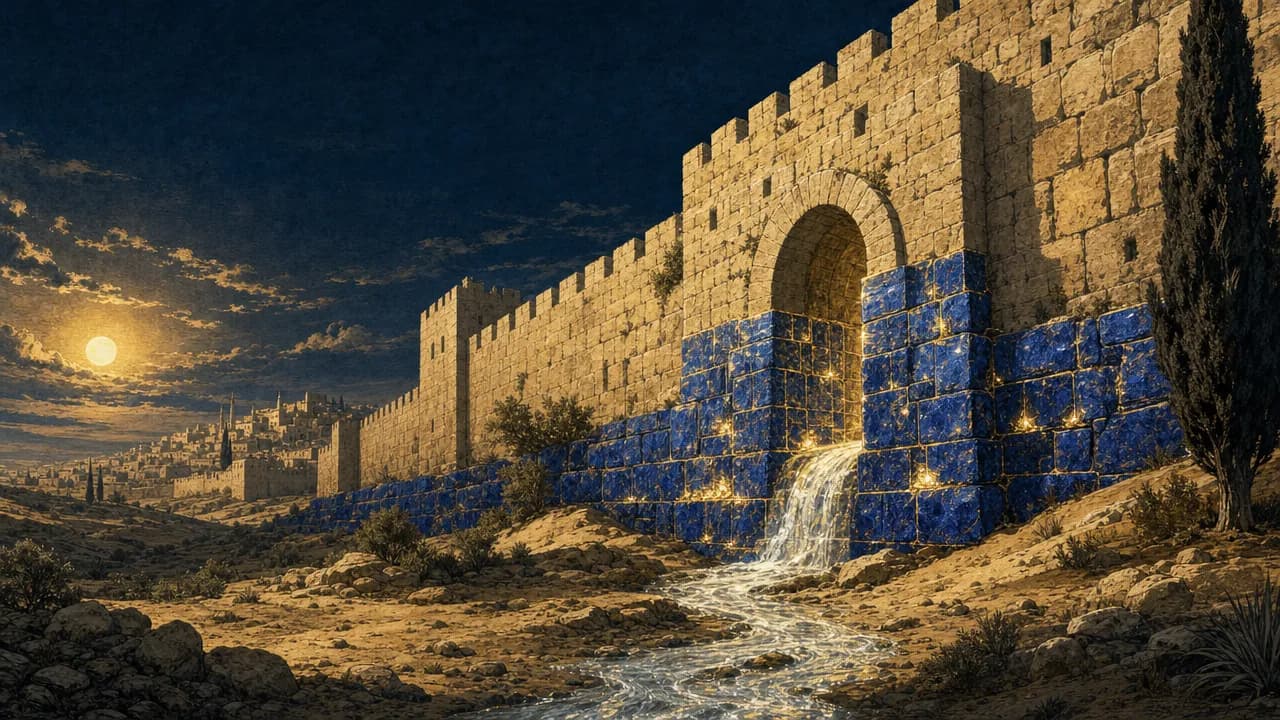
God tells the afflicted city that He will set small pearls into the foundations of her walls and lay sapphires and precious stones upon them. Her windows will be made so that the sun shines through and illumines great pearls within, and her gates will blaze with precious stones like a flame. Every stone found within her boundaries will be transformed into gems and pearls. And the people themselves will be transformed no less: all her children, great and small alike, will be disciples of the Lord, scholars in the days of the Mashiach. When Israel gives charity and acts justly, the city will stand secure, free of fear and anxiety, with no dread coming near her.
The prophet then turns to the enemy. Many nations may gather against Jerusalem, but God did not command it. This is Gog and Magog, who will come with swords, bows, and every weapon of war; yet they will end up doing Israel a favor, for Israel will take their goods and their money. Do not fear the weapons, God says, for He created the smith who blows on the coals to forge the iron of swords. Since the maker of weapons is God's own creation, He can disrupt that craftsman and shatter the very swords, and He has also created a ravager to destroy whatever He wishes. No weapon formed against Israel will succeed; every accusing tongue brought to court will be found at fault, and Israel will be justified. This vindication is the inheritance of the servants of God.
The final passage changes register entirely, calling out to all who are thirsty to come to the waters. Here the water is Torah and wisdom: one should study Torah with the same craving a thirsty person feels for water, for the world cannot endure without it. Whoever has no money need not worry, for wisdom and Torah come without payment, and the Torah is better than wine and milk. Why, then, spend money on a wisdom that is not Torah, one that cannot be called bread? Just as no one can live without bread, no one can truly live without the wisdom of Torah, while other kinds of learning help neither body nor soul.
Incline your ears and come to Me, God continues, and your body and soul will live. He promises an everlasting covenant that will not abandon His people, rewarding the lovingkindness of David. And a nation that does not know Israel, coming from far beyond the land, will run to serve her when she calls — hearing of the miracles God performs and recognizing that He alone grants Israel her beauty.
Message
The heart of this Haftarah is a redemption that repairs both the city and her people. The gemstones are not mere ornament; the sages taught that in the days of the Mashiach Israel will mark the boundaries of their fields with precious stones, and that such abundance will even bring peace between neighbors, since a man will settle a debt of a thousand gulden simply by handing over two stones lying on the ground. Alongside this material glory stands a deeper promise: today Israel learns Torah from human teachers, and because human beings pass away, their teaching is forgotten — but in the days of the Mashiach Israel will learn Torah from the Holy One Himself, who lives eternally, so that it will never be forgotten.
The Torah is compared to water, wine, and milk to teach how it must be received. Like water it flows down to the valley and flees the mountain, so it settles only in the humble and runs from the arrogant; like those drinks it keeps best in plain earthen vessels, not in gold and silver. And like a single raindrop swelling into a river, one begins with two halachot and grows, through study, into greatness.
Jerusalem's future is built of two treasures that outlast every empire: stones so plentiful they make peace, and a Torah learned from God Himself that can never be forgotten.