this week: Rosh Hashana I (festival on Shabbat) · cycle resumes with Ha'Azinu on 09/19
ראש השנה א
Rosh Hashana I
Bereshit 21:1-34
Where He Is: The Chapter That Judges Only the Present
The covenant arrives through prayer for strangers, is guarded by present conduct, and endures as an open tent.
Summary
1 min
Judged not by lineage or destiny but strictly by the present moment, divine providence reveals that exclusion is never abandonment, sustaining life even in the driest wilderness.
Sarah bears Yitzchak at ninety, Avraham circumcises him at a hundred, and the joy lasts exactly until the weaning feast, when Sarah demands that Hagar the Egyptian maidservant and her son Yishmael be sent away. The analysis argues that the chapter decides nothing by lineage and everything by what a person is doing at the moment. Two words carry the case. Sarah's grounds are compressed into the single participle metzachek — playing, mocking, making sport — and the traditional reading fills it with present offenses rather than genealogical unfitness; God confirms this by calling Yishmael Avraham's own seed and promising him a nation even while endorsing his removal from the covenant. Then the criterion reverses. When the water runs out in the wilderness, God hears the boy ba'asher hu sham, "where he is": judged by his present deeds, not by what his descendants will become. The frame supports the reading. The chapter opens just after Avraham prays for the barren household of Avimelech, a foreign king, and closes with Avraham planting a tamarisk at Be'er Sheva and bringing strangers to bless God there. Read on the first day of Rosh Hashanah, the chapter insists that election is not immunity and exclusion is not abandonment.
In the haftarah, the opening of the book of Shmuel, the childless Hannah prays at Shiloh, where the Mishkan then stood, moving her lips without sound; Eli the kohen mistakes her for a drunkard. From those silent words the sages derived the laws of prayer, and from her vow came the prophet Shmuel.
Generated 09/06/2026
Parashah SynthesisBy topic
This is a chapter of long-delayed joy and hard decisions, set in the dry country of the Negev where water is the difference between life and death. Read it slowly: almost every turn in it hangs on a single word.
Synthesis topics
The Autoparashah methodology selected 6 topics to summarize the parashah's sequence.
The chapter opens with a sentence that has been waiting a very long time to be written: Hashem took note of Sarah as He had said, and did for Sarah as He had spoken. The doubling is not carelessness — the text is insisting that nothing here is accident or surprise. Avraham is ninety-nine turning a hundred; Sarah is ninety; they have been carrying a promise of offspring since Avraham first left his father's house. The scene just before this had Avraham in the territory of Avimelech, a local king who had taken Sarah into his household and been warned off her by God; Avraham had prayed for that household, struck with barrenness, and it was healed. The narrative moves from that prayer straight to Sarah's conception, and the reader is meant to feel the seam.
Yitzchak: naming, brit milah, and Sarah's laughter
Sarah bears a son. Avraham names him Yitzchak, from the root meaning laughter — the name God Himself had assigned when the promise was given and Avraham and Sarah had each laughed at hearing it. On the eighth day Avraham performs brit milah, the covenantal circumcision he had been commanded to give every male of his household, and the text notes his age of one hundred years as if to keep the impossibility in view. Sarah then speaks in two registers: God has made laughter for me, and everyone who hears will laugh with me — joy and the memory of being an object of ridicule folded into one word. Who would have said to Avraham that Sarah would nurse children? The boy grows, is weaned, and Avraham makes a great feast on that day.
What Sarah sees, and what she demands
The feast is the last calm moment. Sarah sees the son of Hagar the Egyptian — the maidservant she had years earlier given to Avraham, who bore him Yishmael, now a youth in his teens — and the text describes him with a single participle, metzachek, which can mean playing, joking, mocking, or making sport. The same root that gave Yitzchak his name now describes what Sarah sees, and she does not find it innocent. Her demand is immediate and total: drive out this slave-woman and her son, for the son of this slave-woman shall not inherit together with my son, with Yitzchak. Whatever she has witnessed, she names inheritance as the stake — not honor, not household friction, but who stands in Avraham's line.
Bread, water, and a voice from heaven
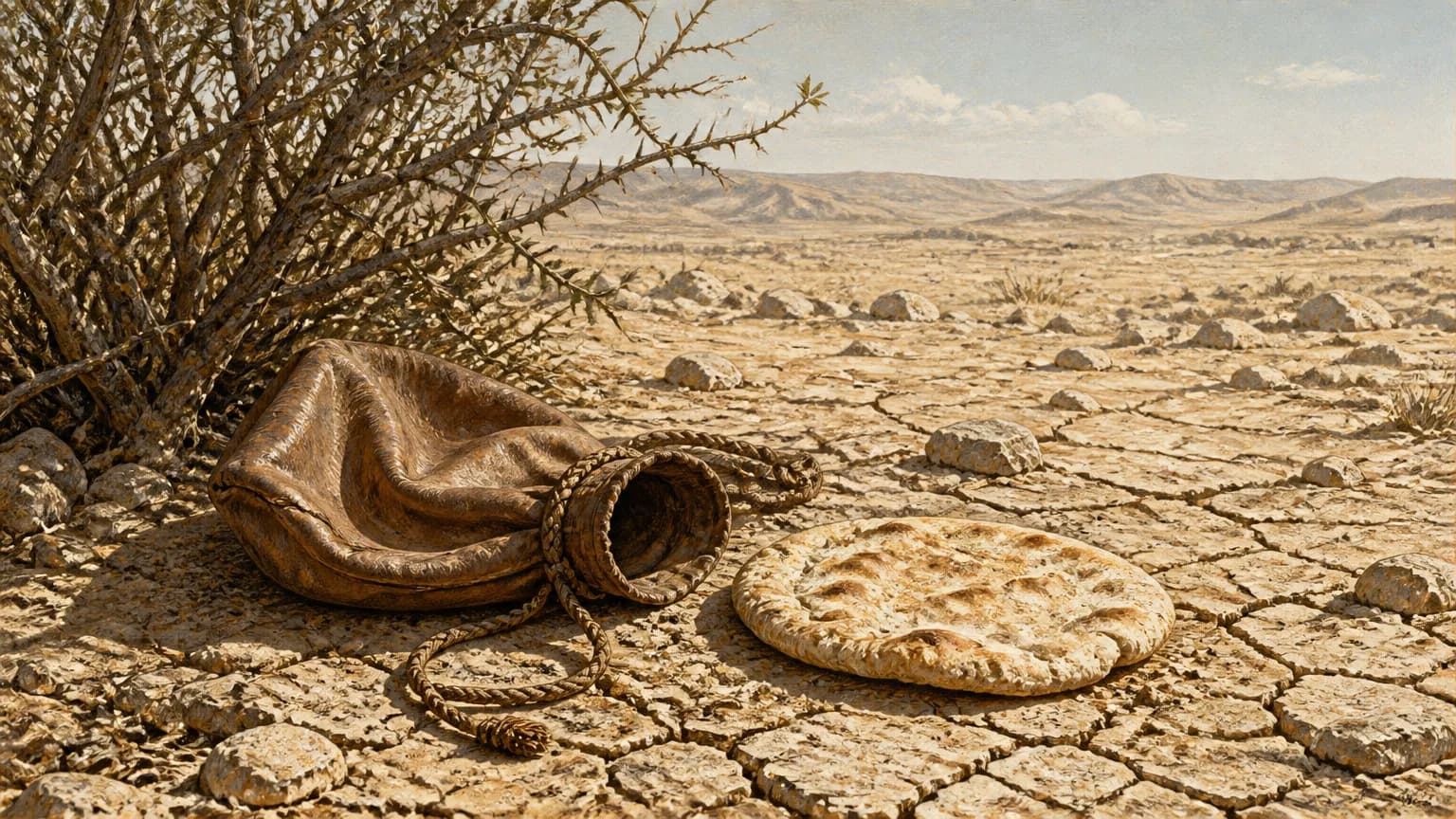
Avraham is badly pained, and the text says why: because of his son. Yishmael is his child, circumcised in his house, the boy he had once asked God to let live in His favor. God's answer neither denies the pain nor lingers on it: do not be pained over the lad and over your slave-woman; in everything Sarah says to you, listen to her voice, for through Yitzchak shall your seed be called — and also the son of the slave-woman I will make into a nation, for he is your seed. Two futures are granted at once; only one of them is the covenant. Avraham rises early, gives Hagar bread and a skin of water, sets the child with her, and sends her off. She wanders in the wilderness of Be'er Sheva, the water runs out, and she lays the boy under a bush and sits a bowshot away, unwilling to watch him die.
Avraham gives Hagar bread and a skin of water, sending them into the dry wilderness where the water runs out.
Avimelech, a well, and seven ewes
Then God hears — and the text is precise about whom: the voice of the na'ar, the lad, not the weeping mother. An angel calls to Hagar from heaven: what troubles you, Hagar, do not fear, for God has heard the voice of the lad where he is. That last phrase, ba'asher hu sham, seems superfluous — of course he is where he is — and it is the hinge of the rescue: he is heard in the place and the condition he is in at this moment. Hagar's eyes are opened to a well of water; she fills the skin and gives the boy to drink. God is with the lad; he grows, dwells in the wilderness, becomes a bowman, settles in Paran, and his mother takes him a wife from Egypt. He has a life, and it is not Yitzchak's.
A tree at Be'er Sheva and a name proclaimed
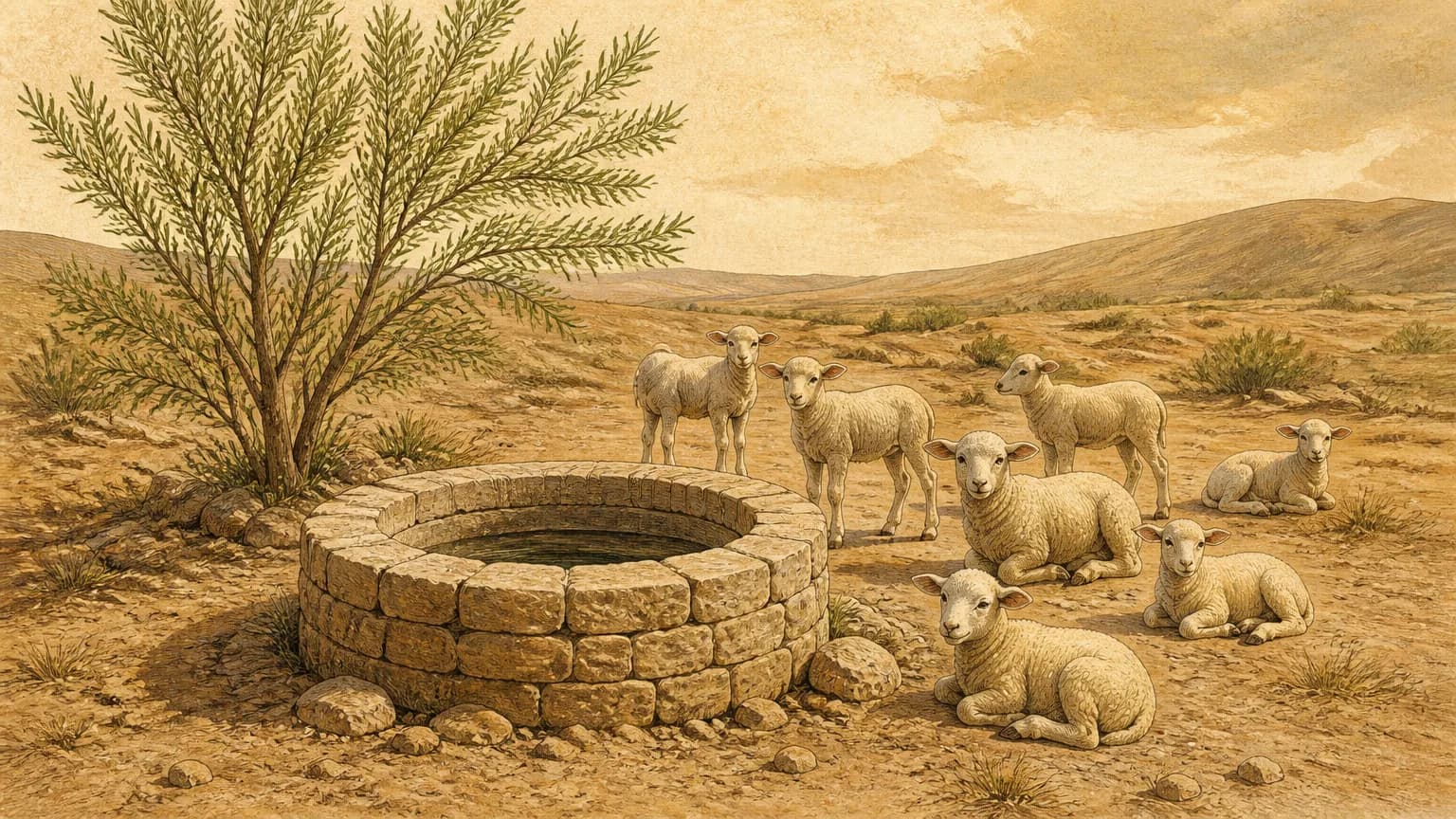
The chapter's last movement returns to Avimelech, who arrives with Phicol, his army commander, to propose a sworn pact: God is with you in all that you do, so swear you will not deal falsely with me or my descendants. Avraham swears — and then immediately raises a grievance, that Avimelech's servants had seized a well he had dug. In that country a well is not a convenience but a title deed, and Avimelech pleads ignorance. Avraham gives sheep and cattle, then sets seven ewes apart, and when asked, explains that accepting them is Avimelech's acknowledgment that the well is his. The place is therefore called Be'er Sheva — well of seven, well of the oath — for there the two of them swore. Avimelech and Phicol go home to the land of the Pelishtim, the people of the coastal plain. Avraham plants an eshel, a tamarisk, at Be'er Sheva and calls there in the name of Hashem, God of the world, and dwells in that land many days. The chapter closes with the heir secured, one son gone into the desert with a nation of his own promised him, and Avraham settled at a well he had to prove was his.
Avraham sets apart seven ewes to confirm his ownership of the well and plants a tamarisk tree at Be'er Sheva.
Generated 09/06/2026
Analysis axes
They form the central interpretive thread and appear interspersed in the essay below, connecting the parashah's sequence to a unified reading shaped by Rashi.
1.A promise kept, at last, in old ageוה' פקד את שרה וגו'Rashi on 21:1
2.Yitzchak: naming, brit milah, and Sarah's laughterמצחקRashi on 21:9
3.What Sarah sees, and what she demandsבאשר הוא שםRashi on 21:17
4.Bread, water, and a voice from heavenויקרא שם וגו'Rashi on 21:33
Interpretive Analysis4 Rashi axes at the turns of the reading
Read the chapter as an architecture and something unexpected appears: it is bracketed by two acts aimed entirely outward. It begins in the shadow of Avraham praying for the fertility of a foreign king's household, and it ends with Avraham planting a tree in the wilderness and making the name of God known there. Between those brackets sits the harshest act of narrowing in the whole story of the avot — the expulsion of a son. The temptation is to read the middle as the chapter's real business and the frame as scene-setting. The reverse is true. The frame supplies the criterion by which the middle becomes legible, and the criterion is startlingly narrow: nothing in this chapter is decided by lineage or by what someone will one day become. Everything is decided by what a person is doing now.
Rashi, the eleventh-century commentator of northern France, reads the seam at the chapter's opening as instruction rather than chronology: the account of Sarah's conception is placed directly after Avraham's prayer for Avimelech's household to teach that one who asks mercy for another while himself needing the very same thing is answered first. Sarah's womb and Avimelech's household needed identical relief. The heir of the covenant, on this reading, does not arrive as the payoff of a dynastic entitlement patiently earned; he arrives on the far side of Avraham's willingness to spend his prayer on a pagan king's barren house. The promise is old, but its fulfillment is dated to an act of intercession for outsiders.
That reframing is what makes the expulsion readable. Sarah's ground for it is compressed into one participle, metzachek, and the received reading opens it out: idolatry, sexual license, bloodshed, and a quarrel with Yitzchak over which of them would inherit. Each of those is a present act. Sarah is not asserting that an Egyptian maidservant's child is genealogically unfit; God Himself immediately refuses that logic by calling Yishmael Avraham's seed and promising him nationhood. What is at stake is what is happening in the house this week, at the weaning feast, in the field. The boundary drawn through Avraham's family is a moral demarcation, not a bloodline snobbery — which is precisely why God can endorse Sarah's voice and Yishmael's future in the same breath.
Then the same principle turns and does the opposite work. Under the bush, with the water gone, the phrase ba'asher hu sham is the pivot of a dispute the text only hints at: the ministering angels press the case against saving a boy whose descendants will one day torment Israel, and the answer comes back — what is he now, righteous or wicked? By his present deeds I judge him. The criterion cuts both ways: present conduct removes Yishmael from the covenantal line, and present conduct saves his life. Divine justice here declines to read the future as evidence. This is why the rescue is triggered by the voice of the lad rather than his mother's weeping; Hagar is grieving a fate, while Yishmael is simply crying now, and now is the only tense in which this chapter renders verdicts.
Which explains the ending that otherwise looks like an anticlimax. Avraham has just secured the covenantal line and negotiated a treaty and a legal title to a well — every marker of a dynasty consolidating itself. What he does with that security is plant an eshel and, on the received reading of the causative phrasing, run it as an inn: after his guests had eaten and drunk he told them to bless the One whose food they had consumed. It is not that he called upon God's name; he caused God's name to be called, by strangers, as El Olam, God of all the world. The chapter that begins with a prayer for a foreigner's household ends with foreigners praying. The narrowing in the middle exists to produce a household capable of that, not a household insulated by it.
This chapter is read in the synagogue on the first day of Rosh Hashanah, when Israel stands before the One who judges, and the choice of reading is an argument in itself. Not the covenant's grandeur, not the promise of a great nation, but three words spoken over a dying boy who was not even in the covenant: God heard him where he was. Bereshit has been building a family by selection since Noach, and a reader might reasonably conclude that selection means the elect are safe and the rest are written off in advance. This chapter refuses that reading in both directions at once — election is not immunity, and exclusion is not abandonment — and it locates the whole weight of judgment in the only place a person actually stands.
In the very next chapter Avraham again rises early in the morning and again walks into a wilderness with a son and provisions, and again a voice calls from heaven at the last possible moment. One son is heard where he lies; the other is stopped where he lies bound. A reader who has watched Hagar's eyes opened to a well may want to ask what Avraham had already learned, before Moriah, about how heaven listens.
Generated 09/06/2026
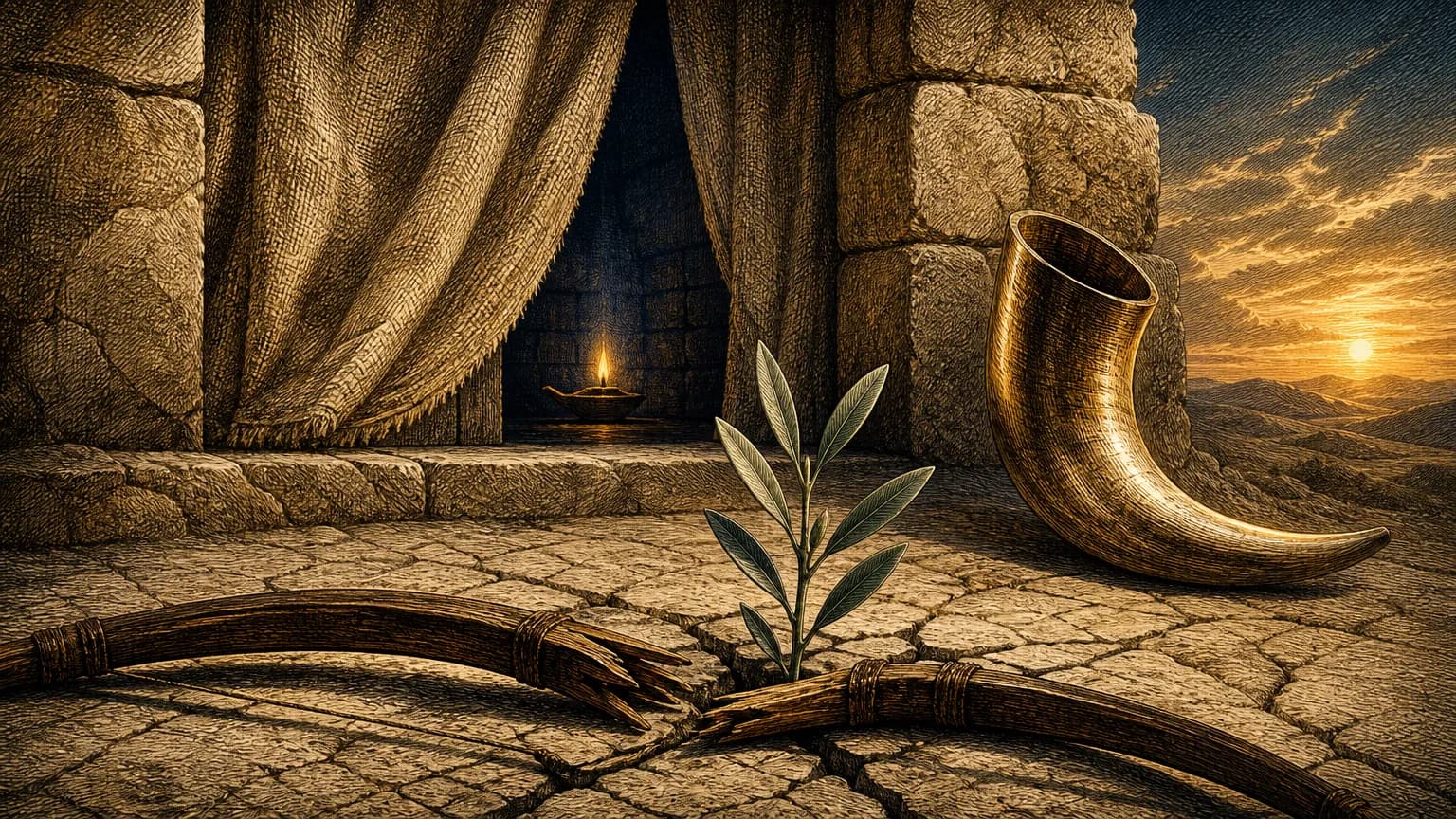
Hannah’s silent plea reorders the world: the shattered bow and rising consecrated horn testify that God shatters earthly power to elevate the humble, turning silent grief into prophetic strength.
Context
This Haftarah opens the book of Shmuel, which begins in the closing years of the period of the Shoftim, before Israel had a king. There was as yet no Yerushalayim to which korbanot could be brought, so all offerings were carried to Shiloh, where the Mishkan stood and where Eli served as kohen together with his two sons, Hophni and Phinehas.
Into this setting comes Elkanah, a righteous man of Ramot in the hill country of Ephraim, who went up to Shiloh every year for the festival and would call many people along the way to accompany him. He had two wives, Peninah, who had children, and Hannah, who had none. From her anguish the prophet Shmuel will be born, and with him a new chapter in the life of Bnei Yisrael.
Interpretation
The Haftarah Explained
The Torah says that Elkanah went up "to worship and to offer sacrifice," placing bowing before slaughtering, and our sages learned from this word order that prayer stands in place of the korban and that bowing before God is even dearer to Him than an offering. When Elkanah distributed portions, he gave gifts to Peninah and her children and a fine portion to Hannah, hoping to lift her spirits. But Peninah tormented her, asking her husband in Hannah's hearing why he had not given a coat to the eldest boy or a shirt to the next — needling her precisely where she had nothing. Some sages say Peninah did this so that Hannah would take it to heart and pray for children.
Hannah wept and would not eat, and Elkanah said to her that he loved her as much as Peninah's ten children. After the meal she rose and prayed before Eli, who sat on his chair in the House of God. Calling out "Lord of Hosts," she argued before Him: You created hosts of angels above who have no children but never die, and hosts of people below who have children but do die — if I am like the angels, let me live forever; if I am one of the mortals, then let me have children. Her prayer was voiced in the heart, her lips moving without sound, and she vowed that a son given her would serve in God's house forever — not from the age of twenty, as the levi'im begin their service, but from the age of two.
Eli, seeing only her moving lips, took her for a drunkard and told her to sleep it off. Hannah answered that she was a woman of great trouble and pain, that she had drunk no wine, and that he should not take her for a worthless woman. Eli blessed her — "go in peace" — and she ate, and her sorrow lifted from her face. Only when Elkanah returned home to Ramot did he and Hannah conceive, and from this our sages learned that a guest should not be with his wife in another's house. A year later Shmuel was born, and she named him for what she had asked of God.
When the child was weaned Hannah brought him to Shiloh with oxen, flour and wine, and delivered him to Eli to be taught Torah. Already the boy ruled on halachah in his teacher's presence, telling Eli that any Israelite may slaughter a korban and no kohen need be summoned — a correct ruling, Eli conceded, yet one who rules before his teacher is liable to death. Hannah cried out that she had won this son through great suffering, and that having lent him to God, Eli had no power over him.
Then Hannah prayed. Her sad heart had become glad; the head she could not lift before Peninah was now raised; her mouth, once silent, could answer. There is no holy one like God and no creator besides Him: He breaks the bow of the mighty, sends the wealthy to hire themselves out for bread, and fills the hungry. "The infertile woman bears seven" — for as Hannah bore sons, Peninah's ten children died two by two, until Peninah fell before her and begged her to pray that the last two live; Hannah prayed, took them as her own, and so came to seven.
Interpretation
Message
From Hannah's few silent words the sages drew the shape of Jewish prayer itself: one must pray with an earnest heart and not with lightheadedness, with intention directed to God, with lips that move and form the words, and with a voice that is not heard by others. Because Eli mistook her for a drunkard, they learned that a drunk must not pray at all. And because she answered him plainly, they learned that one suspected of wrongdoing may clear himself before others, and that one who wrongly suspects his fellow must make amends at once, as Eli did when he said "go in peace."
Her boldest argument is also her simplest. No limb was created in a person without purpose — eyes to see, ears to hear, the mouth to speak, the hands to work. Then for what were the breasts placed over the heart, if not for a child to nurse? Hannah's song answers her own question: the One who raises the poor from the dust and seats them among nobles is the same One who turns a barren woman into a mother of seven.
Hannah asked for one son and received a prophet, and Israel received the model of how to stand before God: quietly, bitterly if need be, and with the whole heart.
What the world could not give her, she took to the One who breaks the bow of the mighty and lifts the needy from the dunghill.