לעילוי נשמתIn memory ofאברהם בן יצחק ז״לAvraham ben Yitzchak z"l· Família Cohen
this week: Shavuot II (festival on Shabbat) · cycle resumes with Nasso on 05/30
שבועות ב
Shavuot II
Devarim 14:22-16:17
The Conditional Economy of the Covenantal Harvest
The text transforms private agricultural wealth into a divine deposit, conditioning human prosperity on the active care of society's most vulnerable.
Summary
1 min
The image symbolizes how distributing our material harvest in pursuit of justice forms the very roots that anchor us when the world shakes.
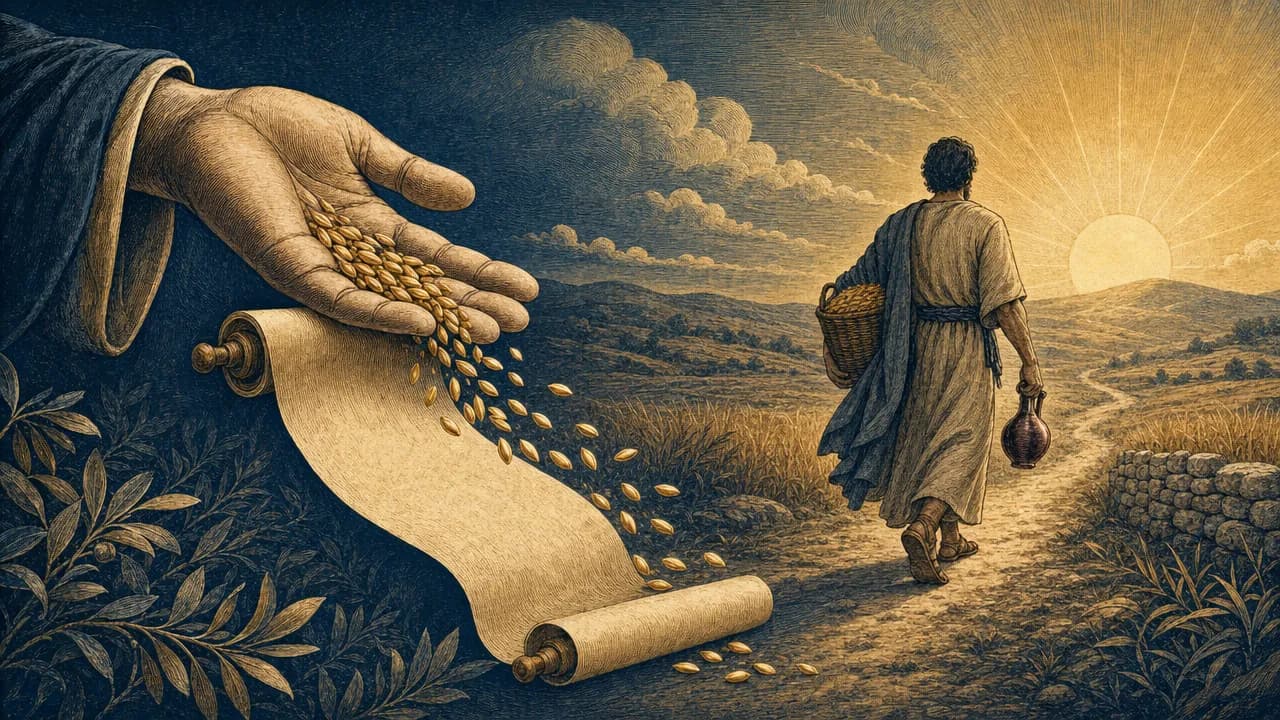
The agrarian laws of Devarim dismantle the illusion of private wealth, reframing material prosperity as a conditional divine deposit. A close reading of harvest tithes, debt cycles, and festival pilgrimages reveals an economy where the earth's yield is inextricably bound to communal ethics. This is starkly exposed in the text’s tension regarding poverty: a promise that there shall be no needy sits alongside a command to support the destitute because they will never cease from the land. Rather than a contradiction, this serves as a spiritual barometer; eradicating poverty depends entirely on collective covenantal fidelity. The structural shift in the tithing cycle—moving from personal celebration at the central sanctuary to local distribution for the marginalized—reinforces this principle. True blessing requires transferring generative capital, seen in the mandate to provide freed servants with livestock and grain. Ultimately, the householder’s right to rejoice is made entirely contingent upon their inclusion of God’s vulnerable wards, ensuring ritual devotion is inseparable from economic justice.
In the haftarah, Chavakuk receives a terrifying vision of cosmic upheaval and approaching national distress. Witnessing God’s absolute mastery over nature, the prophet shifts from anguished questioning to a profound expression of unconditional faith. He declares that even if the land suffers total devastation and material security vanishes, he will still rejoice in the Sovereign God, finding an unbreakable anchor when the world shakes.
Generated 05/19/2026
Parashah SynthesisBy topic
As Bnei Yisrael stand on the precipice of entering the land, Moshe outlines the profound rhythms that will govern their agricultural and economic life. The instructions move systematically from the handling of the annual harvest to the cyclical release of debts and servants, culminating in the national pilgrimage festivals. What emerges is a blueprint for a society where the yield of the earth is inextricably bound to the ethical obligations of the community.
Synthesis topics
The Autoparashah methodology selected 6 topics to summarize the parashah's sequence.
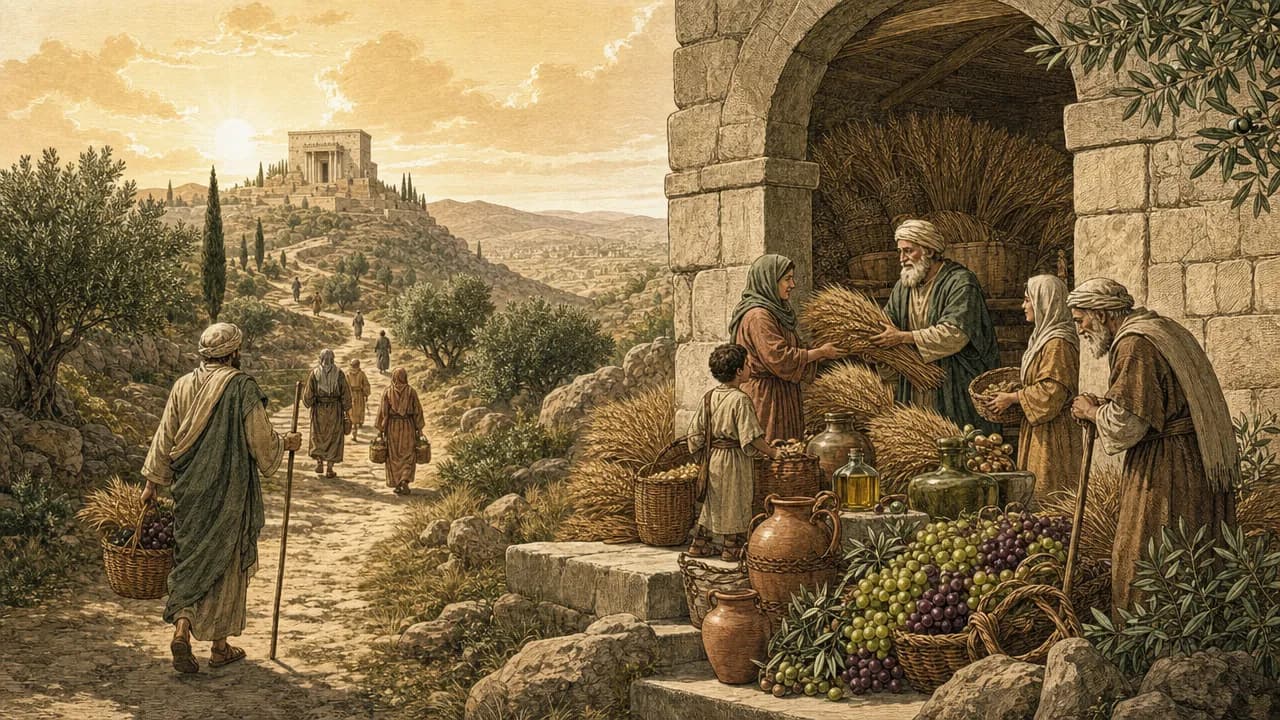
The parashah opens in the book of Devarim with a mandate regarding the annual agricultural yield. An Israelite must set aside a tenth of the seed from the field, along with new grain, wine, oil, and the firstborn of the herds and flocks. This bounty is not to be consumed at home; rather, the owner and their household must travel to the central place where God chooses to establish the divine name, eating the tithe there in a state of reverence. If the journey is too long to transport the physical goods, the owner may convert the tithe into silver, travel to the sanctuary, and spend the money on whatever their heart desires—cattle, sheep, wine, or other celebratory foods—rejoicing there before God.
The Third-Year Local Distribution
A sudden disruption in this personal pilgrimage occurs every third year. Instead of taking the tithe to the central sanctuary for a private family celebration, the Israelite is commanded to leave the full tithe of that year's yield within their local settlements. This stored abundance is designated specifically for the Levi, who has no territorial inheritance, alongside the stranger, the orphan, and the widow. The text promises that feeding these vulnerable local populations will bring divine blessing upon all the enterprises the householder undertakes.
The dual destination of the tithe balances personal devotion at the central sanctuary with local responsibility toward the community's most vulnerable members.
The Sabbatical Year of Release
The economic calendar then expands to a seven-year cycle with the introduction of shmittah, the Sabbatical year of release. In this year, all creditors must remit the debts owed to them by their fellow Israelites. The text presents a sudden contrast regarding the economic reality of the nation: it first declares a sweeping promise that there shall be no needy among them, provided they heed God's voice and keep the commandments. Yet, only a few verses later, the text warns that the needy will never cease from the land. Because of this enduring reality, the Israelite is strictly commanded not to harden their heart or shut their hand against a destitute neighbor, even when the year of debt cancellation is rapidly approaching.
Parting Gifts for the Freed Servant
This principle of release extends to human labor. A Hebrew man or woman sold into servitude must be set free in the seventh year of their service. The master is forbidden from sending the freed servant away empty-handed. Instead, the master must furnish the departing servant with specific parting gifts drawn directly from the flock, the threshing floor, and the vat. The text roots this mandate in the national memory of slavery and redemption in Egypt. If, however, the servant loves the master's household and refuses to leave, a ritual is performed using an awl to pierce the servant's ear to the door, binding them to lifelong service.
The Sabbatical year demands a radical opening of the hand, releasing both financial debts and human servants into a state of dignified independence.
Consecration of the Firstborn
The narrative then turns to the consecration of firstborn male livestock. These animals belong entirely to God and cannot be put to work or shorn of their wool. The owner must bring them to the central sanctuary to be eaten annually. If the animal possesses a serious physical defect, such as lameness or blindness, it cannot be offered on the altar. It loses its sacred restriction and may be eaten freely in the local gates by anyone, provided its blood is poured out onto the ground.
The Three Pilgrimage Festivals
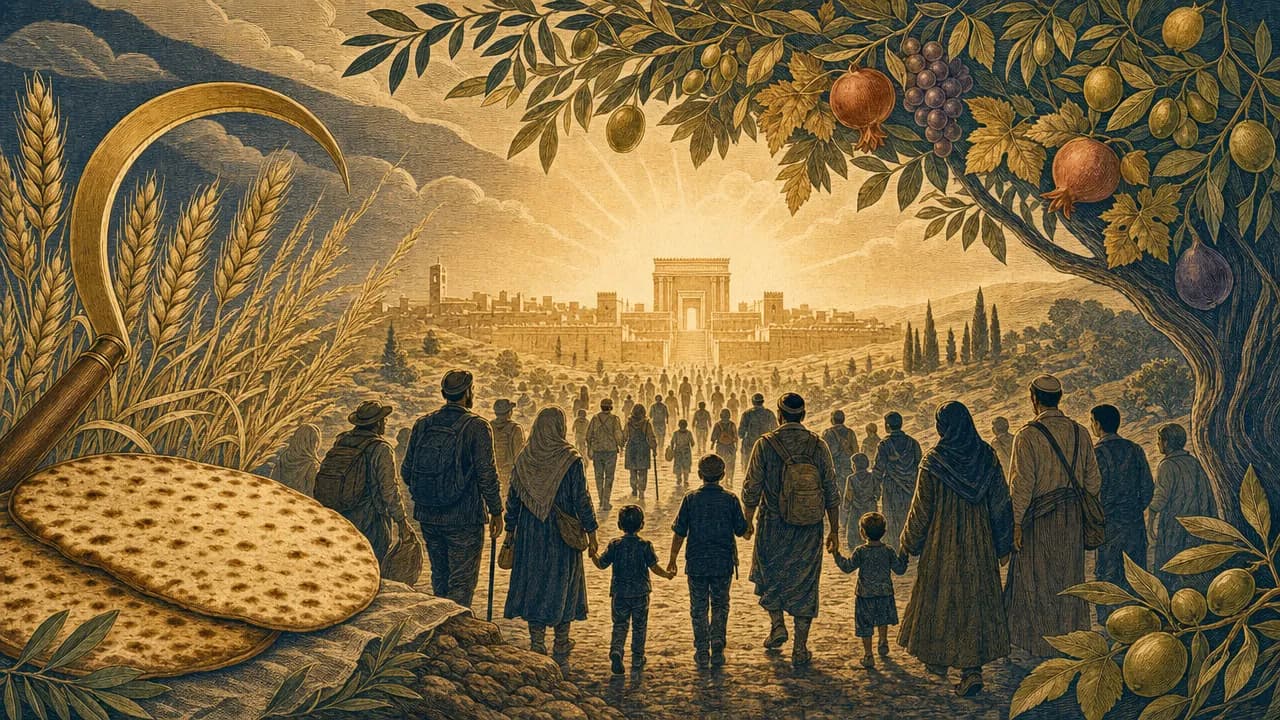
The parashah closes by gathering the nation for the three major pilgrimage festivals. Pesach requires the offering of the Passover sacrifice at the central sanctuary in the evening, accompanied by six days of eating matzah, the bread of distress, culminating in a solemn assembly. Shavuot is triggered by counting seven weeks from the first sickle put to the standing grain, celebrated with a freewill offering proportional to the year's blessing. Sukkot follows the ingathering from the threshing floor and the vat. For both Shavuot and Sukkot, the text meticulously lists who must participate in the joy at the central sanctuary: the householder, their son and daughter, their male and female slave, alongside the Levi, the stranger, the orphan, and the widow. The cycle concludes with the strict requirement that all males appear before God three times a year, bringing a gift commensurate with the blessing they have received.
The three pilgrimage festivals unite the entire community, ensuring that joy is shared equally among all classes, from the householder to the stranger.
Generated 05/19/2026
Analysis axes
They form the central interpretive thread and appear interspersed in the essay below, connecting the parashah's sequence to a unified reading shaped by Rashi.
1.The Annual Harvest Titheוהגר והיתוםRashi on 14:29
2.The Third-Year Local Distributionאפס כי לא יהיה בך אביוןRashi on 15:4
3.The Sabbatical Year of Releaseמצאנך ומגרנך ומיקבךRashi on 15:14
4.Parting Gifts for the Freed Servantלוי גר יתום ואלמנהRashi on 16:11
Interpretive Analysis4 Rashi axes at the turns of the reading
A surface reading of the parashah suggests a practical manual for an agrarian economy, detailing the logistics of harvest tithes, debt cycles, and festival travel. However, a close reading of its internal tensions and precise lists exposes a radical redefinition of ownership. The text systematically dismantles the illusion of private wealth, revealing it instead as a conditional divine deposit. Material prosperity is not a static possession but a dynamic current, one that must flow toward the vulnerable in order to retain its status as a blessing.
This conditional nature of wealth is most starkly exposed in the unresolved tension surrounding poverty. The text asserts an absolute promise that there shall be no needy among the people, yet immediately commands open-handedness precisely because the needy will never cease from the land. This is not a contradiction but a spiritual barometer. The eradication of poverty depends entirely on the collective obedience of the community. When the nation aligns with the covenant, poverty vanishes; when it falters, the vulnerable multiply. The presence of the destitute is therefore not an economic inevitability, but a reflection of the community's spiritual state, turning every encounter with the poor into a test of covenantal fidelity.
The structural shift in the tithing cycle reinforces this exact dynamic. For two years, the harvest tithe elevates the individual, funding a joyous personal pilgrimage to the central sanctuary. But in the third year, the destination abruptly shifts from the spiritual heights of the sanctuary to the dust of the local gates. The text structurally equates the spiritual elevation of eating before God with the ethical imperative of feeding the marginalized. The pilgrimage is incomplete, and the blessing of the land is suspended, until the personal celebration yields to communal survival.
When the text legislates the release of the Hebrew servant, it applies this same generative principle to the concept of compensation. The master is commanded to provide parting gifts specifically from the flock, the threshing floor, and the vat. The text does not mandate a lump sum of silver or generic provisions. By specifying these exact agricultural categories, the parashah insists on transferring assets capable of biological reproduction and organic growth. True blessing is not mere survival; it is generative capital. The master must provide the freed individual with the very mechanisms of future prosperity, ensuring they do not merely leave servitude, but enter into the capacity to build a self-sustaining life.
This profound interdependence between the householder's prosperity and the welfare of the marginalized reaches its apex in the laws of the pilgrimage festivals. At Shavuot and Sukkot, the text meticulously enumerates the required participants for the celebration at the sanctuary. A striking theological symmetry emerges in this list. The householder brings four dependents: the son, the daughter, the male slave, and the female slave. God, in turn, brings four dependents: the Levi, the stranger, the orphan, and the widow. The householder's right to rejoice with their own family is made entirely contingent upon their inclusion of God's vulnerable wards. Divine joy is held hostage to human generosity; God will gladden the householder's dependents only if the householder gladdens God's.
The Israelite economy operates as a shared ecosystem where human action triggers divine reaction. By intertwining the central sanctuary with the local gates, and by binding the joy of the private estate to the survival of the landless, the text refuses to separate ritual devotion from economic justice. The harvest is never truly owned by the one who reaps it; it is merely held in trust, waiting to be activated by the open hand.
The command to rejoice before God is inextricably bound to the memory of having been slaves in Egypt. The land yields its strength not to those who merely work the soil, but to those who remember the bitterness of the empty hand, ensuring that the cycle of redemption is renewed with every harvest.
Generated 05/19/2026
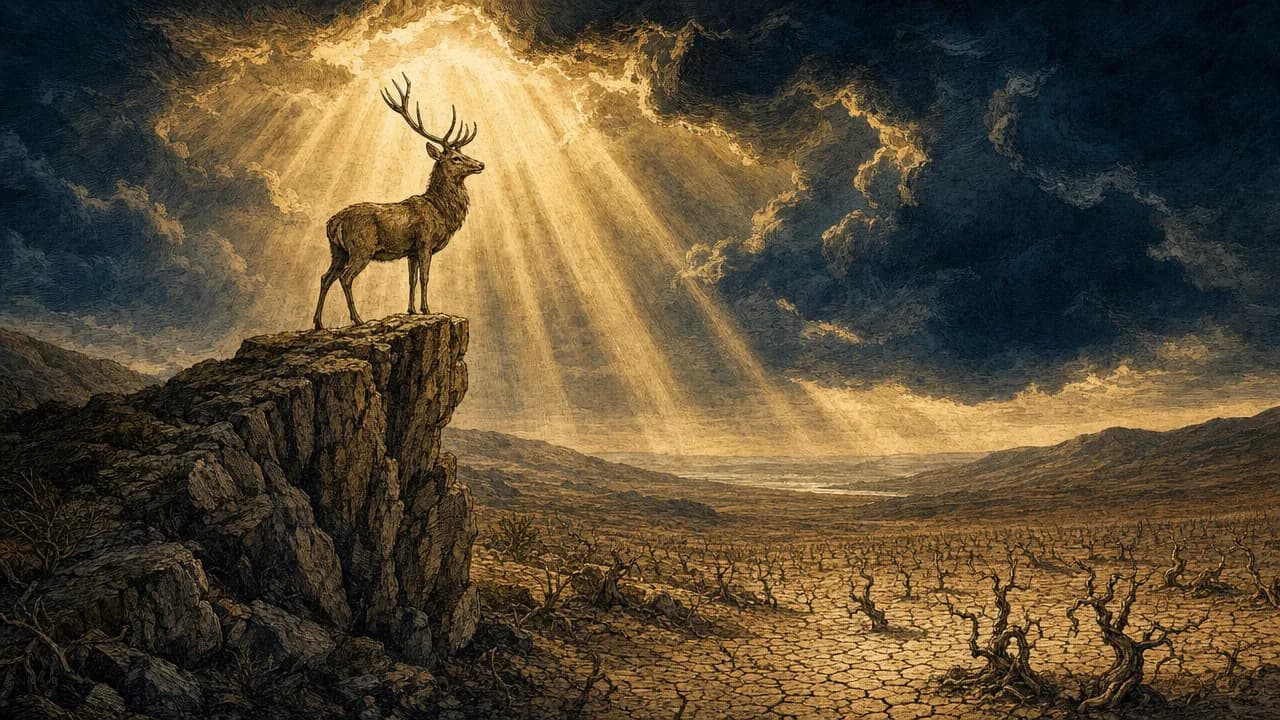
This illustration captures Chavakuk’s ultimate triumph of faith, symbolizing how a soul anchored in divine strength can navigate devastating historical upheavals with the sure-footed grace of a deer on treacherous heights.
Context
The prophet Chavakuk, who prophesied in Yehudah during the turbulent years preceding the Babylonian exile, concludes his short book with a majestic and terrifying prayer. In the preceding chapters, Chavakuk boldly questioned how God could use a ruthless foreign empire to punish His own people. Here, the prophet shifts from anguished questioning to a profound vision of divine power.
Because of its vivid depiction of God appearing in radiant glory from Mount Paran—imagery that strongly echoes the giving of the Torah at Mount Sinai—this passage is traditionally read as the Haftarah for the festival of Shavuot.
Interpretation
The Haftarah Explained
Chavakuk opens by expressing deep awe at God’s renown, pleading for compassion to be remembered even in the midst of divine anger. He envisions God appearing from Teman and Mount Paran, radiating a brilliant light that fills the earth and covers the skies. As the Creator moves, the very foundations of the world react. The earth shakes, ancient mountains shatter, and the surrounding nations tremble in fear. Pestilence and plague march before Him, signaling the overwhelming force of His presence.
The prophet then describes God’s absolute mastery over the forces of nature, recalling the miracles of the Exodus and the splitting of the sea. God is depicted as a warrior riding a victorious chariot, wielding a readied bow, and commanding the mighty waters. The sun and moon stand still in the sky, a testament to the Creator’s control over the cosmos. Yet this overwhelming display of might is not arbitrary. God marches forth specifically to deliver His people and His anointed king. He shatters the strongholds of the wicked, cracking the skulls of the enemies who delight in devouring the vulnerable in secret ambushes.
Witnessing this vision of upheaval and the approaching day of national distress, Chavakuk is gripped by physical terror. His body quakes and his lips quiver at the thought of the coming invasion. Yet, from this place of absolute vulnerability, he reaches a breathtaking crescendo of faith. He declares that even if the land suffers total devastation—if the fig trees fail to bud, the vines yield no grapes, the olive crops wither, and the sheep and cattle vanish from their pens—he will still rejoice in God. Stripped of all material security, the prophet finds his ultimate strength in the Sovereign God.
Interpretation
Message
The concluding prayer of Chavakuk stands as one of the most powerful expressions of unconditional faith in our tradition. The prophet teaches that true trust in God does not depend on peace, prosperity, or even basic physical security. When the world is shaking and all material blessings have withered, the memory of God’s past redemptions serves as an unbreakable anchor.
Chavakuk demonstrates that even in the darkest moments of historical upheaval, a person can find profound joy by relying entirely on the God of Israel. God becomes the prophet's strength, making his feet like those of a deer. Just as a deer can navigate treacherous, steep heights without slipping, the faithful soul can walk securely through the most terrifying periods of history, upheld by the enduring promise of ultimate deliverance.
True faith does not demand a world free of turmoil.
It is the quiet confidence that, no matter how steep the climb or barren the field, God remains our unfailing strength.