When the Eyes Spy the Wrong Land: Faith, Fear, and the Fringe
A scouting report becomes a national rebellion, and the Torah answers not with rebuke alone but with a thread tied to the eye.
Summary
1 min
The illustration contrasts the faithless scouting of the physical eye with the corrective threads of faith and commandment, retraining our vision to see divine promise instead of earthly fear.
The deepest seam of the parashah is not the sin of the scouts but the organ that sinned: the eye, and the verb that governs it. The mission opens with the word latur, to scout, and the parashah closes with the same root in the warning velo taturu—do not go scouting after your heart and eyes. This is architecture, not coincidence. The command shelach lecha is a concession to a desire already formed; a people secure in the promise would not need to look. The scouts' report is accurate in its data but corrupt in its interpretation: "it is stronger than we," where the Hebrew mimenu hovers between "than us" and "than Him." The slide from "we cannot" to "He cannot" is the whole distance between fear and heresy. The laws that follow—libation, dough, the certainty of entry once the children settle the land—are consolation disguised as legislation. And tzitzit at the close is the structural counterweight to the opening: a corrective lens fixed onto the very instrument that failed, retraining the eye to recall the mitzvot rather than wander after its own appetite.
In the haftarah, from the opening of Sefer Yehoshua, two righteous spies—identified as Pinchas and Calev—are sent to reconnoiter Jericho. They lodge with Rahab, who hides them and makes a great confession: she knows God has given the land to Israel, for dread of them has melted every heart. Spared through a crimson cord, she later converts and merits eight prophets among her descendants.
Generated 06/07/2026
Parashah SynthesisBy topic
Bnei Yisrael stand at the threshold of the land promised to the avot, close enough to taste its fruit. What follows is the story of how a people on the edge of arrival turned themselves back into a people of the wilderness—and how God answered.
Synthesis topics
The Autoparashah methodology selected 6 topics to summarize the parashah's sequence.
The mission to scout the land and the report that breaks the camp
The parashah opens with God speaking to Moshe about a mission: to send men to scout the land of Canaan, one leader from each of the twelve tribes. These are not ordinary men but chieftains, named individually, dispatched from the wilderness of Paran. Among them is Hoshea son of Nun, whose name Moshe changes to Yehoshua. Moshe instructs them to assess everything—the people, the cities, the soil, the fruit—and to bring back produce from a land said to flow with milk and honey. The tone is one of anticipation: the people are at the doorstep of their inheritance.
From fearful report to blasphemous claim of weakness
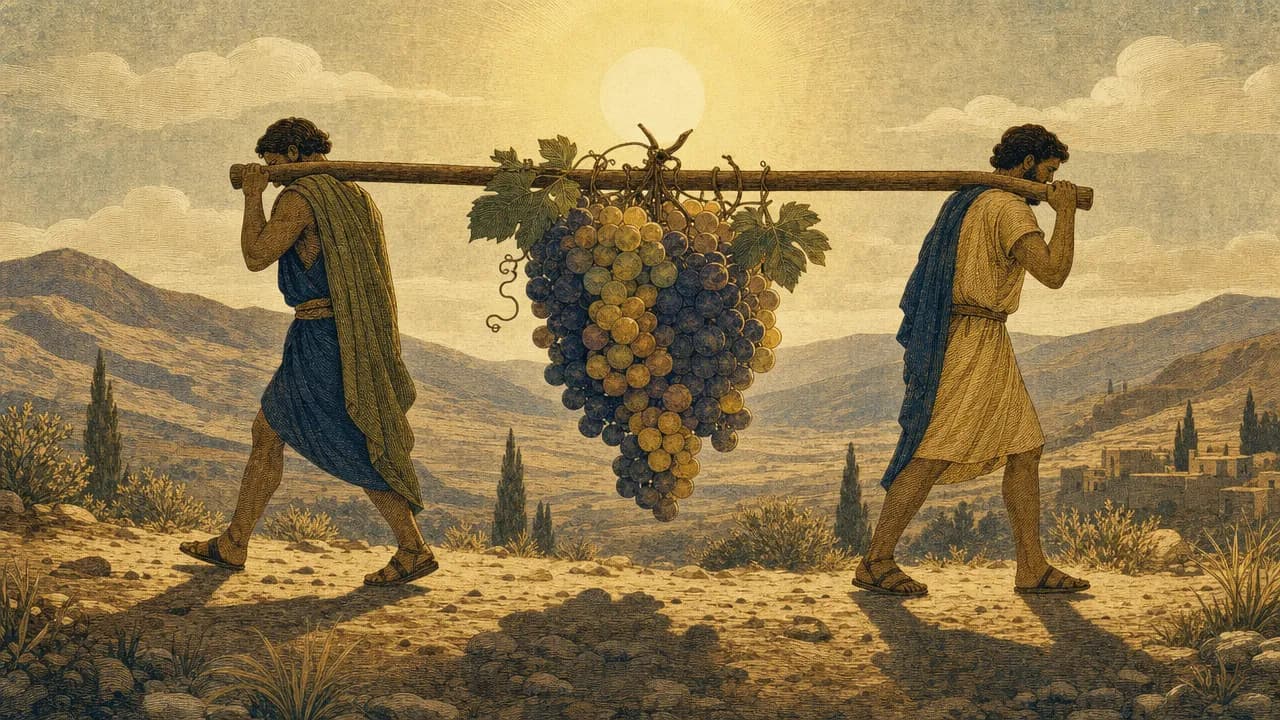
The scouts traverse the land over forty days and return bearing a single cluster of grapes so heavy it must be carried on a frame by two men, along with pomegranates and figs. Their report begins truthfully—the land does flow with milk and honey—but then turns. The inhabitants are powerful, the cities fortified, and giants, the Anakites, dwell there. Caleb silences the assembly and insists they can prevail, but the other scouts override him, declaring, "We cannot attack that people, for it is stronger than we." The Hebrew phrase here carries a darker edge than mere self-doubt: it can be heard as a claim that the inhabitants are stronger even than the One who promised the land. They escalate further, calling the land one that "devours its settlers" and describing themselves as grasshoppers in the eyes of giants. A truthful scouting report has curdled into something poisonous.
The immense cluster of grapes symbolizes the rich promise of the Land of Israel, a physical bounty that tested the scouts' faith and courage.
Rebellion, Moshe's intercession, and the decree of forty years
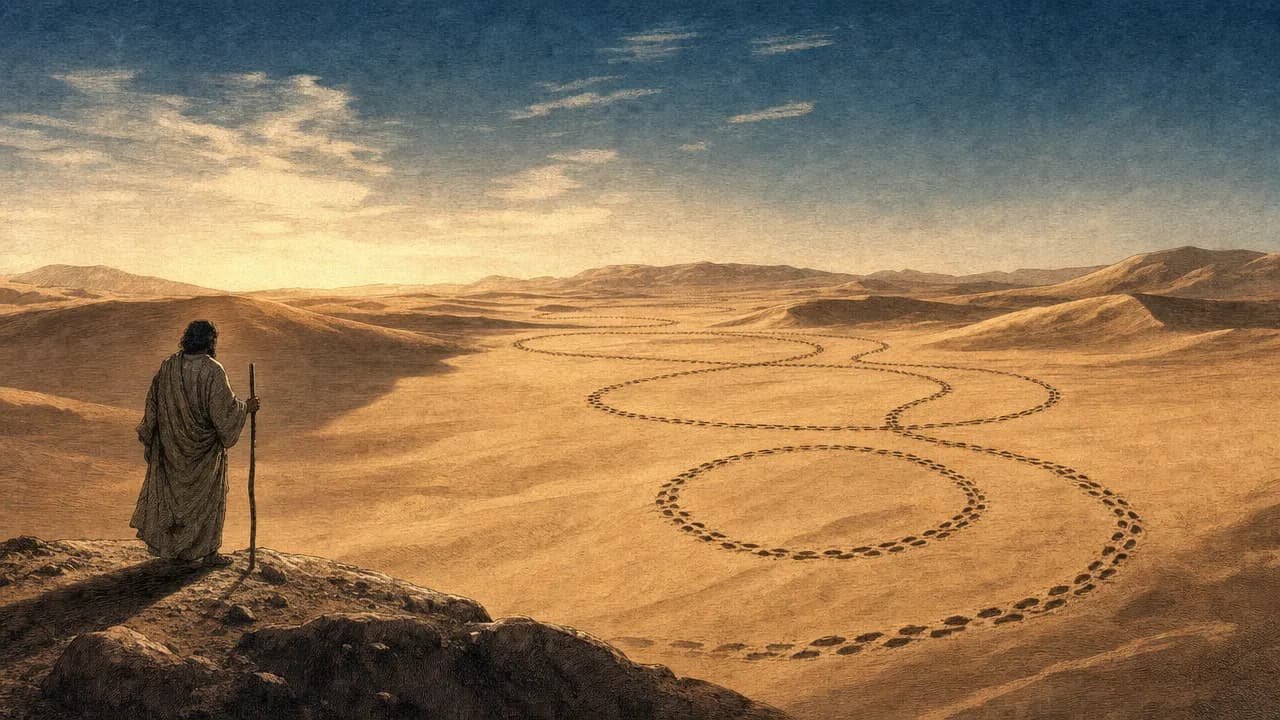
The community collapses into panic. They weep through the night, rail against Moshe and Aharon, and begin proposing a return to Egypt under new leadership. Moshe and Aharon fall on their faces; Yehoshua and Caleb tear their garments and plead that the land is good and that God will bring them in if only they do not rebel. The crowd answers by threatening to stone them. At this moment God's Presence appears, and God proposes to destroy the nation and begin anew from Moshe. Moshe intercedes, appealing not to Israel's merit but to God's own reputation among the nations and to the attributes of mercy God had earlier proclaimed. God pardons—but issues a measured decree: this generation, all those counted from age twenty who saw the wonders and still rebelled, will not enter the land. They will wander forty years, a year for each day the scouts spent in the land, until their bodies fall in the wilderness. Only Caleb and Yehoshua are spared. The ten scouts who spread the slander die by plague.
The looping path of footprints in the desert sand represents the forty-year delay, transforming a direct journey into a generation of spiritual refinement.
The doomed invasion at Hormah
When Moshe reports this to the people, grief overtakes them, and they swing to the opposite extreme. A group rises early and marches toward the hill country to seize the land after all, declaring they were wrong. Moshe warns them not to go: God is not among them, and they will fall. They go anyway, defiantly, while the Aron HaBrit—the holy ark housing the covenant—and Moshe remain in the camp. The Amalekites and Canaanites descend and shatter them at a place called Hormah. The same overconfidence that should have carried them into the land the day before now carries them to ruin a day too late.
Laws of offerings, dough, and the line between error and defiance
The text then turns abruptly to law. God gives instructions for offerings to be brought once the people enter the land: the meal, oil, and wine libations that accompany an olah or other korban, scaled to the animal offered. There follow the laws of challah, a portion of dough set aside as a gift, and a careful distinction between sins committed unwittingly—atoned through communal or individual korbanot—and sins committed defiantly, "with upraised hand," which sever a person from the people. The placement of these promises of future entry, immediately after a decree of death in the wilderness, signals that the nation's future in the land is not cancelled but deferred to the children.
The wood-gatherer and the commandment of tzitzit
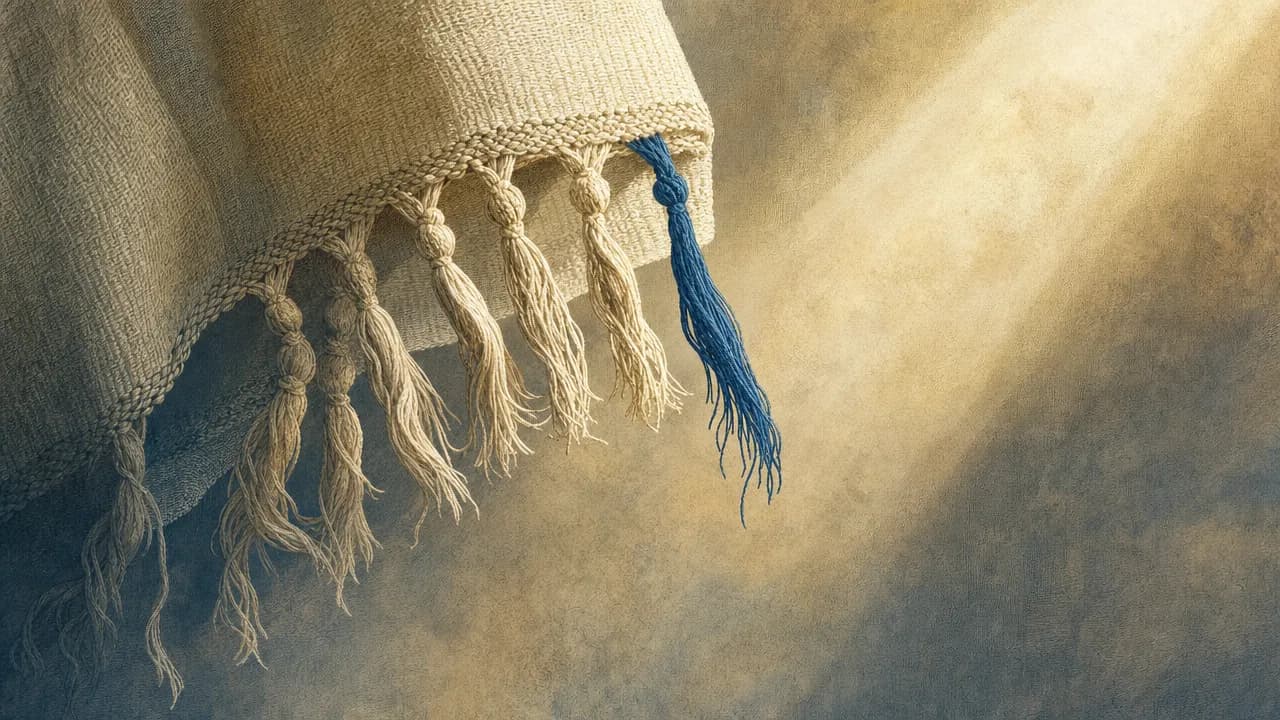
A short narrative interrupts: a man is found gathering wood on Shabbat. Because the penalty has not yet been specified, he is held in custody until God commands that he be stoned outside the camp, and so he is. The parashah closes with the mitzvah of tzitzit—fringes on the corners of the garment, with a cord of blue—which Bnei Yisrael are to look upon and thereby remember all of God's mitzvot, "so that you do not follow your heart and eyes" in straying. The people who began the parashah by following their eyes into despair end it holding in their hands a thread meant to redirect the gaze.
The blue thread of the tzitzit serves as a visual anchor, designed to redirect the eyes of a people prone to straying back toward divine instruction.
Generated 06/07/2026
Analysis axes
They form the central interpretive thread and appear interspersed in the essay below, connecting the parashah's sequence to a unified reading shaped by Rashi.
1.The mission to scout the land and the report that breaks the campשלח לךRashi on 13:2
2.From fearful report to blasphemous claim of weaknessחזק הוא ממנוRashi on 13:31
3.Rebellion, Moshe's intercession, and the decree of forty yearsכי תבאוRashi on 15:2
4.The doomed invasion at Hormahולא תתורו אחרי לבבכםRashi on 15:39
Interpretive Analysis4 Rashi axes at the turns of the reading
The deepest seam running through this parashah is not the sin of the scouts but the organ that sinned: the eye, and the verb that governs it. The mission opens with the word latur, to scout or seek out, and the parashah ends with that same root in the warning velo taturu—do not go scouting after your heart and your eyes. This is not coincidence but architecture. The Torah opens by sending the eyes out into the land and closes by tying a thread to the eyes to bring them home. To read the parashah as a story of failure followed by unrelated laws is to miss that the final mitzvah is a precisely engineered answer to the opening catastrophe.
Begin where the failure actually originates. The command shelach lecha—send for yourself—carries a strange permissiveness. God is not commanding the mission so much as conceding to a desire that has already formed in the people. The land has already been promised and described as good; nothing needs verifying. The concession itself is the test: a people secure in the divine promise would not have needed to look. Once the looking is granted, the failure is built into the structure, because the eye that goes out to confirm a promise has already replaced trust with sight. The scouts do not fail by seeing wrongly. They fail by treating their own perception as the final authority over what God has spoken.
Watch how quickly perception becomes theology. The scouts' report is accurate in its data—the cities are fortified, the inhabitants are large. The corruption enters in the interpretation: "it is stronger than we." The Hebrew mimenu is poised on a knife's edge, meaning either "than us" or "than Him." Read the second way, the sentence is no longer a military assessment but a verdict on God's power—the claim that the giants of the land outmatch the One who split the sea. This is the moment a scouting report becomes a rebellion. The slide from "we cannot" to "He cannot" is the entire distance between fear and heresy, and it is traveled in a single ambiguous word. The self that measures everything by its own eyes will eventually measure God by them too, and find Him wanting.
Now the turn to law stops looking like an interruption. The phrase ki tavou—when you enter the land—lands immediately after the decree that this generation will never enter it. Spoken to a people who have just been told their bodies will fall in the sand, these laws of libation and dough are not a change of subject; they are consolation disguised as legislation. By detailing exactly how offerings will be brought once Bnei Yisrael settle the land, God affirms that entry is certain—only the generation has changed. The children whom the scouts feared would be "carried off" are precisely the ones who will knead the dough and pour the wine. The legal section quietly reverses the scouts' despair by making the future land a matter of ritual detail rather than open question.
And so tzitzit at the close is not a pious afterthought but the structural counterweight to shelach lecha at the opening. If the heart and eyes are, in the Torah's own framing, the body's internal scouts—the agents that go out and bring back a report that seduces a person into sin—then the fringe is a permanent corrective lens fixed onto the very instrument that failed. The wilderness generation could not be trusted to look at a land and see God's promise rather than their own smallness. Their children are given a thread of blue to look at instead, so that every glance retrains the eye to recall the mitzvot rather than to wander after its own appetite. The grasshopper who could not see past the giant is handed a way to govern his own gaze.
Read this way, the parashah is bracketed by two acts of seeing that mirror and invert each other. At the start, twelve men are sent to look at a land and return having destroyed a generation's faith. At the end, every person in Israel is commanded to look at a corner of cloth and rebuild that faith daily. The book of Bamidbar is the account of a people learning, painfully, that the wilderness is not a place but a condition—the condition of measuring the promise against the evidence of the eyes. The remedy the Torah offers is not to stop looking but to consecrate the act of looking itself.
The cord of blue at the parashah's end recalls the sky, and the sky recalls the One who promised the land the scouts feared to enter. A people once undone by what they saw is now told, in effect, to keep looking—but to tie their sight to something that will not lie to them. What changes between Paran and the fringe is not the eye, but what it is bound to.
Generated 06/07/2026
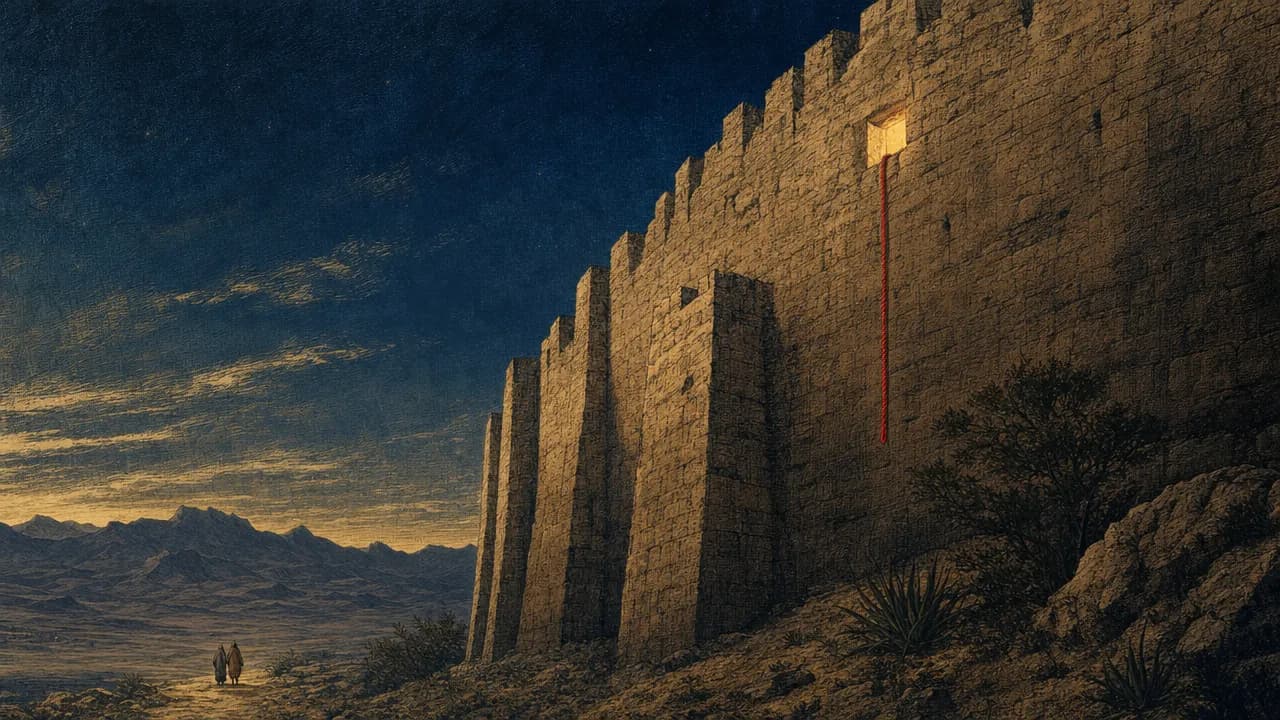
The stark contrast between Jericho's formidable stone walls and the fragile scarlet thread symbolizes how Rahab's quiet, courageous faith breached the city's defenses long before the battle began.
Context
This Haftarah is taken from the opening of Sefer Yehoshua, the book that follows the death of Moshe and recounts how Bnei Yisrael, the people of Israel, crossed the Jordan and took possession of the land. Yehoshua bin Nun, Moshe's faithful disciple and successor, now leads the nation as it stands poised on the threshold of the land.
The first city before them is Jericho, a stronghold so formidable that it was reckoned as strong as the whole land of Israel together. Before any conquest, Yehoshua sends two men to reconnoiter the city and its defenses. Unlike the spies sent in the days of Moshe, who were evildoers and brought back an evil report, these two men were righteous, and their mission would unfold very differently.
Interpretation
The Haftarah Explained
The two spies entered Jericho with great care, appearing as deaf and dumb men so that no one would ask where they came from. They presented themselves as potters carrying pots to sell, both so that the townsfolk would leave them alone and so that women would come to buy from them. Women speak freely and tell the secrets of a city, and the spies wished to learn whether the people of the land were afraid of the Jews. They came to the house of Rahab, who kept an inn where guests would lodge.
Word reached the king of Jericho that two Israelites had come to spy out how the city and the land might be conquered, and he sent to Rahab demanding that she hand the men over. But she had already hidden them. She told the king's messengers that two men had indeed come but had departed when the gate was locked for the night, and she urged the pursuers to chase after them toward the Jordan. The verse hints that she hid only one man, for the two spies were Pinchas and Calev; Pinchas, a kohen, said he was like an angel who cannot be seen and needed no hiding, while another reading is that she hid them both in a single tight hole, so cramped they seemed as one.
Having concealed them on the roof beneath stalks of flax, Rahab came up and made her great confession. She knew that God had given the land to Israel, for the dread of them had fallen upon all the nations. She had heard how the Holy One split the sea before them and destroyed the two mighty kings, Sihon and Og; their hearts had dissolved and no man had any spirit left, for the Lord is God in the heavens above and on the earth below.
Rahab then asked the men to swear, since she had shown them kindness, that they would deal kindly with her and spare her family, giving her a true and reliable sign. They agreed, but warned her not to disclose their words or the sign, lest her neighbors adopt the same protection. She lowered them by a rope through the window in the wall and told them to hide in the mountains for three days until the pursuers returned. The men instructed her to tie a red thread at the window, gather her family within the house, and any who stayed inside would be spared.
She sent them off and tied the crimson cord at the window. It is told that Rahab would always tie a red thread when she was menstruating, so that no man should come to her, and for forty years no man approached her at such times. Now she tied it both as the spies' sign and for its accustomed purpose. The two men hid three days, the pursuers searched in vain, and Calev and Pinchas returned to Yehoshua and reported that the Holy One had given the nations into their hands, for their hearts had melted before them.
Interpretation
Message
The Sages teach how Rahab could declare that no man had any spirit left: she had been a prostitute for forty years, and there was no chieftain in the land who had not come to her, yet now none came, for all were paralyzed by fear of Israel. Rahab was ten years old at the Exodus and lived those forty years in sin, but afterward she converted, confessing before the Lord of the Universe her failings in the three mitzvot entrusted especially to women, Nidah, the laws of family purity, Hallah, the dough offering, and the kindling of Shabbat candles, and asking forgiveness through the rope, the window, and the wall by which she had saved His messengers. For this she merited that eight prophets descended from her, and Yehoshua himself married her.
A woman the world wrote off recognized the hand of God where mighty kings saw only their own fear, and her faith and kindness lifted her from sin to the mother of prophets.