Shoftim: What a Hand May Hold, and What It Must Release
Israel's courts, kings, armies and elders are each defined less by the power they wield than by the grip they must relinquish.
Summary
1 min
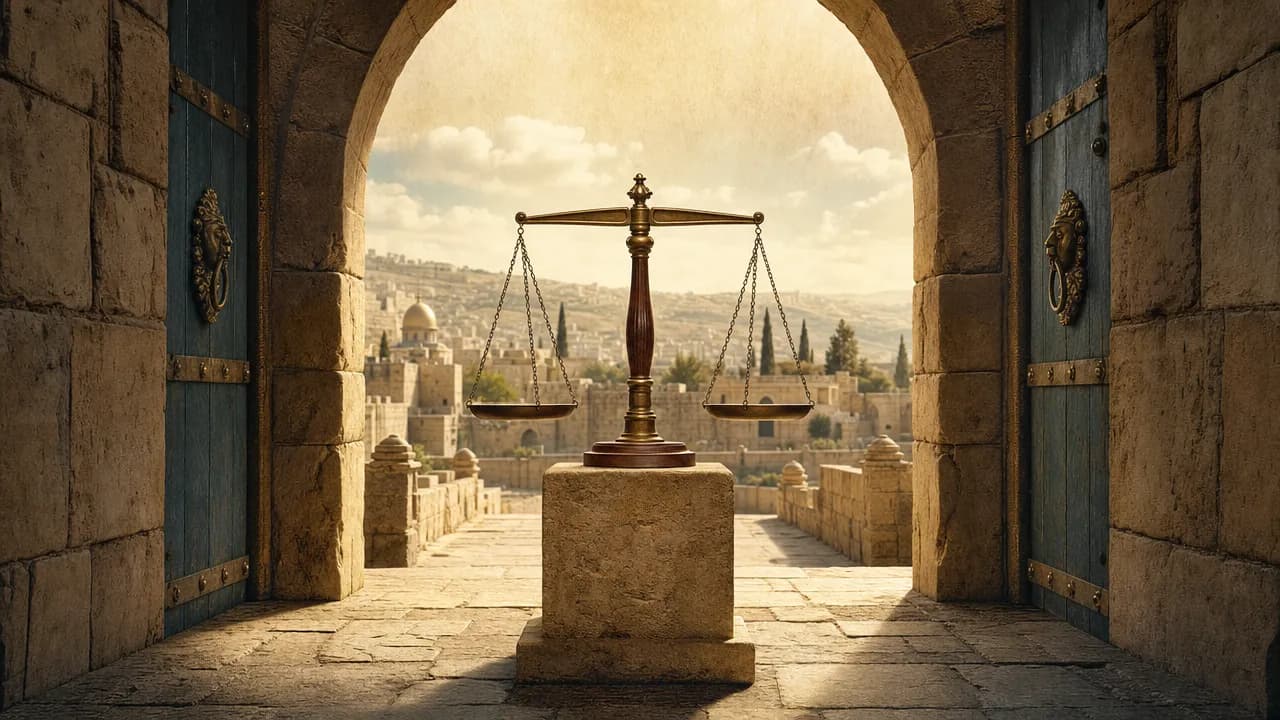
The image visualizes authority and redemption through the motif of the restrained hand, where true leadership and divine comfort are defined not by gripping power, but by releasing it.
Parashat Shoftim lays out the blueprint of a functioning nation: courts, a monarchy, a priesthood, an army, and a set of laws governing testimony and bloodshed. On the surface it reads like a constitution, an inventory of offices. But the analysis argues that the text defines its officials less by what they may do than by what their hands may not hold, tracing the single word yad, hand, through the whole portion. A judge is disqualified by a bribe in his hand; the witness in a capital case must be the first to raise his hand against the condemned, so that accusation is never a weapon held from a distance. The king, strikingly, is given no task at all: forbidden to amass horses, wives, or gold — the instruments of military and political leverage — he is left only with a Torah scroll to copy and read. Even the army empties itself before battle, dismissing the man with a new house, vineyard, or betrothed, and anyone afraid. The portion closes with elders washing their hands over an unworked heifer beside an untilled valley, swearing over an unsolved roadside killing that they never let a traveler leave unaccompanied — guilt measured not by what their hands did but by what they failed to extend.
In the haftarah, drawn from Yeshayahu among the readings of consolation that follow Tisha b'Av, the fast marking the destruction of the Temple, the prophet tells an exiled and humiliated people to stop fearing mortal men who wither like grass. The doubled opening, "I, I am the One who comforts you," is read as a promise of double payment. God takes the bitter cup of exile from Israel's hand and places it in their tormentors', and redemption will come not as a frightened flight but as a slow, public procession, with God walking before and behind so none is left behind.
Generated 08/09/2026
Parashah SynthesisBy topic
Moshe has been speaking for chapters now, and here his words turn into architecture. What follows is the blueprint of a society Israel has not yet built: courtrooms, a monarchy, an army, a priesthood, and a strange ritual for a death no one can explain. Read it slowly and in order — the sequence is doing work.
Synthesis topics
The Autoparashah methodology selected 7 topics to summarize the parashah's sequence.
Judges in every gate, and the doubled call to justice
Israel is still east of the Yarden, encamped in the plains of Moav, and Moshe is deep into the long address that fills Devarim. The parashah opens with no preamble and no story: "Judges and officers you shall appoint for yourself in all your gates." Judges to rule, officers to enforce what the judges rule. The tone is statutory and brisk, addressed to a single "you" who is about to become a functioning nation with towns, courts, and gates. What follows immediately narrows to how such a court must behave: do not bend a judgment, do not recognize faces — that is, do not let a litigant's identity or standing enter the reckoning — and take no bribe, because a bribe blinds even the eyes of the wise and twists the words of the righteous. Then comes the doubled charge, "Justice, justice you shall pursue," and, attached to it, a promise startling in its scale: that you may live, and inherit the land Hashem is giving you. The doubled word carries the sense of relentlessness; the promise attached to it makes honest courts a condition of national life.
The establishment of impartial courts at the city gate anchors Israel's national existence, transforming the pursuit of relentless justice into the fundamental condition for dwelling securely in the promised land.
Forbidden worship and the trial of the idolater
The text then turns abruptly from the gate to the Mizbeach, the altar of Hashem: do not plant an asherah, a cultic tree or pole, beside it; do not raise a standing pillar; do not offer an ox or sheep with a serious blemish. Having named what may not be set up in Israel's worship, Moshe brings the case that tests a court's nerve most severely — a man or woman found serving other gods, the sun, the moon, the host of heaven. Here the procedure matters more than the verdict: you must inquire, search, and ask thoroughly; the fact must be established; and no one dies on the word of a single witness, only on the testimony of two or three. Then a further requirement: whoever testified must be the first to lift a hand against the condemned, which makes accusation a costly thing. The people's hands follow afterward. Nothing here is left to rumor or to a mob.
The high court and the limits of dissent
Local courts will not always be able to decide. For a case too baffling — a matter of bloodshed, of civil claim, of assault — the litigants go up to the place Hashem will choose, to the kohanim of Levi and to the judge of that time, and the ruling handed down there is binding: do not deviate from it right or left. And the passage supplies the institution's spine. Whoever presumes to act against the kohen ministering there, or against the judge, is put to death, and all Israel will hear and fear. The high court is not merely wiser; defying it is treated as an attack on the possibility of law itself.
A king, and the inventory he may not amass
Next, kingship — introduced not as a command but as an anticipated request: when you enter the land and say, "Let me set a king over me, like all the nations around me." Permission is granted, with the king chosen by Hashem and drawn from among your brothers, never a foreigner. Then the restrictions, and they are all restrictions: he may not amass horses, nor send back to Egypt for them; he may not take many wives, lest his heart turn; he may not accumulate silver and gold. What he must acquire is a written copy of this Torah, made in the presence of the kohanim of Levi, kept beside him and read all his days — so that his heart not be lifted above his brothers, and so that he and his sons may reign long.
Levi's portion, banned divination, and the promise of a navi
Attention shifts to those who hold no land at all. Levi has no territorial portion; Hashem is his portion, and he lives from the offerings — the shoulder, the cheeks and the stomach of a slaughtered animal, the first of grain, wine and oil, the first shearing of the flock. Any Levi who comes from his town to the chosen place may serve there and eats an equal share. Then Moshe forbids the practices of the nations Israel is displacing: passing a son or daughter through fire, and the whole catalogue of divination — augury, soothsaying, sorcery, spells, consulting ghosts and the dead. In the middle of this list stands a positive charge: "Whole shall you be with Hashem your God." Israel is not left without access to God's word; it will have a navi, a prophet raised up from among the people, speaking what God places in his mouth. This answers what Israel itself asked at Chorev, when it could not bear to hear the voice directly. A prophet who speaks presumptuously dies, and the test is plainly given: if the word does not come true, it was not spoken by Hashem, and you need not dread him.
Cities of refuge, boundary stones, and false witnesses
The next block concerns blood and testimony. Three cities are set aside, with roads measured so that a man who kills unintentionally can reach one — the case given is an ax-head flying loose from its handle and striking a companion in the forest. Without such cities, the redeemer of blood, the victim's kinsman, would overtake him in hot anger and kill a man who did not deserve death. Three more cities are promised if the borders expand. But the man who lay in wait out of enmity and struck to kill gets no shelter: the elders of his own city fetch him back and hand him over. Two further laws follow: do not move your neighbor's boundary marker, set in place by earlier generations; and again, no single witness establishes anything. A witness who testifies falsely and maliciously is investigated by the court and then suffers exactly what he schemed — life for life, eye for eye, hand for hand.
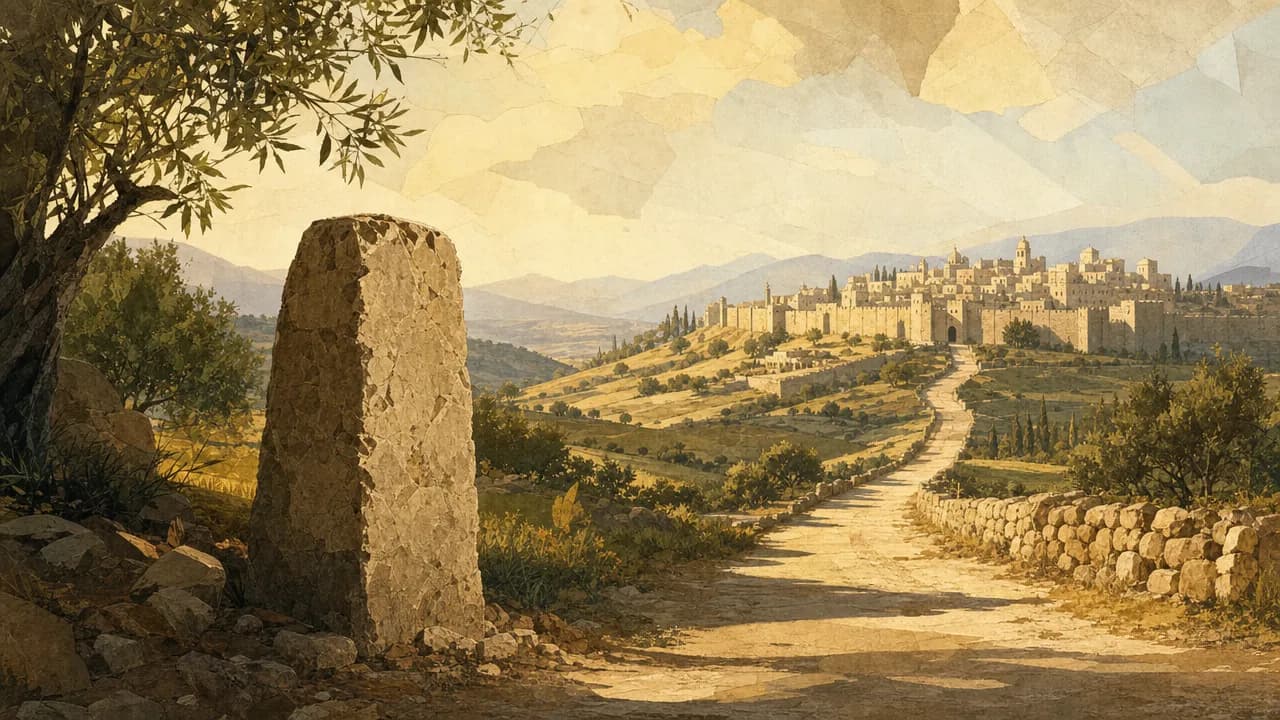
Designating cities of refuge and permanent boundary markers creates a landscape of sanctuary and integrity, protecting accidental life while upholding communal accountability across the expanding tribal territories.
War, siege, and the heifer in the untilled valley
War comes last, and it comes with a warning against fear: you will see horse and chariot, a force larger than yours, and you shall not be afraid. A kohen addresses the troops; then the officers dismiss whoever built a house and has not dedicated it, planted a vineyard and not used it, betrothed a wife and not married her, and finally whoever is simply afraid, lest he melt his comrades' hearts. Only then are commanders appointed. A distant city is offered terms of peace before it is besieged; the cities of the seven nations in the land itself are not, lest Israel learn their practices. Even in siege, the fruit trees may not be cut down — "is the tree of the field a man, that it should come before you in the siege?" The parashah then closes on a case with no defendant. A slain man is found in the open field and no one knows who struck him. Elders and judges go out and measure to the nearest town; its elders take a heifer that has never been worked, bring it down to a wadi that is not tilled or sown, and break its neck there. The kohanim stand by, the elders wash their hands over the heifer, and they say: "Our hands did not shed this blood, and our eyes did not see." They are not under suspicion of the killing; their oath concerns their own conduct and their own town — that nothing they did or failed to do left a man dead on the road. Then they ask Hashem to absolve Israel, and the parashah ends with the land cleared of that blood.
Sparing fruit-bearing trees during military siege and measuring distances for an unsolved death reflect a profound ethic of life that holds the community accountable for every unseen tragedy.
Generated 08/09/2026
Analysis axes
They form the central interpretive thread and appear interspersed in the essay below, connecting the parashah's sequence to a unified reading shaped by Rashi.
1.Judges in every gate, and the doubled call to justiceלמען תחיה וירשתRashi on 16:20
2.Forbidden worship and the trial of the idolaterתמים תהיה עם ה' אלהיךRashi on 18:13
3.The high court and the limits of dissentכי תצא למלחמהRashi on 20:1
4.A king, and the inventory he may not amassידינו לא שפכהRashi on 21:7
Interpretive Analysis4 Rashi axes at the turns of the reading
Follow one small word through this parashah and its whole architecture reorganizes itself: yad, the hand. Shoftim reads on the surface like a constitution — an inventory of offices, each with its jurisdiction. But the text does not actually define its officials by what they may do. It defines them, almost obsessively, by what their hands may not hold. Read it this way and the parashah stops being a list of institutions and becomes a single sustained discipline of the grip: the hand that must not take, must not move, must not wield, must not close on the future, and at the end must be washed and held open.
The evidence is unusually concrete. The judge's disqualification is a bribe in the hand, which blinds eyes that were open. The one hand licensed to kill belongs to the witness who spoke, placed first so that testimony can never be a weapon held at a distance. You may not move a boundary stone your neighbor's ancestors set. You may not swing an ax at a fruit tree even when a siege makes it convenient. And when the false witness is sentenced, the formula runs "hand for hand" — the hand that reached to destroy is itself the reckoning. Most telling is the paradigm case of unintentional killing: not a moment of rage, but an ax-head slipping loose from the handle. The whole institution of refuge cities is built around a hand that could not hold what it was holding. Israel is commanded to build roads and measure distances for the sake of human hands that fail.
The same logic governs the two figures who look least alike. The king's prohibitions are not a random list of vices; they are precisely an inventory of leverage — horses, which are military reach; many wives, which are alliance and dynasty; silver and gold, which are the capacity to compel. Strip those and notice what remains: the king is the only figure in the parashah given no job at all; his entire portfolio is a scroll. He is never assigned command of the army, never seated on a court, never sent to war. He writes and reads, all his days, so that his heart not rise above his brothers. And the same relinquishment is demanded of every Israelite in the domain of time: "Whole shall you be with Hashem your God" is set down in the middle of the divination laws because divination is the hand closing on what has not yet happened. The classical reading takes tamim exactly there — walk with Him wholeheartedly, do not investigate the future, and whatever comes upon you, receive it. What Israel is given instead is a navi, whose authenticity can only be recognized after the fact. No technique, no leverage, no advance purchase on tomorrow.
This is why the transition to warfare, which looks like a change of subject, is nothing of the kind. The received reading of "when you go out to war" is that Scripture placed the campaign here, immediately after the laws of testimony and false witness, to say: if you have executed just judgment, go out confident of victory. That claim is not an edifying flourish; it is the same claim already made when the doubled "Justice, justice you shall pursue" was joined to living and inheriting the land — the appointment of honest judges is itself sufficient merit to keep Israel alive on its soil. Security is being relocated. It does not sit with horses and chariots, which the parashah tells you not to fear, and which the king may not stockpile. It sits in the gates.
And so the war chapter does something no army would do: it empties itself. Before a single command is issued, the officers dismiss the man with a new house, the man with a young vineyard, the man with a betrothed wife, and finally anyone afraid. Only after the ranks have been thinned are commanders appointed over what remains. The force that goes out is a force from which everything that could be gripped — property, harvest, marriage, even nerve — has been released. It is the king's stripped inventory enacted on a national scale, and it is offered as the condition of victory rather than its obstacle.
The parashah opened with "you shall appoint" — hands taking hold of the machinery of a state. It ends with elders washing their hands over a heifer that has never pulled a yoke, in a wadi that is not tilled or sown: unused strength, unforced ground, and an oath that reads, taken literally, as absurd, since no one suspects the high court of murder. The classical commentary hears in it a different confession — that they never let a traveler leave their town without food and without escort. The guilt in question is not what their hands did but what their hands failed to extend. That is the inversion Devarim is driving at in a book otherwise thick with the language of taking possession: the last word of Israel's judicial code is not a verdict, a conquest, or a punishment, but leaders standing in an unplowed valley, accounting for a stranger on a road at the margin of their reach.
An ax-head flies from a man's hand and someone dies; elders wash their hands and say they shed no blood. Between those two images the parashah places every office Israel will ever hold. It is worth asking why a text that so carefully builds courts, kings, and armies chose to end with the one case none of them can solve.
Generated 08/09/2026
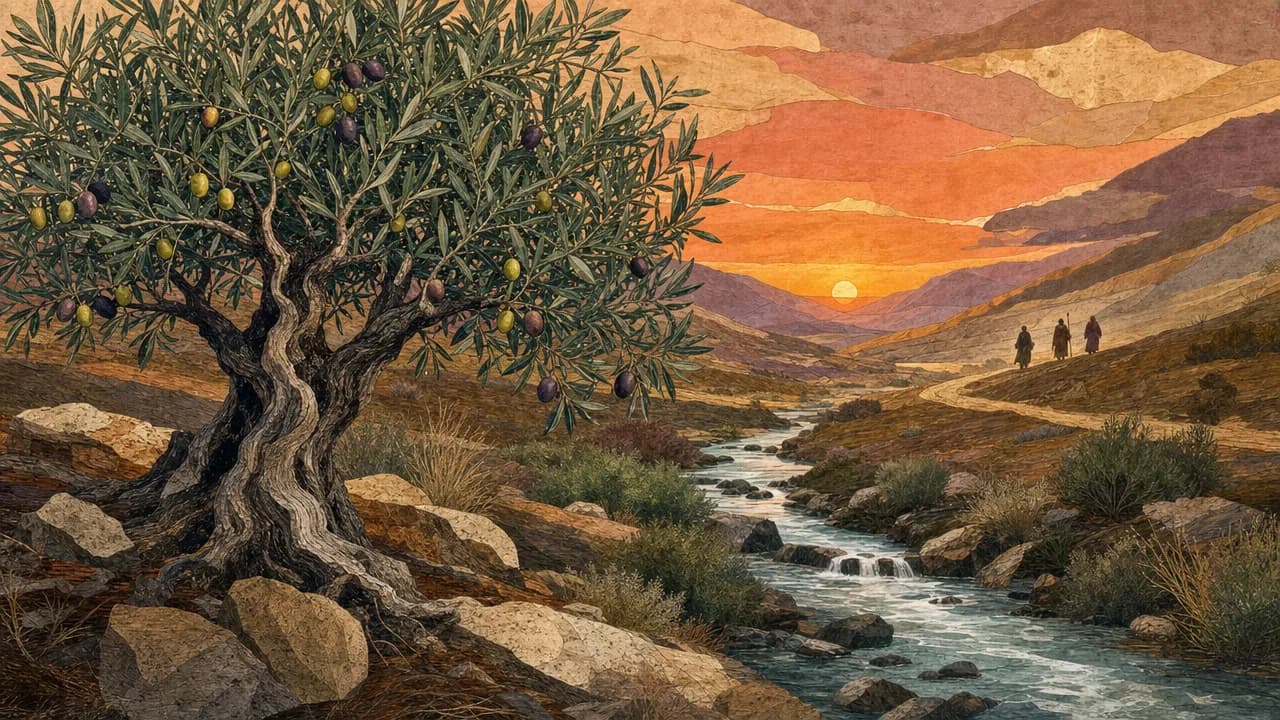
The image condenses the haftará’s central gesture: the cup of exile lifted from Zion’s dust and emptied, while light on the mountains heralds the comfort that will not leave Israel behind.
Context
This Haftarah comes from the book of Yeshayahu, the prophet who spoke in Jerusalem in the generations of the Assyrian threat, and whose later chapters look far ahead to the exile of his people and to their redemption. It is one of the readings of consolation that follow Tisha b'Av, the fast marking the destruction of the Beit HaMikdash, when Israel most needs to hear a prophet's voice of comfort.
The passage speaks to Israel as a people already scattered and humiliated among the nations, addressed here under the name of the city that embodies them: Zion, Jerusalem lying in the dust. Its subject is not the punishment but its end — the exile of Babylon and the long exile that followed, and the promise that both will be undone.
Interpretation
The Haftarah Explained
"I, I am the One who comforts you" — the Holy One tells Israel that they are righteous and full of merit, and asks why they should tremble before a human being who may die any day, a man who withers as quickly as grass. "You have forgotten GOD your Maker": they have failed to rely on the One who is able to help them, who formed them and formed the heavens and the earth as well. The rage of an oppressor flares up today and tomorrow is gone. When the prophet says "Quickly the crouching one is freed; he is not cut down and slain," he means that the persecution will soon end, and that even if exile is like a grave, Israel will not die there — those who do die in exile will rise again at the resurrection of the dead, and meanwhile they will not lack food among the nations. There is another way to hear the words: the mortal you fear is himself a weak creature. Eat too much and his stomach pains him; eat nothing and he starves. "He shall not want for food" — he must eat every single day simply in order not to die. Such is the man before whom Israel cowers.
"I the ETERNAL your God — who stirs up the sea into roaring waves": I am the One who split the sea and set its winds roaring, and I can certainly bring you out of exile. "Have put My words in your mouth" — I gave you My words so that you would be My people, and covered you with My hand to shield you from your enemies; so will I shelter you through the exile until the Mashiach, the redeemer promised to Israel, comes and the heavens and earth are renewed. Then the address turns to the city: "Rouse, rouse yourself! Arise, O Jerusalem" — you have drunk enough of the bitter drink of exile, drained even the dregs, and there was none among all the children you reared to lead you back on the right path. Two evils came upon you, hunger and the enemy's sword; ordinarily a sufferer finds some comfort in learning that others have borne the same, but here there was no one to be found whose anguish matched yours. Your children lay fainting with broken limbs at every street corner, Israel caught in exile like a wild ox in a net, drunk with sorrow and not with wine.
Then comes the reversal. "Thus said GOD, your Sovereign" — He is Israel's Master while the nations are only Israel's temporary lords, and He will fight the nations on His people's behalf. He takes the cup of reeling from Israel's hand, never to be drunk again, and places it in the hands of the tormentors — those who said "Get down, that we may walk over you," until Israel lay flat like a paved boulevard for the nations to tread upon. "Awake, awake, O Zion!": put on again the beautiful garments you once wore, for the uncircumcised and the impure will not enter Jerusalem again. Shake off the dust of exile, take your seat, and loosen the bonds from your neck. You were sold for no price — it was your sins that sold you — and you will be redeemed not with silver but with teshuvah, the return to God.
God recalls that Israel went down to Egypt of its own accord, and later into the exile of Babylon, where the king of Ashur seized them and gave nothing in return. And now, in this long third exile, what has been earned by so much waiting? "My people has been carried off for nothing" — they owe the nations no money; only their sins have done this, while God's name is reviled among the nations. But in the time of redemption His name will be recognized, and every word He spoke through the prophets will be seen to have come true.
The close of the Haftarah is pure anticipation. How lovely will be the feet that run over the high mountains announcing peace, the coming of the Mashiach, and God's kingship over Zion — for the nations ruled Zion in her exile, but then the whole world will declare that God reigns. The watchmen will cry out together from the ramparts, prophecy that ceased in exile will return, and every eye will behold Him clearly. Even the ruins of Jerusalem will lift their voices in song. God will bare His holy arm before all the nations and their rulers, and they will see who brings Israel out. "Turn, turn away, touch naught impure" — leave the nations behind, purify yourselves of every impurity and sin, you who bear no sword and no bow but only the mercy of the Holy One, which is your sword and spear. And this departure will not be a flight: Israel will walk out openly and unhurried, with God going before them and behind, helping along whoever has not the strength to walk.
Interpretation
Message
The opening words are doubled — "I, I am the One who comforts you" — and the sages read the repetition as a promise of double payment. A king in his anger sent his wife away; when he wished her back, she asked that her marriage contract be rewritten for twice the sum. So Israel, driven into exile, asks the Holy One to double the ketubah, the marriage contract binding husband to wife. At Sinai He said "I am the Lord your God" once; at the redemption He says "I, I" — the consolation will exceed the covenant that preceded it.
Everything else in the Haftarah follows from that doubling. The fear of mortal men is misplaced because such men must eat daily to stay alive, while the God who split the sea has pledged His hand over Israel. The cup Israel drained to its dregs is not endless; it passes to other hands. And the redemption, when it comes, will not be a frightened escape but a slow, public procession, with the Holy One walking ahead and bringing up the rear so that no one is left behind.
Israel was sold for nothing and will be bought back with nothing but teshuvah. The comfort offered here is not that the suffering was small, but that the One who permitted it has never let go of His people's hand.