Context
This Haftarah comes from the closing chapter of Zecharyah, a prophet among those who returned from Bavel to rebuild the Beit HaMikdash after the seventy years of exile. His earlier prophecies encourage a small, struggling community to finish the building; his last chapters lift their eyes far past their own generation to the end of days.
Here the subject is the final confrontation: the war of Gog and Magog, the coalition of nations that will gather against Yerushalayim in the days before the redemption. The chapter is read on Sukkot because it ends precisely there — with the surviving nations making their yearly pilgrimage to Yerushalayim to bow before Hashem and to keep the festival of Sukkot.
The Haftarah Explained
"Lo, a day of God is coming" — a day on which the greatness of the Holy One will be revealed. First, though, comes the bitterness: Gog and Magog descend upon the land and divide the spoil among themselves. Hashem Himself gathers the nations to Yerushalayim; the city is taken, houses destroyed, women violated, and half the city driven into exile and held captive in the enemy camp outside the walls. Then the half that remains goes out to fight for their imprisoned brothers, and Hashem goes into battle alongside them, "as a fighter makes war on a day of battle," and they prevail. Our Sages traced the arrogance behind this war: Esav thought Kayin a fool for killing Hevel while their father could still have more children; Pharaoh thought Esav a fool for waiting, and killed the newborns; Haman thought Pharaoh a fool for sparing the daughters, and decreed against men, women, and children alike. Gog says all of them were fools, for they never noticed that Israel has a Protector in heaven — so he proposes to wage war first against the Holy One Himself. To which Hashem replies: you wish to fight Me? I will gladly fight you.
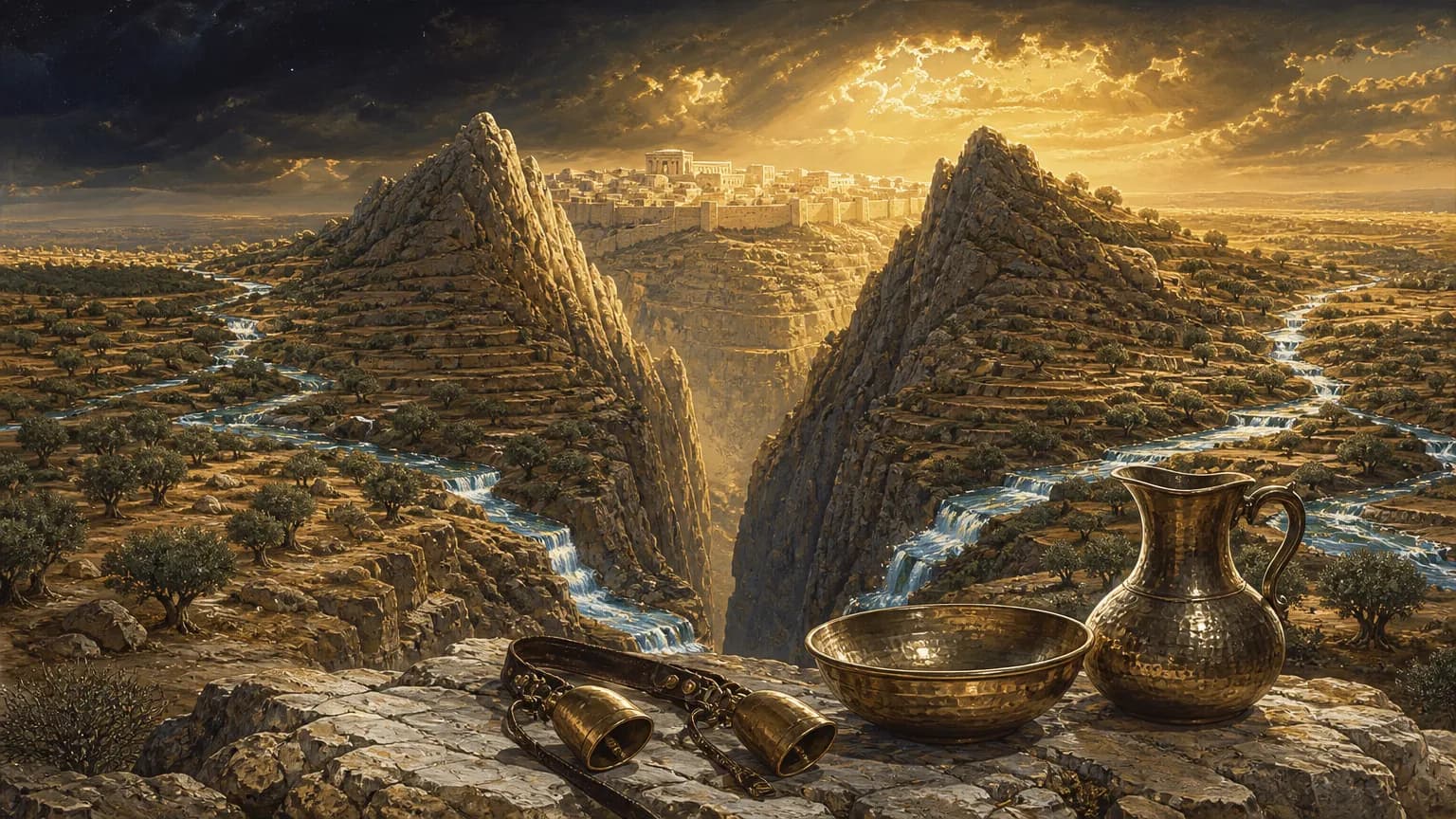
On that day His feet stand on Har HaZeitim, the ridge east of Yerushalayim, and the mountain tears in two, one half moving north and one south, leaving a vast valley between. Through that valley the people flee, as far as Atzal, running from the upheaval as their ancestors fled the earthquake in the days of Uziyahu, king of Yehudah. And then Hashem comes with all His holy angels to take vengeance.
What follows is a day unlike any other — neither daylight nor cold moonlight, a day that is neither a day of trouble nor yet a day of redemption, but a day given over to proclaiming Hashem's wonders. "And there shall be light at eventide": when Israel's night is darkest, in exile and captivity, that is when Hashem kindles the light of their redemption. Living waters then flow out from Yerushalayim, half eastward and half westward, unstopped by winter's cold or summer's heat. These waters will swallow up the waters of Shittim, where Israel once fell into immorality, for as Hashem promised, "I will sprinkle clean water on you" — the yetzer hara, the evil inclination that drives a person to sin, will be removed from Israel in the days of the Mashiach. "And God shall be sovereign over all the earth": all will recognize that He alone is God. The hills around the city will be flattened like the Arabah, the low Jordan plain, so that Yerushalayim stands high and visible, settled and never again uprooted.
Upon the nations that warred against her falls a terrible plague: their flesh drops away while they still stand, their eyes drain from their sockets, their tongues dissolve in their mouths. Madness seizes them and they strike one another down, and the plague takes their horses, mules, camels, and donkeys as well. Those who survive will come up to Yerushalayim every year on Sukkot — the very season of the war — to bow before Hashem and mark their deliverance. Whoever refuses will be denied rain and die of hunger; and since Mitzrayim, whose grain grows from the Nile, has no need of rain, it will be punished by other means.
The chapter closes in holiness reaching down into the smallest things. Even the bells hanging from the necks of horses will be inscribed "Holy to God," and from such metal pots will be made for the Beit HaMikdash, for the korbanot will be so numerous that the Temple's own vessels will not suffice and pots will be brought from the houses of Yerushalayim and Yehudah. No traders will be needed in the House of Hashem: craftsmen will be hired and vessels donated freely. And the Givonim, the servants who once chopped wood and drew water for the kohanim, will be replaced — nobles themselves will draw the water in the days of the Mashiach.
Message
Zecharyah does not hide the darkness. Half the city goes into captivity before anything is put right, and that captivity is described as a test — whether Israel will hold fast to the Holy One when nothing visible supports their faith. The answer the prophet gives is not that the darkness is unreal, but that it is not final: "at evening time there will be light." The redemption arrives at the hour when hope has least to stand on.
And when it arrives, it is total. One God, one Name, recognized by every nation; waters that wash away the very inclination to sin; a city that will never again be emptied of its people; and a holiness so abundant that ordinary household pots and the bells on a horse's harness are drawn into the service of the Beit HaMikdash. That is the vision we read on Sukkot, sitting in a fragile booth, while the nations of Zecharyah's prophecy are pictured streaming up to Yerushalayim to keep this very festival.
The war of Gog and Magog is fought on Sukkot, and Sukkot is the festival the survivors will keep forever. What begins as the world's assault on Yerushalayim ends as the world's pilgrimage to her.