Context
This Haftarah comes from the book of Zechariah, a prophet who spoke to the Jews who had returned from the Babylonian exile to rebuild the Beit HaMikdash in Jerusalem. His words are addressed to a fragile community whose enemies hoped to halt the rebuilding, and who needed reassurance that God had not abandoned them.
Two figures stand at the center of the passage: Joshua, the Kohen Gadol of the returning community, and Zerubbabel, who led the building of the second Beit HaMikdash. Through visions granted to the prophet, both men are shown that the future of the Jewish people and their sanctuary rests entirely in the hands of Heaven.
The Haftarah Explained
The passage opens with a promise of joy: "Shout for joy, fair Zion." When the Messiah comes, the Holy One will sing and rejoice over the city of Zion, for He will come and rest among her. Many nations will attach themselves to God on that day and become one people in whose midst He will dwell. Each Israelite will inherit his portion in the Holy Land, and Jerusalem will be chosen again. Then comes the call, "Be silent, all flesh, before the Lord" — all creation must fall silent, for God will rouse Himself from heaven. King David begged God to arise, yet the answer was that God arises in His own time: when He sees the poor treated unjustly and the needy crying out, then He acts, and then every person should stand in awe and be still.
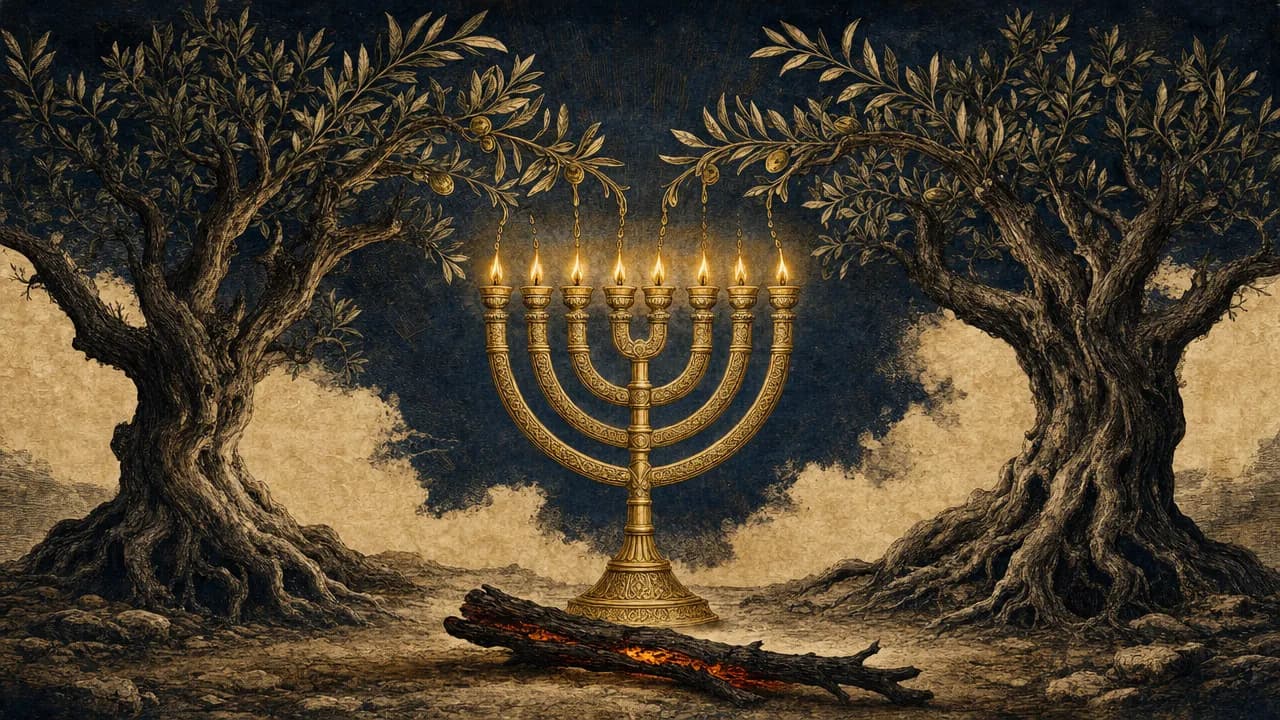
The prophet is then shown Joshua the Kohen Gadol standing before the angel of God, with the Accuser at his right hand seeking to speak evil of him. The angel rebukes the Accuser: God who has chosen Jerusalem rebukes you, for this man is "a brand plucked from the fire." The tradition recalls how two false prophets, Zedekiah and Ahab, were cast into Nebuchadnezzar's furnace together with Joshua, who joined them hoping his merit might protect all three. The two were consumed, while Joshua emerged with only his garments singed — for when dry logs burn beside damp wood, even the wet log is scorched. Joshua was thus separated from the fire.
Joshua appears dressed in filthy garments, which represent transgressions that cling like stains — in his case, his failure to warn his children against marrying divorcees, which is forbidden. The angel orders the soiled clothes removed and assures him that God forgives his sins and will clothe him in beautiful garments. He is told that if he walks in God's ways he will rule over the House and Temple, and if he remains pious he will be granted a place among the angels who stand eternally before the Holy One. Joshua and his companions, men for whom God works wonders, are a sign of the coming Messiah, called Zemach. The single stone set before Joshua promises that Zerubbabel's Beit HaMikdash will stand, guarded by God as if by seven watching eyes, and that the schemes of the wicked will be undone and the land's sins removed in a single day.
The angel then wakes the prophet as one is roused from sleep and asks what he sees. He describes a golden candelabrum with a bowl above it holding oil, seven branches, and seven pipes feeding oil into each branch — and two olive trees, one on each side, supplying oil so that it never runs dry. When the prophet asks how the oil flows by itself into the bowl and on into each lamp with no human hand involved, the meaning is revealed: "Not by might, nor by power, but through My spirit, says the Lord." Just as the trees and lamp fill themselves, so the Beit HaMikdash will be built by God Himself, not by human strength.
Message
The heart of this Haftarah is the assurance that the rebuilding of the Beit HaMikdash does not depend on human power. To those facing enemies who seemed an unconquerable mountain, the word came that for Zerubbabel the righteous the work would be as easy as building on smooth ground — "Not by might, nor by power, but through My spirit." Just as the olive trees feed the lamp without any human hand, so God Himself sees His House completed. And just as the crowds once cried "Beautiful, beautiful" when the first stone was laid, so the whole structure would rise with His blessing.
Joshua, plucked from the fire and clothed anew, and the lamp that fills itself with oil together teach that redemption and rebuilding come not by human strength but by the spirit of God.