Context
This Haftarah comes from Sefer Shmuel Alef, the book that tells how Israel passed from the era of the Shoftim, the judges who led before the monarchy, to the rule of kings. It is read when Rosh Chodesh, the new-moon day, falls on a Sunday, and so it bears the name Machar Chodesh, after Yehonatan's opening words, "Tomorrow will be the new moon."
Shaul, Israel's first king, has turned against David, the young warrior whose victories have won the people's love and whom Shmuel has quietly anointed as Shaul's successor. Caught between them stands Yehonatan, Shaul's son and rightful heir, who loves David as his own soul. The two friends have just bound themselves by oath, and Yehonatan has promised to learn whether his father truly means David harm. Our passage opens as they settle on a secret signal.
The Haftarah Explained
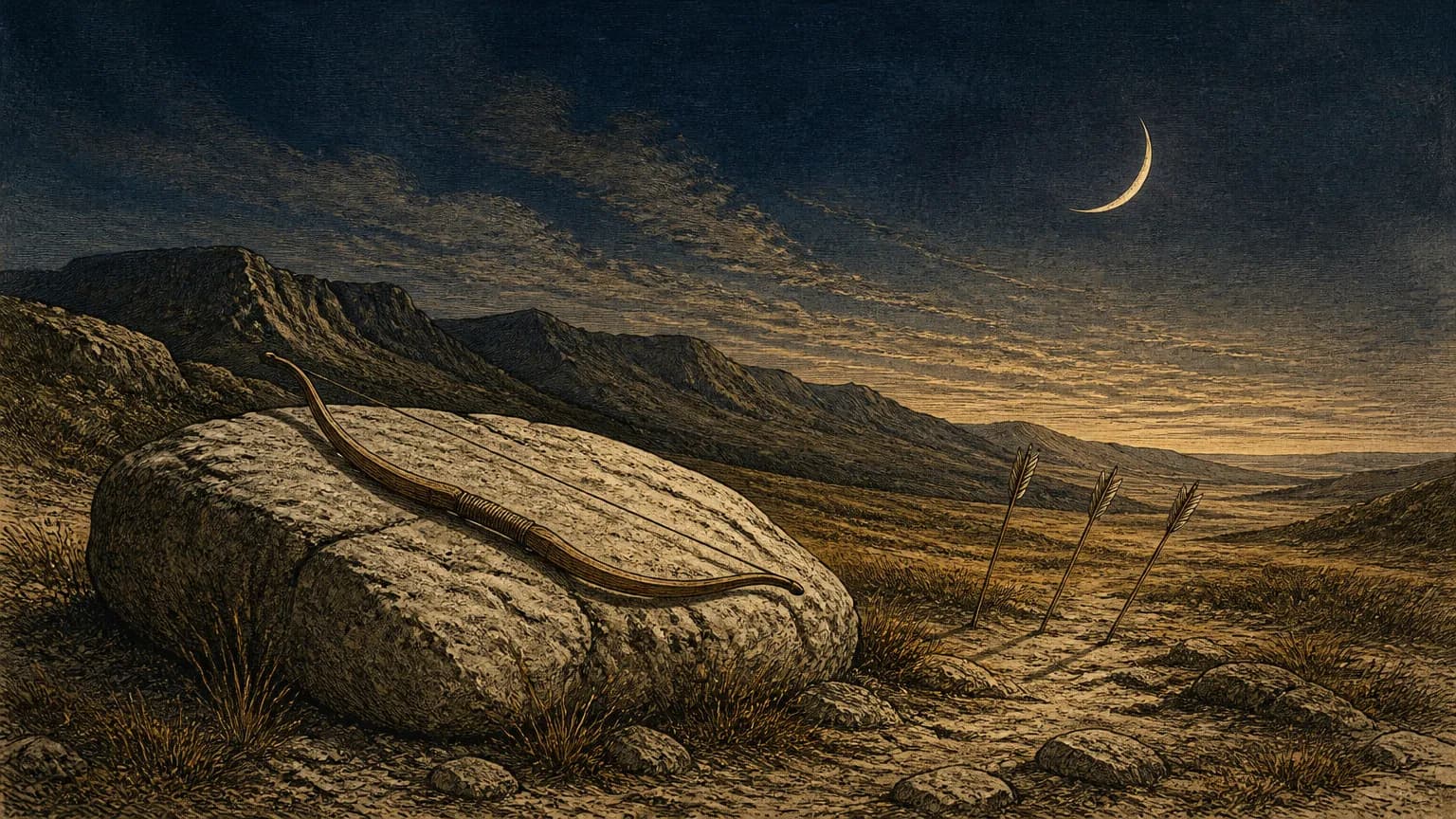
Yehonatan lays out the plan with care. At the new-moon feast David's seat will be empty, and the king will notice. On the third day David is to hide by the Ezel stone, a landmark in the field near the city. Yehonatan will shoot three arrows as if at a target and send a boy to fetch them. If he calls, "the arrows are on this side of you," David may come out in safety; if he calls, "the arrows are beyond you," David must flee, "for GOD has sent you away." Even in danger, Yehonatan places their bond under Heaven: "may GOD be witness between you and me forever."
The feast begins. Shaul takes his usual place by the wall, with Avner, commander of the king's army, at his side, and David's seat stands vacant. On the first day Shaul says nothing, assuming David has become ritually impure and cannot yet eat of the sacred meal. On the second day the empty seat can no longer be explained away, and Shaul asks pointedly why "the son of Yishai" has not come.
Yehonatan offers the agreed answer: David asked leave to join a family feast in Beit Lechem, his home town. Shaul's anger erupts. He insults Yehonatan and his mother, and then he speaks the truth that drives his fury: "For as long as the son of Yishai lives on earth, neither you nor your kingship will be secure." He demands that David be brought to him for death. Yehonatan answers simply, "Why should he be put to death? What has he done?" In response Shaul hurls his spear at his own son. Now Yehonatan knows his father's intent. He leaves the table in anger and eats nothing, grieved for David and humiliated by his father.
In the morning Yehonatan goes out to the field with a young boy. He shoots, and as the boy runs he calls the fateful words: "the arrows are beyond you!" Then, urgently, "Quick, hurry up. Don't stop!" The boy gathers the arrows, understanding nothing; only the two friends know what has been said. Yehonatan sends him back to town with the gear.
Then David emerges. He bows to the ground three times before the prince, and the two kiss and weep together, David weeping the longer. Yehonatan's last words return to the oath: "Go in peace! For we two have sworn to each other in the name of GOD: 'May GOD be witness between you and me, and between your offspring and mine, forever!'"
Message
Shaul names exactly what Yehonatan stands to lose: the throne itself. Yehonatan hears it and still asks only what David has done wrong. His loyalty is not naïve, since he has seen the spear and understood. It is a loyalty that has measured the cost and accepted it, because it rests on an oath made before God. That is why the parting, for all its tears, is not an ending. The friends separate, but the covenant reaches forward to their descendants, with God Himself as the witness who does not leave.
An empty seat at the king's table, three arrows in a field, and two friends weeping. Through it all, a covenant sworn in God's name endures beyond the parting.