Context
This Haftarah is drawn from the book of Micah, one of the twelve minor prophets whose words were spoken to Bnei Yisrael, the people of Israel, in the era of the kings. It is paired with Parashat Balak, since the prophet himself recalls the episode of Balak, king of Moav, and Bilam, who was hired to curse Israel and could only bless them.
The passage moves through two horizons. First it gazes far ahead, to the great war of Gog and Magog and the redemption that follows it. Then it draws close, presenting a kind of courtroom scene in which God Himself sets out His case before Israel, recalling the kindnesses He has done and asking what He requires in return.
The Haftarah Explained
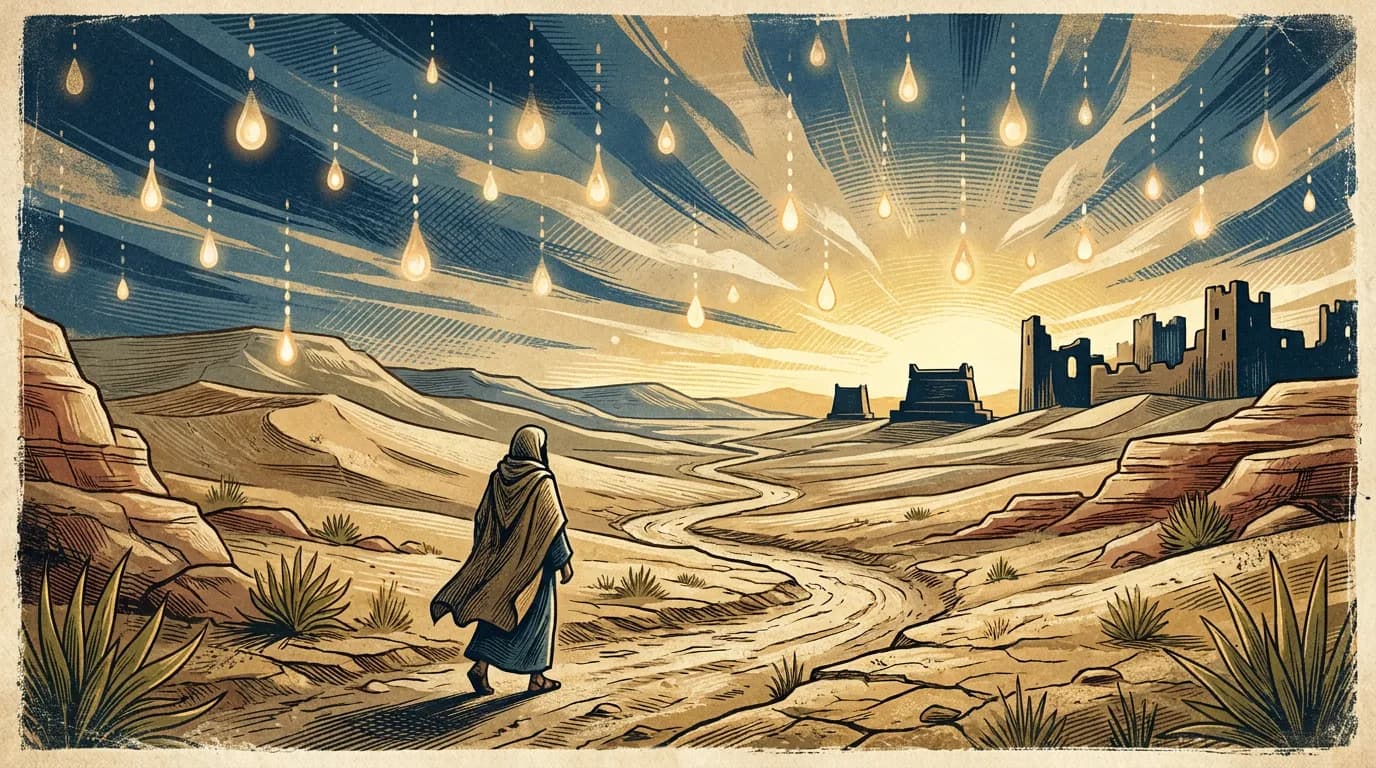
The prophet opens with a vision of the end of days. When Gog and Magog come and Israel suffers great troubles, falling captive among the nations, those who endure will believe in God and in the Mashiach, and their suffering will purify them of sin like pure silver. The remnant that survives will be "like dew from God"—for Israel places its hope in the Holy One alone and not in any human helper, and through this merit they will be redeemed. Yet that same remnant will also be "like a lion among beasts of the wild," for Israel found itself among nations so numerous and so strong that no one could rescue them from their grasp, as a cow caught among lions cannot be saved.
Then the tide turns. God need only raise His hand against the vast nation of Gog and Magog, and they are cut down and destroyed. A great peace follows the war: Israel will no longer need horses for battle, nor walled and fortified cities, for their open towns will be secure. God promises also to remove sorcery from their midst—indeed, to remove the evil inclination itself in the days of the Mashiach—so that there is peace not only from the nations but peace within the body, where the good and evil inclinations once warred. The idols will be cut down, and the nations that did not heed God's commands will be visited with anger and wrath.
Now the scene shifts to judgment. "Hear what God is saying"—God calls Israel to a reckoning, summoning heaven and earth, and the avot and imahot, Avraham, Yitzchak and Yaakov, Sarah, Rivkah, Rachel and Leah, to hear who is in the right. "My people, what have I done to you?" God asks—what wrong, what hardship, what burdensome mitzvot have wearied you of Me? On the contrary: "I brought you up from the land of Egypt," sending Moshe to teach Torah, Aharon to atone for Israel, and Miriam to teach the women.
God continues to recount His kindnesses: remember how Balak sought to have Bilam curse you, and how Bilam was compelled instead to bless you; and remember that even after the sin at Shittim, when Israel deserved destruction, the punishment was lightened. God brought them across the Yarden on dry land and dealt with them only in charity and kindness.
The closing verses raise the great question. With what should a person approach God to find favor—with burnt offerings, with calves a year old, with thousands of rams, with rivers of oil, even with his own firstborn child for his sins? The answer cuts through all of it: God does not desire your flocks and herds or your oil, but that you be faithful and keep His mitzvot—"to do justice," to love kindness and charity, to recognize and love God in your heart, and to walk modestly with your God.
Message
The heart of this Haftarah lies in its final answer. A person might imagine that God's favor must be purchased with grand and costly offerings, even at unthinkable price. But what God truly asks is within reach of every soul: to act justly, to love kindness, and to walk modestly with Him. Our sages explained that walking modestly means escorting the dead to burial and leading a bride to the chuppah—and more inwardly still, that true teshuvah is the quiet regret of the heart, which God accepts even when no other person knows of it.
God recounts every kindness He has shown, and then asks for so little in return: justice, kindness, and a humble walk before Him.