Moshe's last song installs witnesses who outlive him and a wrath engineered to exhaust itself before Israel does.
Summary
1 min
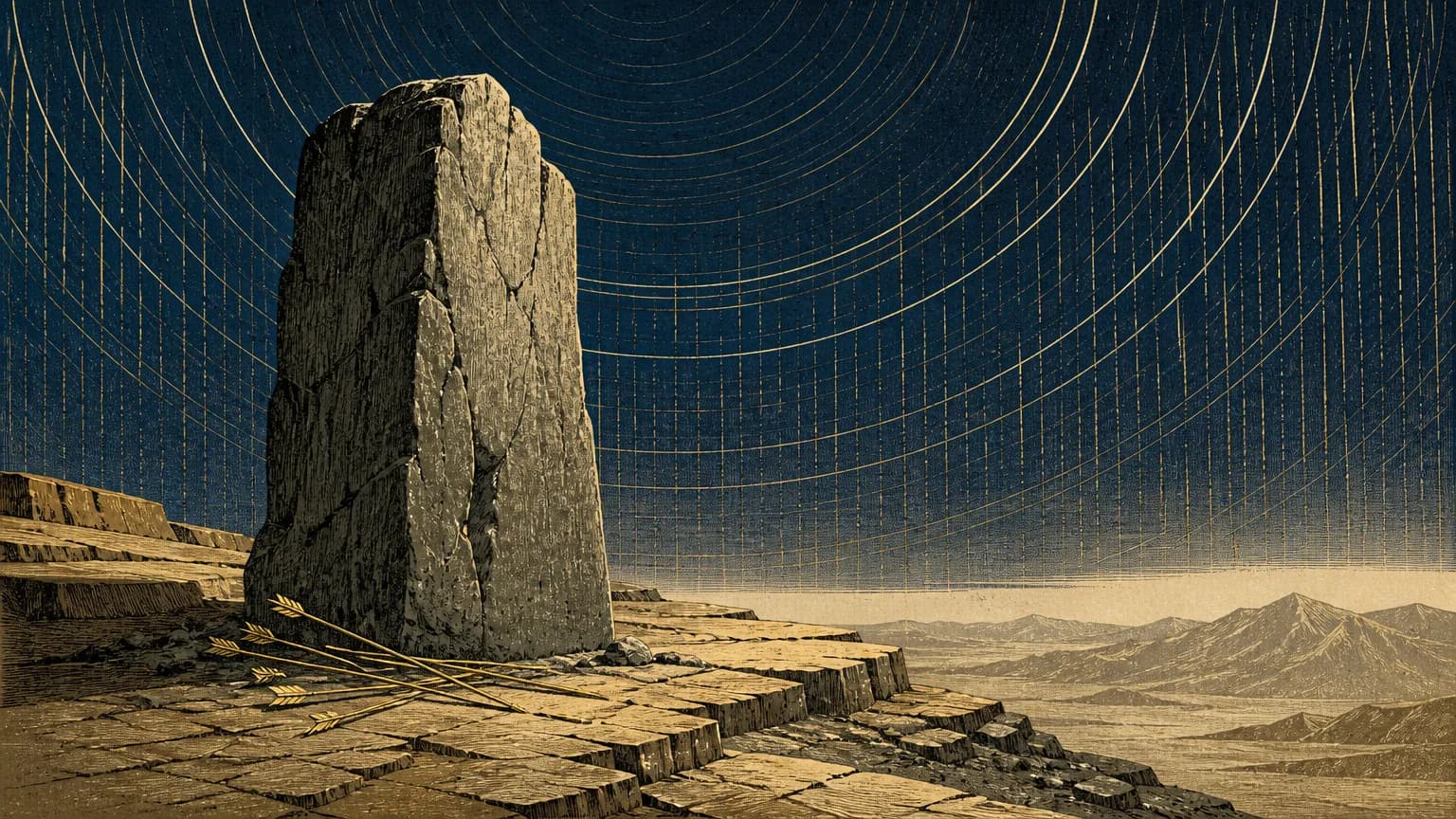
Heaven and earth stand as eternal witnesses to divine justice, anchored in the unwavering Rock whose measured judgment exhausts its arrows long before destroying the people.
Ha'Azinu is the song Moshe recites on the last day of his life, after the laws, blessings and warnings of Devarim are finished and the people stand assembled in the plains of Moav. Its opening line does something strange: instead of addressing the tribes in front of him, Moshe calls on heaven and earth to listen. The reading takes that oddity as the key to the whole poem. Rashi, the eleventh-century commentator of northern France, notes that heaven and earth outlast any human witness and are themselves what delivers rain and grain or withholds them — witness and enforcer in one office. What follows, then, is less a plea for repentance than testimony filed permanently with the cosmos, which explains the song's most conspicuous absence: nowhere is Israel asked to return. Rescue arrives when Israel's strength is simply spent. The guarantee lies instead in the nature of the judgment: God calls Himself haTzur, the Rock, whose strength is exercised in measured judgment rather than flooding anger, and who declares He will "use up My arrows" — an arsenal that ends before its target does. The same exactness gives Moshe his own sentence: view the land from Mount Nevo, and die without entering it.
In the haftarah, the closing verses of Hoshea — who prophesied to the northern kingdom in its last generations — ask not for offerings but for speech: "Take words with you and return." Israel renounces three false securities, the Assyrian empire, Egypt's horses, and handmade gods, and healing comes unpurchased, quiet as dew.
Generated 09/13/2026
Parashah SynthesisBy topic
Moshe has finished legislating, finished blessing, finished warning. What is left to him is a song — and the first thing the song does is turn away from the people standing in front of him and speak to the sky. Read slowly; the poetry is old and compressed, but it moves in a clear line from creation's witness to Israel's rebellion to the day the nations are told to acclaim this people.
Synthesis topics
The Autoparashah methodology selected 6 topics to summarize the parashah's sequence.
Bnei Yisrael are assembled in the plains of Moav, at the very end of Devarim, on the last day of Moshe's life. He has already given the mitzvot, already set blessing and curse before them, already appointed Yehoshua. Now he opens his mouth and the register changes entirely: "Give ear, O heavens, let me speak; let the earth hear the words I utter." This is not a speech to the tribes but poetry addressed over their heads, to the permanent furniture of the world — the one audience that will still be standing when this generation, and the man speaking, are long gone. He asks that his words come down like rain, like dew, like showers on new grass: not thundered at the people but soaked into them.
The Rock whose ways are justice, and a crooked generation
The song's first theological move is to fix the standard by which everything that follows will be measured. Moshe proclaims the Name and calls God haTzur, the Rock — a word for unshakable strength — and immediately defines that strength: "whose deeds are perfect, yea, all of whose ways are just; a faithful God, never false." Only then does the indictment come, and it comes without warning: "Unworthy children — that crooked, perverse generation." The corruption is theirs, not His. Moshe then turns to instruction: remember the days of old, ask your father, ask the elders. When the nations were apportioned their homes and boundaries, Israel was already God's own portion, Yaakov His allotted share. The claim is not that Israel earned this but that it precedes Israel's history.
Eagle's wings, the wilderness, and the fat of the land
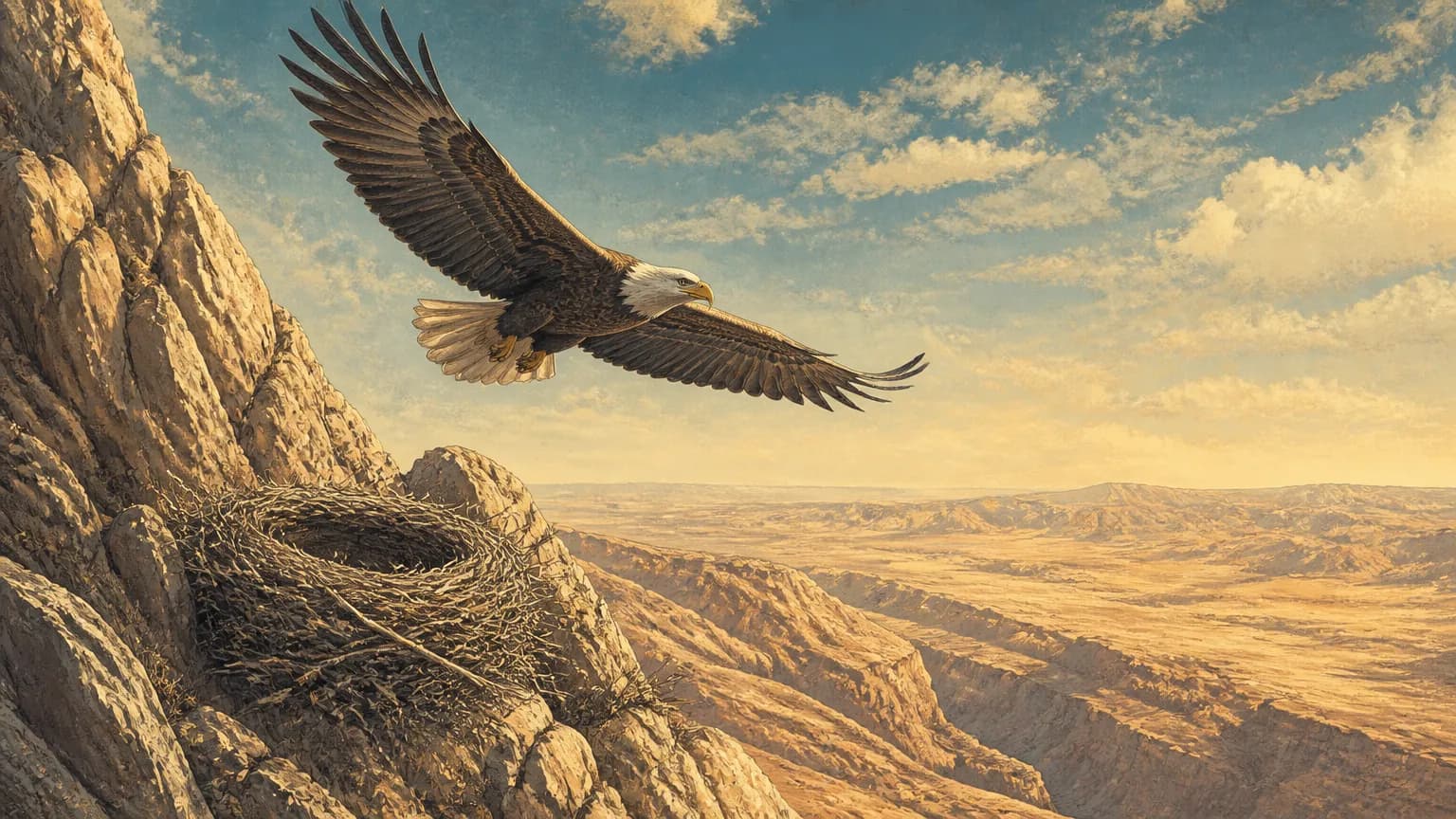
That history is then told in a rush of images. God "found them in a desert region, in an empty howling waste," encircled them, guarded them like the pupil of an eye; like an eagle stirring its nest and gliding beneath its young, He carried them on His wings. "The Eternal alone did guide them, no alien deity alongside" — a line that faces two directions at once, and the reader should expect this from here on. The song constantly slides between what already happened in the wilderness, where no foreign god had any part in Israel's rescue, and what has not yet happened, the day Israel will seek out foreign gods anyway. Both tenses are held together by the earlier instruction to remember; the poem is memory and forecast in a single breath. Then comes plenty: the heights of the land, honey from the crag, oil from flint, curds and milk, the best of the flocks, the finest wheat, wine.
The song recalls how God guarded Israel in the barren wilderness, likened to an eagle hovering over its young in the crags.
Yeshurun grows fat and kicks: the decree of affliction
Prosperity is the hinge. "So Yeshurun grew fat and kicked" — Yeshurun is a poetic name for Israel, from a root meaning upright, and the irony is deliberate. Satisfied, the people forsake the God who made them and spurn the Rock of their support, turning to "demons, no-gods, gods they had never known, new ones, who came but lately." The response is measured out in kind: they provoked with what is not a god, so they will be provoked by a people that is no people. God declares that He will hide His countenance and see what becomes of them, and the afflictions are named — wasting famine, plague, pestilence, fanged beasts, the sword outside and terror within, striking youth and elder alike. "I will sweep misfortunes on them, use up My arrows on them," the verse says, a phrase that sounds like the end of everything. Yet the song then states plainly why the end does not come: God would have blotted out their very memory, "but for fear of the taunts of the foe" — enemies who would conclude "our own hand has prevailed; none of this was wrought by God." The restraint is not credited to Israel's merit. It is credited to the honor of the Name.
The enemy's boast, the sealed vengeance, the final vindication
The poem's attention now swings to those enemies. They are "a folk void of sense": had they any insight, they would ask how one man could rout a thousand "unless their Rock had sold them" — recognizing that Israel's defeat was a verdict, not a conquest. Even the nations must concede that "their rock is not like our Rock." Their own harvest is described as a vine from Sodom, grapes of poison, wine that is the venom of asps, and God declares that all of this lies sealed in His storehouses for the day their foot falters. The turn comes when Israel's strength is entirely spent and "neither bond nor free is left": God asks where the gods are now that ate the fat of their offerings, and then speaks the song's center — "See, then, that I, I am the One; there is no god beside Me. I deal death and give life; I wounded and I will heal." He raises His hand to heaven in an oath, whets His blade, and the final line summons the nations themselves: "O nations, acclaim this people," for He avenges the blood of His servants and cleanses His people's land.
The charge to the children, and the summons to Nevo
The song ends and the prose resumes. Moshe, together with Yehoshua, recites the whole poem in the hearing of the people, and when he finishes he presses it on them: take these words to heart, enjoin them on your children, "for this is not a trifling thing for you: it is your very life" — the means by which they will endure on the land across the Jordan. That same day God speaks to Moshe: ascend the heights of Avarim to Mount Nevo, facing Jericho, look at the land of Canaan, and die there, gathered to your kin as Aharon was gathered on Mount Hor, because of what happened at the Waters of Merivah at Kadesh, where God's sanctity was not upheld before the people. "You may view the land from a distance, but you shall not enter it." The parashah closes with the poem placed in Israel's mouth and its author instructed to climb a mountain and look.
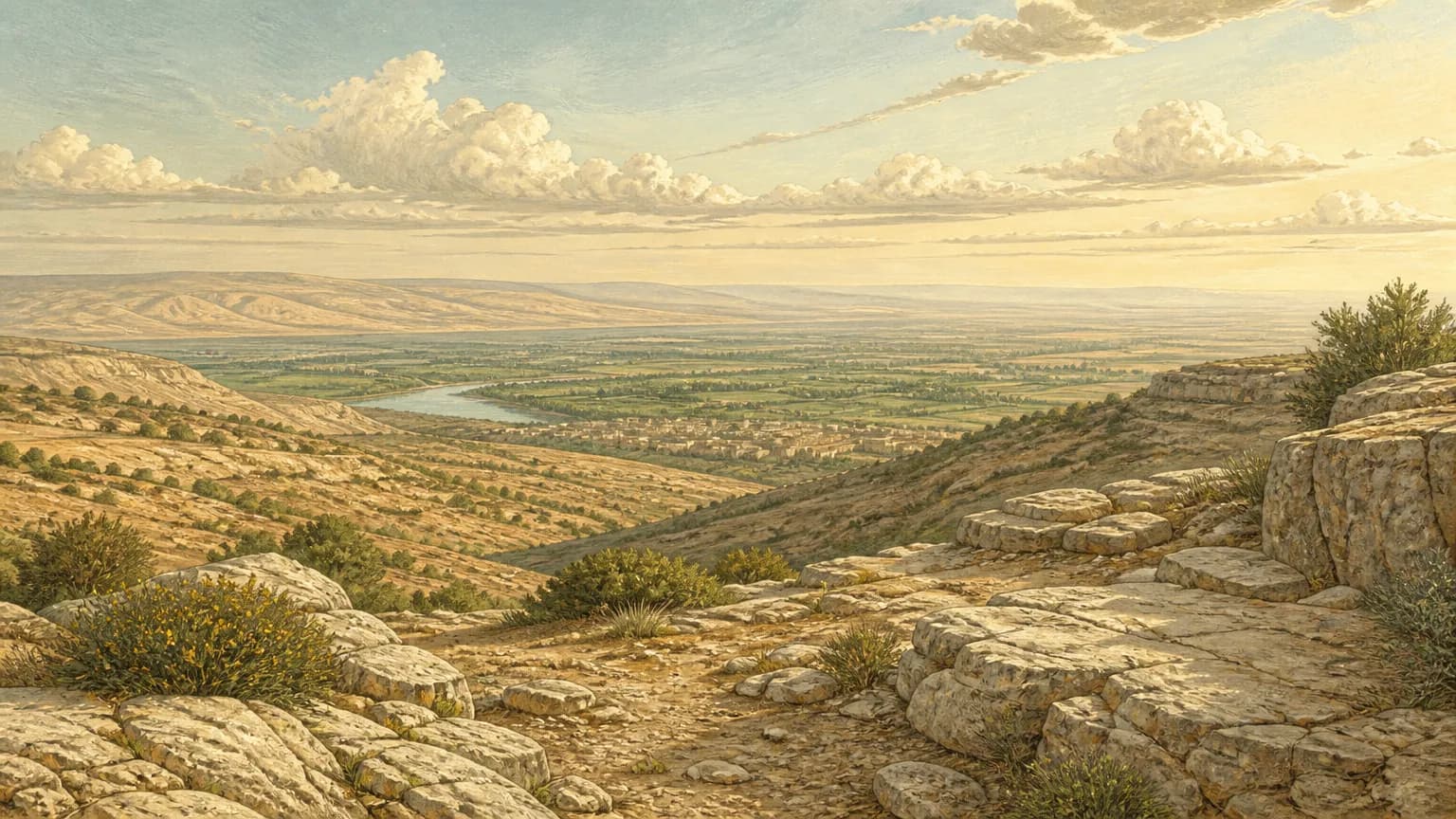
From the heights of Mount Nevo, the land of Canaan is viewed across the Jordan valley from a distance.
Generated 09/13/2026
Analysis axes
They form the central interpretive thread and appear interspersed in the essay below, connecting the parashah's sequence to a unified reading shaped by Rashi.
1.Moshe begins to sing, and addresses the skyהאזינו השמיםRashi on 32:1
2.The Rock whose ways are justice, and a crooked generationהצור תמים פעלוRashi on 32:4
3.Eagle's wings, the wilderness, and the fat of the landואין עמו אל נכרRashi on 32:12
4.Yeshurun grows fat and kicks: the decree of afflictionחצי אכלה בםRashi on 32:23
Interpretive Analysis4 Rashi axes at the turns of the reading
Something is missing from this song, and its absence is the loudest thing in it. Nowhere in Ha'Azinu is Israel asked to do teshuvah — to turn back. Earlier in Devarim, restoration hinges explicitly on return; here, the moment of rescue arrives "upon seeing that their might is gone," when nothing is left, and no repentance is recorded as its trigger. That is not an oversight. Read the song as what its opening line declares it to be — a deposition lodged with heaven and earth rather than an appeal to an audience — and its architecture becomes visible: Moshe is not trying to persuade this generation. He is installing a mechanism whose guarantee of Israel's survival does not depend on Israel behaving, and does not depend on God relenting either. It depends on the structure of divine justice itself being finite in its instruments.
Begin with the witnesses. Rashi, the eleventh-century commentator of northern France, gives two reasons Moshe bypasses the people and addresses the cosmos: a man of flesh and blood may be dead tomorrow, so the testimony must outlast him; and if Israel acts well the witnesses will come and deliver their reward, while if Israel sins "the hand of the witnesses might first be against them." Heaven and earth are not a poetic flourish or a courtroom gallery. They are the parties that actually hand over rain and dew and grain, or withhold them. Witness and bailiff are collapsed into one office. That is why the song asks for words that descend like rain in its opening breath: the very medium of Moshe's speech is the medium of the future verdict. The consequences of the covenant are not appended to the world from outside; they are wired into how the world works.
Then note what kind of power is permitted to operate that mechanism. The title haTzur could easily be heard as raw, crushing force, and the song will shortly describe fire burning to the bottom of Sheol. Rashi reads the verse in the opposite direction: though He is strong, when He brings punishment on those who transgress His will "He does not bring it in a flood of anger, but in deliberate judgment, because His work is perfect." Strength, in this definition, is precisely what is held back. And the word returns with terrible consistency: the Rock who begot you, the Rock of their support whom they spurned, the Rock who sold them, the rock in whom the nations sought refuge — "their rock is not like our Rock." Every appearance measures a power against the standard set in the song's fourth verse. A god who is a flood of anger is exactly what the nations have, and exactly what Israel does not.
This is what makes the song's most frightening phrase into its most reassuring one. "I will sweep misfortunes on them, use up My arrows on them" reads as annihilation, but the wording names what is consumed and what is not: the arrows are spent, the people are the target. Rashi draws the conclusion directly — "My arrows will come to an end, but they themselves will not come to an end." The arsenal is finite; the nation outlasts it. Set this beside the other reason the text gives for holding back, the fear that the enemy will say "our own hand has prevailed," and the two protections turn out to have nothing to do with Israel's virtue. One is the honor of the Name; the other is the arithmetic of measured judgment. A wrath that operates by exact measure is a wrath that can be fully discharged, and a people that survives the full discharge cannot be destroyed by it afterward.
This also explains why the song refuses to sit in one tense. Rashi insists the whole poem hangs on the charge to remember the days of old and consider the years of ages past, and that lines like "no alien deity alongside" are reproof read in both directions at once — the era when no foreign god had any hand in Israel's survival, set against the era when Israel will hire foreign gods anyway. A document addressed to one generation would have to choose a tense. A testimony filed with heaven and earth does not: it is equally in force for the generation in the wilderness, the generation eating honey from the crag, and the generation whose foot falters. Hence Moshe's closing charge is not "repent" but "enjoin them upon your children" — transmit the deposition. It is their very life because it is the record in which their indestructibility is written down.
Devarim has been, until now, a book of conditions: if you listen, then blessing; if you turn aside, then curse. Its last poetic act is unconditional, and the sequence that follows makes the price of that exactness plain. Moshe finishes reciting a song about strength held in restraint and justice that does not flood, and is immediately told to climb Nevo, look, and die — for one failure to uphold God's sanctity before the people, with Aharon's death on Hor named as the precedent. The same measure that cannot be talked out of Moshe's sentence is the measure that cannot be stretched into Israel's annihilation. It would be easier to read Ha'Azinu as a curse-song softened by a happy ending. It is stricter and kinder than that: nothing here is softened, and that is precisely why nothing here can end.
The song asks heaven to give ear and earth to hear; the last words of the parashah tell Moshe he may look at the land but not enter it. Hearing from above and seeing from a distance frame the whole poem, and between them stands a people handed a text and told it is their very life. The open question is not whether the testimony holds, but who in the generations after will still be listening for it.
Generated 09/13/2026
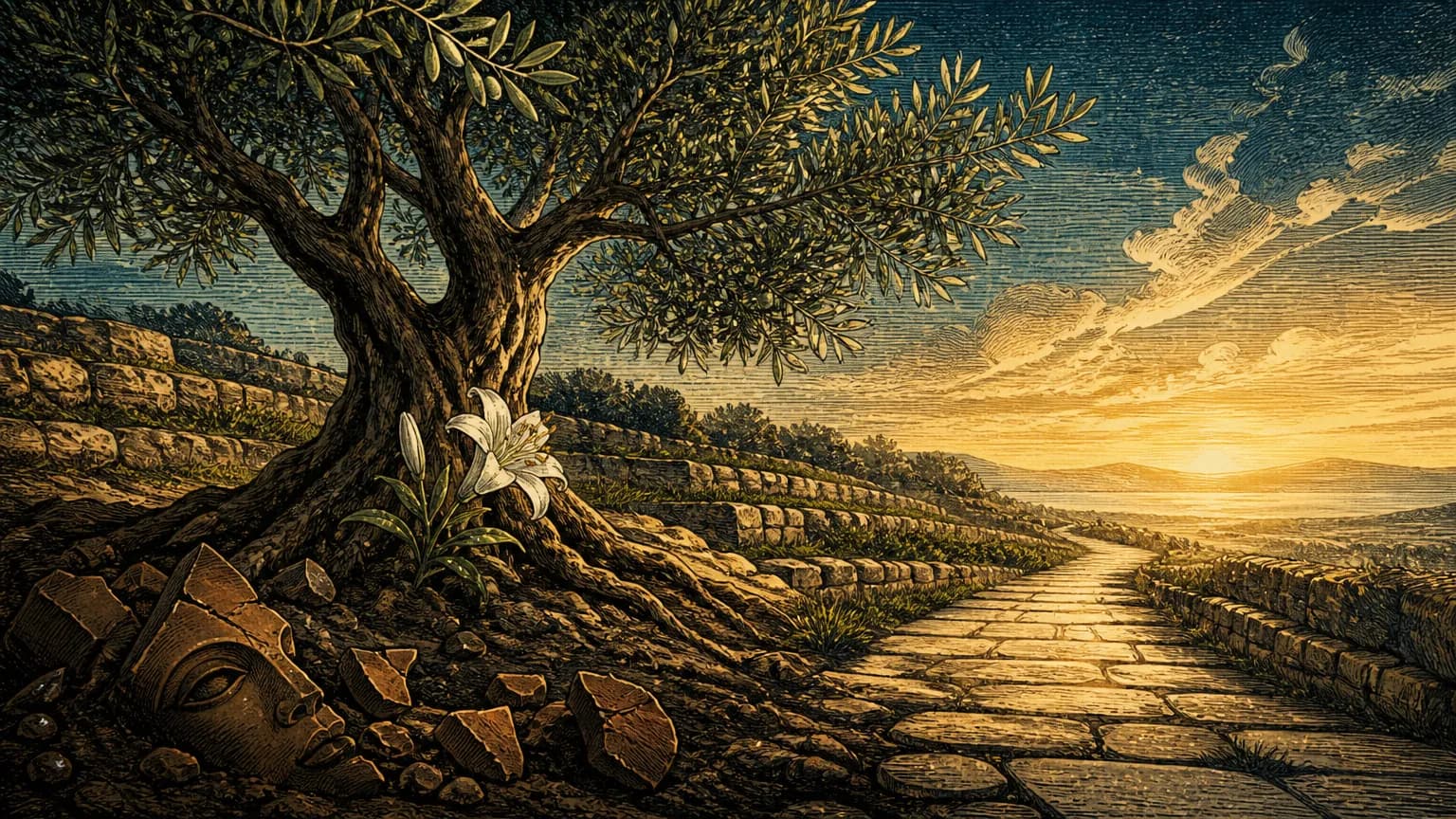
Abandoning fabricated securities for honest speech, Israel is met not with wrath but with quiet dew, blossoming into rooted vitality along the unswerving path of return.
Context
These verses close Sefer Hoshea, the first of the Trei Asar, the twelve shorter prophetic books. Hoshea prophesied chiefly to Malchut Yisrael, the northern kingdom, in its final generations, when its kings sought safety in alliances with Ashur, the Assyrian empire pressing in from the north, and with Egypt and its famous cavalry. Idolatry had become ordinary, and the prophet had spent chapter after chapter describing a people that had wandered from its own God.
Now, at the very end, the tone changes entirely. The rebuke is finished and the door is opened. Because of this, these verses are read as the Haftarah of Shabbat Shuvah, the Shabbat that falls between Rosh Hashanah and Yom Kippur, when the theme of the hour is return.
Interpretation
The Haftarah Explained
"Return, O Israel, to the Eternal your God, for you have fallen because of your sin." The prophet does not say that Israel has been pushed down by enemies or by fate; the stumbling came from within. And what is required to rise? Not treasure, not a caravan of animals: "Take words with you and return to God." Even a person with nothing in his hands has words, and words are what is asked for. The prayer itself is supplied: "Forgive all guilt and accept what is good; instead of bulls we will pay the offering of our lips." Where once a korban, an animal offering brought in the Beit HaMikdash, expressed a person's regret, here speech from the heart is placed on the altar instead.
The confession that follows is remarkably concrete. Three false securities are named and renounced one by one: "Assyria shall not save us" — the great empire will not be our protector; "no more will we ride on steeds" — we will stop leaning on Egypt's horses and chariots; "nor ever again will we call our handiwork our god" — we will not bow to something our own hands have shaped. What remains is the honest admission of a people with no one else: "Since in You alone orphans find pity." Israel stands like an orphan whose only remaining parent is the One who made him.
God's answer comes immediately and without bargaining. "I will heal their affliction, generously will I take them back in love; for My anger has turned away from them." Then a series of images of life returning. "I will be to Israel like dew" — dew that falls quietly, night after night, unasked and unfailing. "He shall blossom like the lily, he shall strike root like a Lebanon tree": beauty above and depth below, the two things a weakened people lacks.
The picture widens. His branches spread, his beauty is like the olive tree's, his fragrance like that of Lebanon; and those who sit in his shade are revived, reviving grain, blossoming like the vine, with a scent like the wine of Lebanon. A people once scattered becomes a tree in whose shade others recover. And Efrayim — the leading tribe of the northern kingdom, whose name Hoshea uses for the whole — speaks the sentence that the entire book has been waiting for: "What more have I to do with idols?" The reply is God's: "Your fruit is provided by Me." Everything Israel thought it was buying from Ashur, from Egypt, from wood and stone, was coming from one Source all along.
The final verse steps back and addresses the reader rather than the nation: "The wise will consider these words, the prudent will take note of them. For the paths of God are smooth; the righteous can walk on them, while sinners stumble on them." The road is level and clearly marked. The difference lies not in the path but in the one walking it.
Interpretation
Message
Teshuvah, return to God, begins with speech — with naming honestly what one has relied on instead of Him. Hoshea's confession is not a vague expression of regret but a list: the powerful patron, the impressive cavalry, the god of one's own manufacture. Each is set down, and only then does the healing come, freely given and unpurchased, like dew.
And the last verse quietly refuses to let the matter become abstract. God's ways are described as smooth and straight; on the very same road, one man walks and another trips. The stumbling in this Haftarah, first and last, comes from the traveler — which is precisely why return is always available.
Hoshea ends his book not with a threat but with an invitation: bring words, and God will bring healing. The path was never hidden; it waits to be walked.