Context
These verses close Sefer Hoshea, the first of the Trei Asar, the twelve shorter prophetic books. Hoshea prophesied chiefly to Malchut Yisrael, the northern kingdom, in its final generations, when its kings sought safety in alliances with Ashur, the Assyrian empire pressing in from the north, and with Egypt and its famous cavalry. Idolatry had become ordinary, and the prophet had spent chapter after chapter describing a people that had wandered from its own God.
Now, at the very end, the tone changes entirely. The rebuke is finished and the door is opened. Because of this, these verses are read as the Haftarah of Shabbat Shuvah, the Shabbat that falls between Rosh Hashanah and Yom Kippur, when the theme of the hour is return.
The Haftarah Explained
"Return, O Israel, to the Eternal your God, for you have fallen because of your sin." The prophet does not say that Israel has been pushed down by enemies or by fate; the stumbling came from within. And what is required to rise? Not treasure, not a caravan of animals: "Take words with you and return to God." Even a person with nothing in his hands has words, and words are what is asked for. The prayer itself is supplied: "Forgive all guilt and accept what is good; instead of bulls we will pay the offering of our lips." Where once a korban, an animal offering brought in the Beit HaMikdash, expressed a person's regret, here speech from the heart is placed on the altar instead.
The confession that follows is remarkably concrete. Three false securities are named and renounced one by one: "Assyria shall not save us" — the great empire will not be our protector; "no more will we ride on steeds" — we will stop leaning on Egypt's horses and chariots; "nor ever again will we call our handiwork our god" — we will not bow to something our own hands have shaped. What remains is the honest admission of a people with no one else: "Since in You alone orphans find pity." Israel stands like an orphan whose only remaining parent is the One who made him.
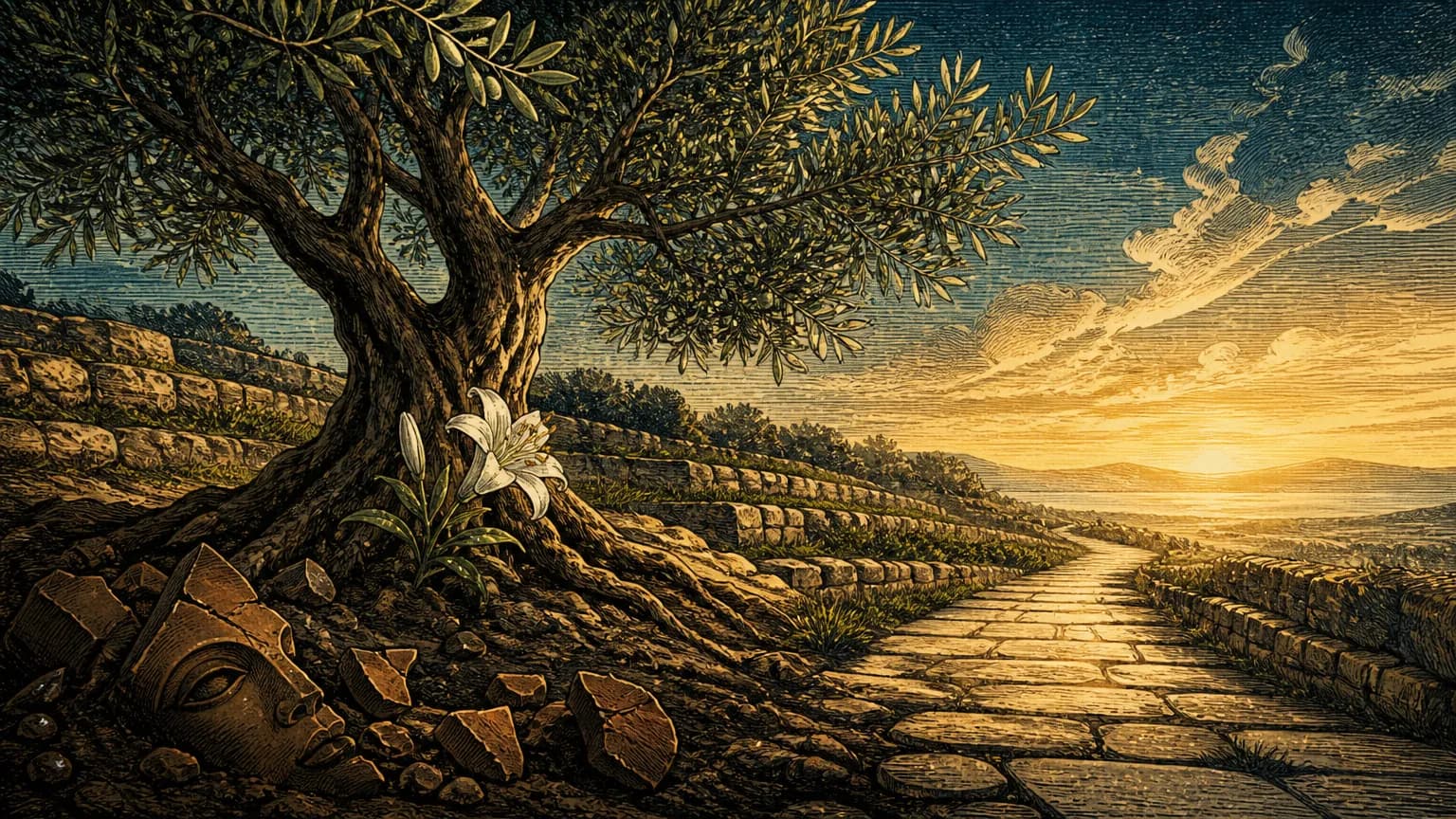
God's answer comes immediately and without bargaining. "I will heal their affliction, generously will I take them back in love; for My anger has turned away from them." Then a series of images of life returning. "I will be to Israel like dew" — dew that falls quietly, night after night, unasked and unfailing. "He shall blossom like the lily, he shall strike root like a Lebanon tree": beauty above and depth below, the two things a weakened people lacks.
The picture widens. His branches spread, his beauty is like the olive tree's, his fragrance like that of Lebanon; and those who sit in his shade are revived, reviving grain, blossoming like the vine, with a scent like the wine of Lebanon. A people once scattered becomes a tree in whose shade others recover. And Efrayim — the leading tribe of the northern kingdom, whose name Hoshea uses for the whole — speaks the sentence that the entire book has been waiting for: "What more have I to do with idols?" The reply is God's: "Your fruit is provided by Me." Everything Israel thought it was buying from Ashur, from Egypt, from wood and stone, was coming from one Source all along.
The final verse steps back and addresses the reader rather than the nation: "The wise will consider these words, the prudent will take note of them. For the paths of God are smooth; the righteous can walk on them, while sinners stumble on them." The road is level and clearly marked. The difference lies not in the path but in the one walking it.
Message
Teshuvah, return to God, begins with speech — with naming honestly what one has relied on instead of Him. Hoshea's confession is not a vague expression of regret but a list: the powerful patron, the impressive cavalry, the god of one's own manufacture. Each is set down, and only then does the healing come, freely given and unpurchased, like dew.
And the last verse quietly refuses to let the matter become abstract. God's ways are described as smooth and straight; on the very same road, one man walks and another trips. The stumbling in this Haftarah, first and last, comes from the traveler — which is precisely why return is always available.
Hoshea ends his book not with a threat but with an invitation: bring words, and God will bring healing. The path was never hidden; it waits to be walked.