this week: Ki Tavo · next: Nitzavim-Vayeilech (09/05)
כִּי־תָבוֹא
Ki Tavo
Devarim 26:1-29:8
The Covenant Changes Hands: Why Ki Tavo Puts the Words in Your Mouth
At the edge of the land, the covenant moves from God's mouth into Israel's — and becomes theirs to say.
Summary
1 min
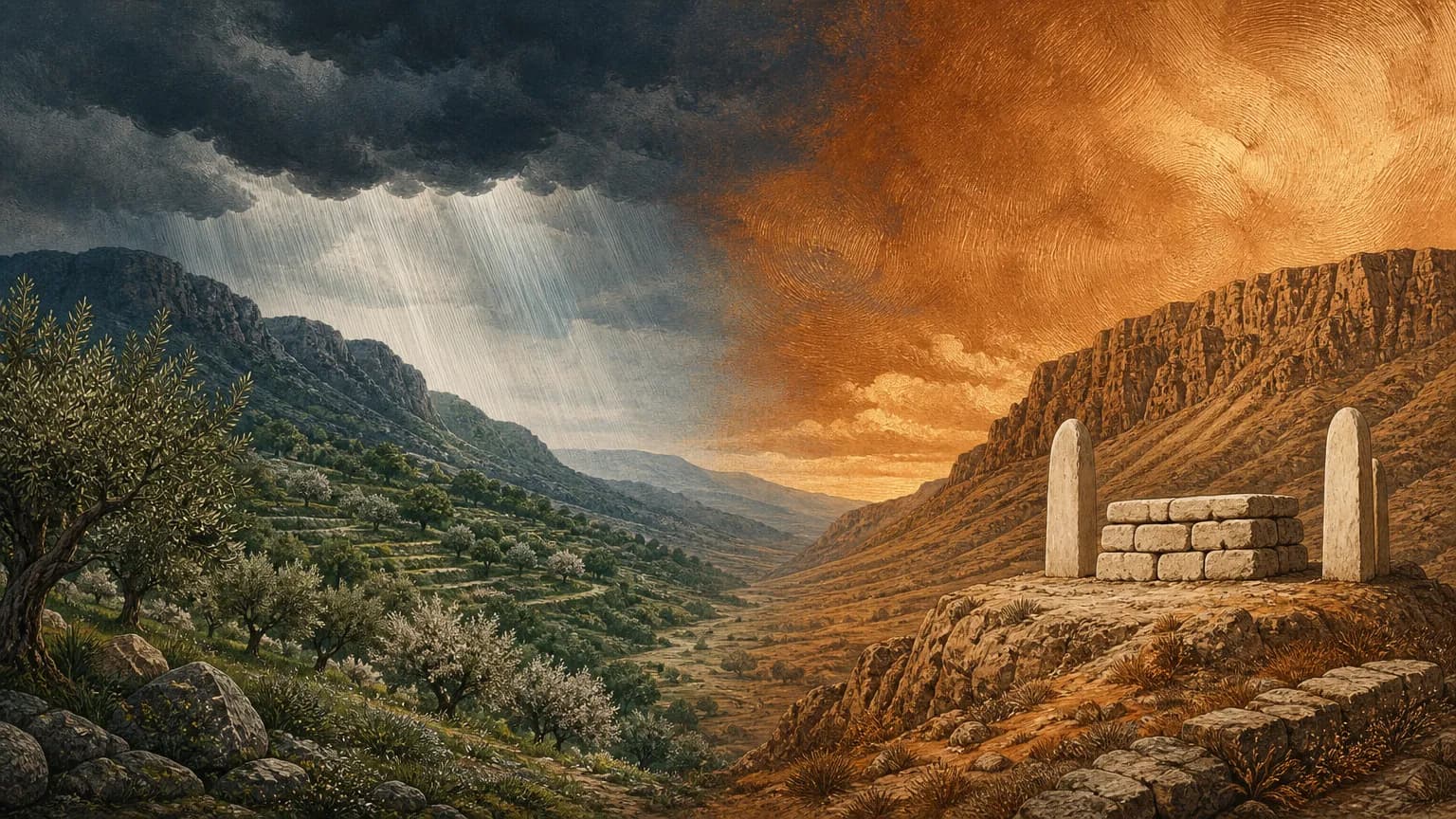
A simple offering of first fruits rests between twin mountain ridges, illuminated by an ascending dawn that marks both the inward acceptance of covenant and the quiet certainty of restoration.
Ki Tavo, set near the end of Moshe's final address on the plains of Moav, opens with a farmer bringing bikkurim — the first ripened produce of his field — to the sanctuary, where he recites the national story in the first person: "the Egyptians dealt harshly with us," claiming an event he never lived. Almost the whole portion is scripted human speech of this kind. At Chorev the words came from God and Israel heard them; here Israel must say them, which is why "this day" is attached to laws given decades earlier — it marks the moment of acceptance, not of revelation. The same logic governs the ceremony at the twin mountains of Gerizim and Eval, where the Leviim proclaim curses over offenses no court could ever detect, such as the idol set up in secret, and the people answer Amen to a final curse covering the whole Teaching: enforcement has moved inside. The long catalogue of curses that follows, gentler in imagery than the one at Sinai yet far longer and harder to read, is therefore not a decree but a warning made imaginable — and the closing note, that only now has Israel been given a mind to understand, is what makes such strictness just.
In the haftarah, Yeshayahu addresses ruined Yerushalayim herself, spoken to as a woman whose children have been carried off, and tells her to arise and shine. It is unconditional consolation: exiles returning by caravan and ship, foreign kings bringing gold and timber to adorn the rebuilt Beit HaMikdash, and God's own light replacing sun and moon.
Generated 08/23/2026
Parashah SynthesisBy topic
Moshe is near the end of his final address, standing with Bnei Yisrael on the plains of Moav within sight of the Jordan. What opens here is not a battle plan or a border list but a man with a basket — and from that small scene the parashah builds outward to the most sweeping covenant ceremony in the Torah.
Synthesis topics
The Autoparashah methodology selected 6 topics to summarize the parashah's sequence.
The parashah begins with something almost domestic. "When you enter the land that Hashem your God is giving you as a heritage, and you possess it and settle in it" — only then, once the conquest is finished and fields have been worked, does the law take effect. A farmer gathers bikkurim, the first ripened produce of his ground, sets it in a basket, and walks to the place God will choose for His name. He hands the basket to the kohen on duty and says a single line: "I acknowledge this day before Hashem your God that I have entered the land that God swore to our fathers to assign us." After long stretches of legislation about courts, warfare, and property, the register here is intimate: one person, one basket, one sentence.
Words in the mouth: recitation and the tithe declaration
Then comes a longer text he must recite by heart. "My father was a fugitive Aramean. He went down to Egypt with meager numbers" — and in a few compressed lines the whole national story passes through his mouth: descent, oppression, the cry, the outstretched arm, arrival in a land flowing with milk and honey. The striking thing is the pronouns. A farmer generations removed from Egypt says "the Egyptians dealt harshly with us." He leaves the basket, bows, and then eats and rejoices together with the Levi, who holds no field of his own, and the ger, the resident stranger. A second scripted declaration follows for the third year of the agricultural cycle, when the ma'aser, the tenth set aside from the harvest, is distributed locally to the Levi, the stranger, the orphan and the widow rather than eaten at the sanctuary. Here the speaker testifies to his own conduct — that he cleared it out, gave it away, did not eat it in mourning or handle it in impurity — and then, uniquely, asks something in return: "Look down from Your holy abode, from heaven, and bless Your people Israel."
The offering of the first fruits grounds Israel's covenant not in imperial triumph, but in a humble domestic gesture of memory, gratitude, and shared sustenance.
"This day": a covenant affirmed from both sides
Immediately afterward Moshe says, "This day Hashem your God commands you to observe these laws and rules." Nothing new has just been legislated; these statutes were given at Chorev and have been rehearsed at length in this very address. The phrase marks not the moment of revelation but the moment of acceptance — the day the law is taken up rather than the day it was issued. What follows is a strange, beautiful reciprocity, stated twice with the same unusual verb: you have caused Hashem to be declared your God, and Hashem has caused you to be declared His treasured people. Two parties speak each other into a bond. The unit ends with Israel set "in fame and renown and glory" and named a holy people.
Stones, an altar, and twelve curses answered with Amen
The scene now shifts to ceremony. Moshe and the elders instruct the people that upon crossing the Jordan they are to erect large stones, coat them with plaster, and inscribe on them the words of this Teaching, and to build there an altar of whole, unhewn stones on Har Eval, offering olah and shelamim and eating in joy. Moshe and the kohanim add a second charge: "Silence! Hear, O Israel! Today you have become the people of Hashem your God." Six tribes will stand on Har Gerizim for the blessing and six on Har Eval for the curse, and the Leviim will proclaim aloud a list of curses to which the whole people answers "Amen." Read the list carefully and a pattern appears: the idol "set up in secret," the one who moves a neighbor's boundary marker, who misdirects a blind man, who strikes a fellow down "in secret," who takes a bribe. These are offenses no human court will ever see. The twelfth and last, however, abandons specificity altogether: "Cursed be whoever will not uphold the terms of this Teaching and observe them." The oath, having enumerated hidden things, closes by covering everything.
Blessing in brief, curse at devastating length
Then the two great catalogues. If Israel listens, blessing saturates every ordinary category of life — city and field, womb and soil, herd and flock, basket and kneading bowl, coming in and going out — enemies scatter by seven roads, the heavens open on schedule, Israel lends and does not borrow, is head and not tail. The curses begin as an exact mirror of that list, phrase for phrase, and then break their frame. "The skies above your head shall be copper and the earth under you iron." Disease, madness, groping at noon, the vineyard planted and never drunk from, children led away while the parent watches. The mirror gives way to sustained narrative: a nation swooping from afar, siege so total that parents eat their own children, the people scattered to the ends of the earth, an anguished heart and eyes that pine, and finally ships back to Egypt where no one will even buy them as slaves. The blessings occupy a page; the curses run on and on.
Standing between fertile rain and skies of burnished copper, the covenant altar witnesses the stark moral gravity and cosmic scope of Israel's communal choices.
A second covenant, made in the land of Moav
The last movement pulls back and names what has just been done: "These are the terms of the covenant that God commanded Moshe to conclude with Bnei Yisrael in the land of Moav, in addition to the covenant that was made with them at Chorev." Not a replacement — an addition. Moshe summons everyone and reviews the evidence: you saw Egypt with your own eyes, the signs and the marvels. And then a sentence that startles: "Yet to this day God has not given you a mind to understand or eyes to see or ears to hear." Forty years of clothes that did not wear out, of food that was not bread, of Sichon and Og defeated and their land given to Reuven, Gad, and half of Menasheh — and only now the capacity to grasp it. The parashah closes on the instruction that follows from that arrival: "Therefore observe faithfully all the terms of this covenant, that you may succeed in all that you undertake." The people are still on the near bank, holding a covenant they have just been told they are finally able to understand.
Generated 08/23/2026
Analysis axes
They form the central interpretive thread and appear interspersed in the essay below, connecting the parashah's sequence to a unified reading shaped by Rashi.
1.A basket at the sanctuary: the first fruitsהיום הזה ה' אלהיך מצוךRashi on 26:16
2.Words in the mouth: recitation and the tithe declarationאשר לא יקיםRashi on 27:26
3."This day": a covenant affirmed from both sidesוהיו שמיך אשר על ראשך נחשתRashi on 28:23
4.Stones, an altar, and twelve curses answered with Amenעד היום הזהRashi on 29:3
Interpretive Analysis4 Rashi axes at the turns of the reading
Notice who is talking. This parashah is built almost entirely out of scripted human speech: a farmer's declaration over his basket, a second declaration over the ma'aser, a mutual affirmation in which each party says something about the other, the Leviim's proclamation, the people's twelve-fold "Amen," and then Moshe's own enormous voice running through blessing and curse. Something is changing hands. At Chorev the words came from the mouth of God and Israel heard them and trembled; here Israel must say them. And the parashah stages this inversion with deliberate cruelty of design: it opens with a farmer, generations into settled life, saying with total confidence "I have entered the land," and it closes with the generation still standing outside the land being told that until this day they had no heart to understand. The competent speaker comes first, projected forward; the belated comprehension comes last.
The bikkurim recitation is where the transfer becomes visible. The farmer does not report his own biography; he says "the Egyptians dealt harshly with us," claiming an event he never lived. A covenant that is merely inherited would let him say "our ancestors were slaves." The Torah makes him say "us." The same logic governs the odd doubled verb of the mutual affirmation — you have caused Him to be declared, He has caused you to be declared — where the bond exists precisely in the saying. And it explains the otherwise puzzling "this day" attached to laws decades old. The received reading of that phrase is that the mitzvot must be new in your eyes each day, as though commanded this very morning. That is not sentiment; it is a structural necessity. Words in the mouth cannot be stored. Inheritance can sit in a drawer for a generation; an utterance has to be uttered again.
This is why the twelfth curse is the hinge of the ceremony at the two mountains and not an afterthought. Eleven curses name deeds that evade detection — the idol set up in secret, the moved boundary stone, the blow struck out of sight, the bribe. No court reaches them; only the person himself knows. Then the list dissolves into "whoever will not uphold the terms of this Teaching," and with that single clause the whole Torah is placed under execration and oath. The ceremony has done something legally extraordinary: it has moved enforcement inside. A community that answers "Amen" to unlimited liability has become its own witness, its own court, and its own claimant. That is only imaginable for a people that has learned to speak the covenant rather than merely receive it.
Which resolves the paradox buried in the long catalogue of curses. The imagery here is famously reversed from the curses spoken at Sinai: there iron heavens and copper earth, here copper heavens and iron earth — and the classical reading hears leniency in the switch, since copper can sweat and yield a little moisture, while iron gives nothing. The reason offered is that these curses come from Moshe's own mouth, addressed in the singular, whereas the earlier ones came in the divine first person. But then why is the milder set four times longer and immeasurably more terrible to read? Because intensity of image is not the measure of severity. A decree needs only to be pronounced; a warning must be made imaginable. The divine curses are terse because a decree is complete when uttered. Moshe's are unbearable in their specificity — the ox slaughtered before your eyes, the daughter taken while you watch, the woman who once would not set foot on the ground — because a teacher who has carried these people for forty years is trying to make the thing vivid enough not to happen. The singular "you" is not severity. It is a hand on one shoulder.
And the final movement tells us what has changed to make any of this enforceable. "God has not given you a mind to understand until this day" is read against the principle that a student cannot reach the bottom of his teacher's mind before forty years have passed — which means that until now, the Omnipresent did not deal strictly with them, and from here on He will. The tochachah, the covenant's catalogue of warnings, arrives at the precise moment its hearers are capable of understanding it, and comprehension is what makes strictness just. That is why the very next words are "therefore observe faithfully all the terms of this covenant." The Moav covenant is "in addition to" Chorev, not instead of it: Chorev supplied the words, Moav supplies the mind that can hold them. This is finally why Devarim had to be a book in Moshe's voice — and it refuses the easier reading of chapter after chapter of curses as a threat designed to frighten. Nobody frightens a child with a document this long. This is the fine print a person of age reads before signing his name.
The parashah's first speaker stands in the land and says "I have entered"; its last words are spoken to people who have not yet crossed the river. Between them sits one small word, hayom, this day, carrying both a farmer's harvest and a generation's late-arriving understanding. Whether a mouth trained to answer Amen at two mountains keeps answering once the land is quiet and the teacher is buried outside it — that the text leaves standing open.
Generated 08/23/2026
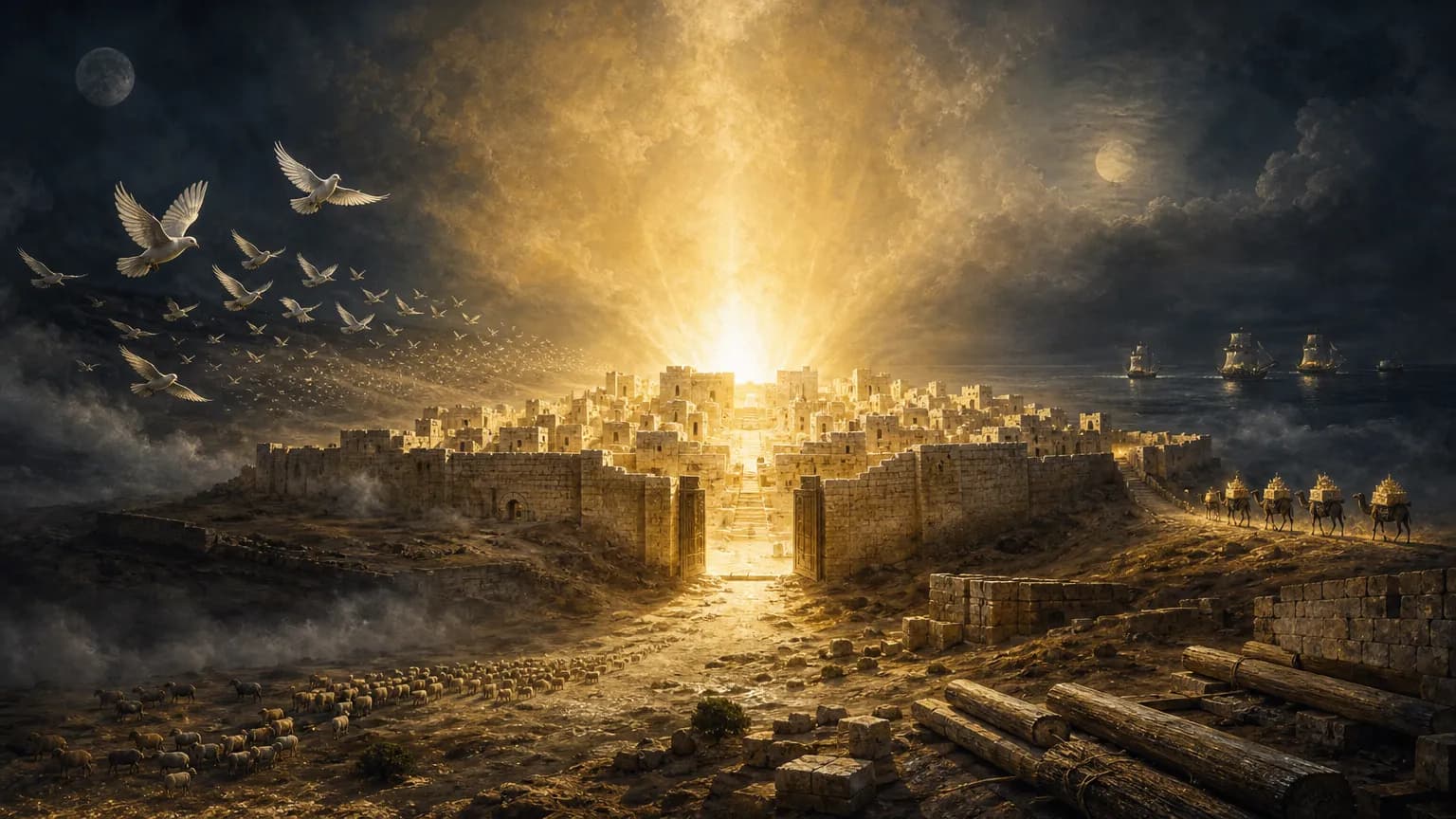
It holds the haftarah's single gesture: a still-ruined city commanded to shine with a light reserved from the beginning, by which even a darkened world will one day walk.
Context
This Haftarah comes from the book of Yeshayahu, the prophet who spoke in Yerushalayim in the generations of Assyrian ascendancy and who was granted, in the later chapters of his book, long visions of consolation reaching far past his own day. Here he addresses not a king and not an army, but the city herself — Yerushalayim, desolate and unvisited, spoken to as a woman whose children have been carried off.
The whole passage is one sustained word of comfort. Nothing in it is conditional, nothing is rebuke. It is a description of what the world will look like when the redemption arrives and the Mashiach, the anointed redeemer of Israel, comes: the exiles gathered, the Beit HaMikdash rebuilt and adorned, and Israel's honor restored in the sight of every nation.
Interpretation
The Haftarah Explained
"Arise, shine, for your light has dawned." The Holy One tells the light to rise up and shine out from Yerushalayim, for her help has come from God. Light here means joy — a great light gladdens a person, and there will be great rejoicing in the city. And the contrast is sharp: "darkness shall cover the earth, and thick clouds the peoples." For the nations there will be darkness and fog, which is to say troubles; for Israel there will be light, joy, and peace. Yet the darkness is not the end for them either, since "nations shall walk by your light" — the kings and ministers of the nations will say, let us go to Israel to learn their ways and their good deeds, and let the light come to us from them.
"Raise your eyes and look about." The Holy One says to the city: lift your eyes and see your children arriving from distant lands, your daughters traveling in comfort, in the sort of wagons kings and ministers use. Then "as you behold, you will glow" — your face will light up with joy, the way a person is startled when something happy comes upon him unexpectedly, and your heart will grow wide and broad. The city that stood empty of adults and empty of children will be full of both. Caravans of camels come from Midian and Ephah and Sheba bearing gold and frankincense and uttering God's praises, and the flocks of Kedar gather to be brought as korbanot, offerings upon the altar, so that the Beit HaMikdash will be beautiful because of them.
"Who are these that float like a cloud, like doves to their cotes?" Israel will come swiftly — as a cloud races, as a bird flies, as a dove hurries home to her young. Great ships of Tarshish, like those that sailed in the days of Shlomo HaMelech, will carry the children home from afar, and Israel will bring their silver and gold out of exile with them. Let the wealthy man in exile not worry that his money will be lost when the Mashiach comes, or that he cannot carry it on so long a journey: the nations themselves will supply money and provisions, for the sake of the holy Name.
Foreigners will rebuild her walls and their kings will serve her, and Israel will recognize that whatever comes to hand, good or bad, comes from God alone. The gates will stand open day and night, kings entering as servants enter their master's house, while any nation refusing to serve will perish. The finest woods of Lebanon will arrive to adorn the Sanctuary — as the king of Tzor sent fine timber in Shlomo's day — to glorify "the place where My feet rest," for the Beit HaMikdash below stands beneath the Throne of Glory above. The children of those who once oppressed Israel will come bowing, and they themselves will call her "City of GOD, Zion of the Holy One of Israel."
Then the reckoning is reversed: whatever was taken in exile is repaid at a higher grade — copper repaid with gold, iron with silver, wood with copper, stone with iron. The officials who once collected taxes will deal in peace and righteousness, and will rule no longer. No cry of violence will be heard; the walls need no fear and the gates need no locking, and in those gates only God's praises will be spoken. Sun and moon will no longer be noticed, for the Holy One Himself will be the great light in which the whole world rejoices; and since sun and moon also stand for the kingdom of Israel, that kingdom will never again set. Israel, refined through the sufferings of exile, will be wholly righteous, planted in the land like a rooted tree, and the smallest family will become a mighty nation.
Interpretation
Message
The closing words hold two truths together: "I GOD will speed it in due time." Our sages taught that if Israel is worthy the redemption comes swiftly, and if not, it comes at its appointed hour — but either way, once it begins it moves quickly to a good end. That is the temper of this whole Haftarah. It does not argue and it does not scold; it describes, in detail so concrete it includes camels and timber and the returning man's savings, a world in which the long humiliation of exile is not merely ended but repaid.
And the light at the center is not a metaphor for good fortune. It is the light the Holy One set aside at the beginning and hid away, kept for the Mashiach and the righteous — the same light by which the nations will finally walk. Israel is told to rise and shine before any of it is visible, because the shining is God's doing and the standing up is ours.
A city spoken to while still in ruins is told to arise and shine — and the light she is promised is one that no exile can extinguish.