Context
This Haftarah comes from the book of Yeshayahu, the prophet who spoke in Yerushalayim in the generations of Assyrian ascendancy and who was granted, in the later chapters of his book, long visions of consolation reaching far past his own day. Here he addresses not a king and not an army, but the city herself — Yerushalayim, desolate and unvisited, spoken to as a woman whose children have been carried off.
The whole passage is one sustained word of comfort. Nothing in it is conditional, nothing is rebuke. It is a description of what the world will look like when the redemption arrives and the Mashiach, the anointed redeemer of Israel, comes: the exiles gathered, the Beit HaMikdash rebuilt and adorned, and Israel's honor restored in the sight of every nation.
The Haftarah Explained
"Arise, shine, for your light has dawned." The Holy One tells the light to rise up and shine out from Yerushalayim, for her help has come from God. Light here means joy — a great light gladdens a person, and there will be great rejoicing in the city. And the contrast is sharp: "darkness shall cover the earth, and thick clouds the peoples." For the nations there will be darkness and fog, which is to say troubles; for Israel there will be light, joy, and peace. Yet the darkness is not the end for them either, since "nations shall walk by your light" — the kings and ministers of the nations will say, let us go to Israel to learn their ways and their good deeds, and let the light come to us from them.
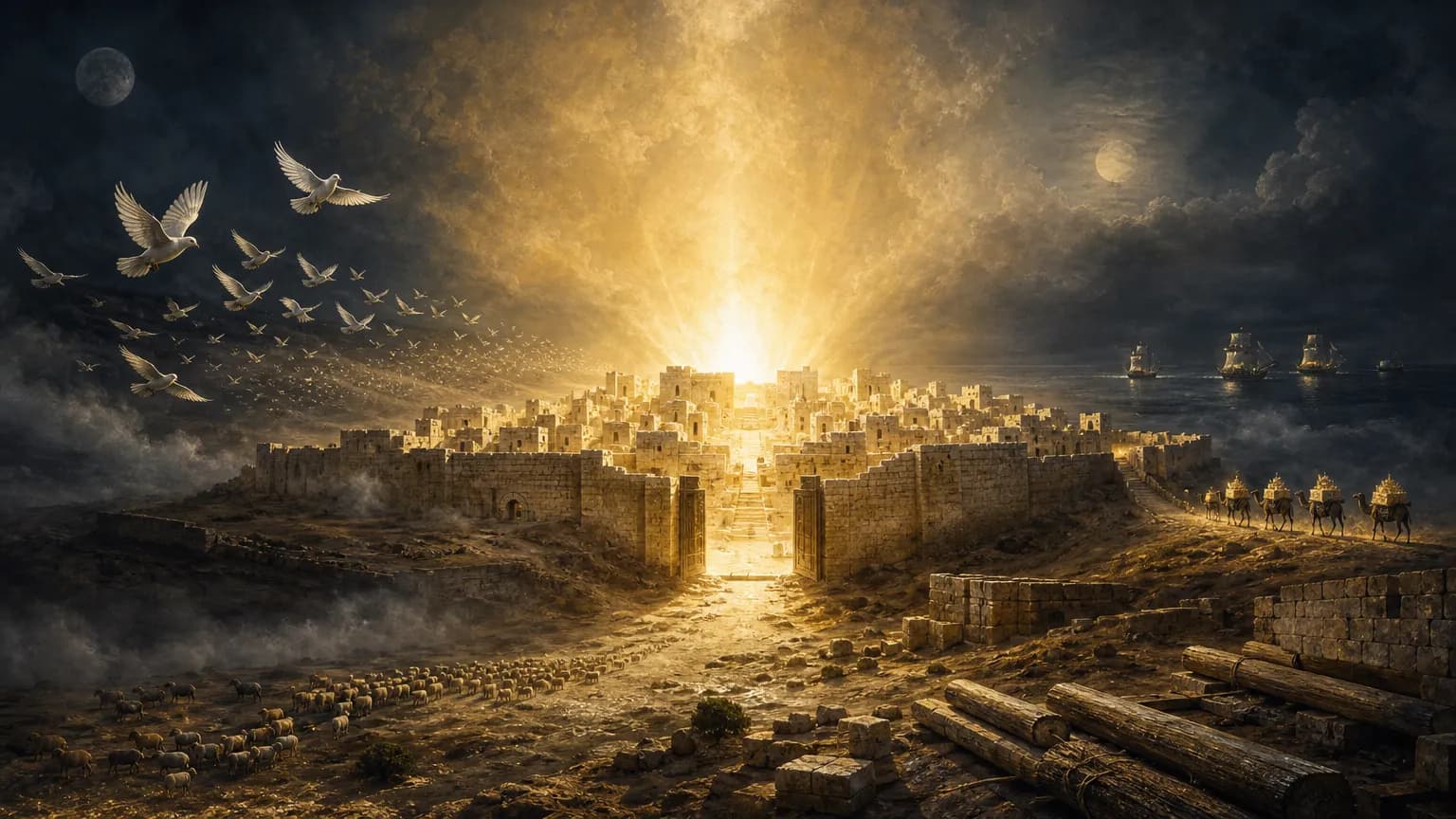
"Raise your eyes and look about." The Holy One says to the city: lift your eyes and see your children arriving from distant lands, your daughters traveling in comfort, in the sort of wagons kings and ministers use. Then "as you behold, you will glow" — your face will light up with joy, the way a person is startled when something happy comes upon him unexpectedly, and your heart will grow wide and broad. The city that stood empty of adults and empty of children will be full of both. Caravans of camels come from Midian and Ephah and Sheba bearing gold and frankincense and uttering God's praises, and the flocks of Kedar gather to be brought as korbanot, offerings upon the altar, so that the Beit HaMikdash will be beautiful because of them.
"Who are these that float like a cloud, like doves to their cotes?" Israel will come swiftly — as a cloud races, as a bird flies, as a dove hurries home to her young. Great ships of Tarshish, like those that sailed in the days of Shlomo HaMelech, will carry the children home from afar, and Israel will bring their silver and gold out of exile with them. Let the wealthy man in exile not worry that his money will be lost when the Mashiach comes, or that he cannot carry it on so long a journey: the nations themselves will supply money and provisions, for the sake of the holy Name.
Foreigners will rebuild her walls and their kings will serve her, and Israel will recognize that whatever comes to hand, good or bad, comes from God alone. The gates will stand open day and night, kings entering as servants enter their master's house, while any nation refusing to serve will perish. The finest woods of Lebanon will arrive to adorn the Sanctuary — as the king of Tzor sent fine timber in Shlomo's day — to glorify "the place where My feet rest," for the Beit HaMikdash below stands beneath the Throne of Glory above. The children of those who once oppressed Israel will come bowing, and they themselves will call her "City of GOD, Zion of the Holy One of Israel."
Then the reckoning is reversed: whatever was taken in exile is repaid at a higher grade — copper repaid with gold, iron with silver, wood with copper, stone with iron. The officials who once collected taxes will deal in peace and righteousness, and will rule no longer. No cry of violence will be heard; the walls need no fear and the gates need no locking, and in those gates only God's praises will be spoken. Sun and moon will no longer be noticed, for the Holy One Himself will be the great light in which the whole world rejoices; and since sun and moon also stand for the kingdom of Israel, that kingdom will never again set. Israel, refined through the sufferings of exile, will be wholly righteous, planted in the land like a rooted tree, and the smallest family will become a mighty nation.
Message
The closing words hold two truths together: "I GOD will speed it in due time." Our sages taught that if Israel is worthy the redemption comes swiftly, and if not, it comes at its appointed hour — but either way, once it begins it moves quickly to a good end. That is the temper of this whole Haftarah. It does not argue and it does not scold; it describes, in detail so concrete it includes camels and timber and the returning man's savings, a world in which the long humiliation of exile is not merely ended but repaid.
And the light at the center is not a metaphor for good fortune. It is the light the Holy One set aside at the beginning and hid away, kept for the Mashiach and the righteous — the same light by which the nations will finally walk. Israel is told to rise and shine before any of it is visible, because the shining is God's doing and the standing up is ours.
A city spoken to while still in ruins is told to arise and shine — and the light she is promised is one that no exile can extinguish.