Context
This Haftarah comes from Sefer Shmuel, the book recording the transition of Israel from the era of the Shoftim, the judges who led before Israel had a king, to the age of the monarchy. Shmuel, the last of those judges and the prophet who anointed Israel's first king, stands at the very hinge of that change.
The immediate setting is the coronation of Shaul, the first king of Israel. Many Israelites had earlier scorned Shaul, asking what such a man could do for them. But after he rescued Israel from Nachash, king of Ammon, the people gathered at Gilgal and accepted him as their rightful king, bringing korbanot, offerings of thanksgiving, and rejoicing greatly before God.
The Haftarah Explained
With the monarchy now established, Shmuel addresses the people. He has done their will and given them a king who can lead them; he himself, he says, has grown old and gray. Our sages teach that Shmuel was only fifty-two when he died, but the Holy One made him prematurely gray so that the people would think of him as old. Otherwise they might wonder how so righteous a prophet could die young and assume he had sinned. In truth, Shmuel had prayed to die so as not to witness Shaul's death in his lifetime, and the gray hair was God's response.
Shmuel then makes his great public reckoning: "Here I am. Testify against me." Whose ox have I taken, whose donkey, from whom have I stolen or taken a bribe to bend my judgments? If anyone is ashamed to speak before him, let them tell others, and he will repay everything. The people answer plainly that he has defrauded no one and taken nothing. Shmuel calls upon God and upon King Shaul to bear witness that he has done no injustice — for he is about to remind Israel of their wrongdoing, and it would not be just for a man with evil deeds of his own to rebuke others.
Shmuel recounts God's kindnesses. Yaakov came to Egypt, the people cried out, and God sent Moshe and Aharon to bring Israel from exile into the holy land. When they forgot God, they fell into the hands of Sisera, the Philistines, and Moav; when they cried out and confessed serving foreign gods, God sent deliverers — Gideon, Shimshon, Yiftach, and Shmuel himself — to protect them. Our sages note that Scripture lists these lesser figures alongside the towering Moshe and Aharon, teaching that whoever the Holy One raises over a community is worthy of honor; no judge or leader should be dismissed as insignificant beside those who came before.
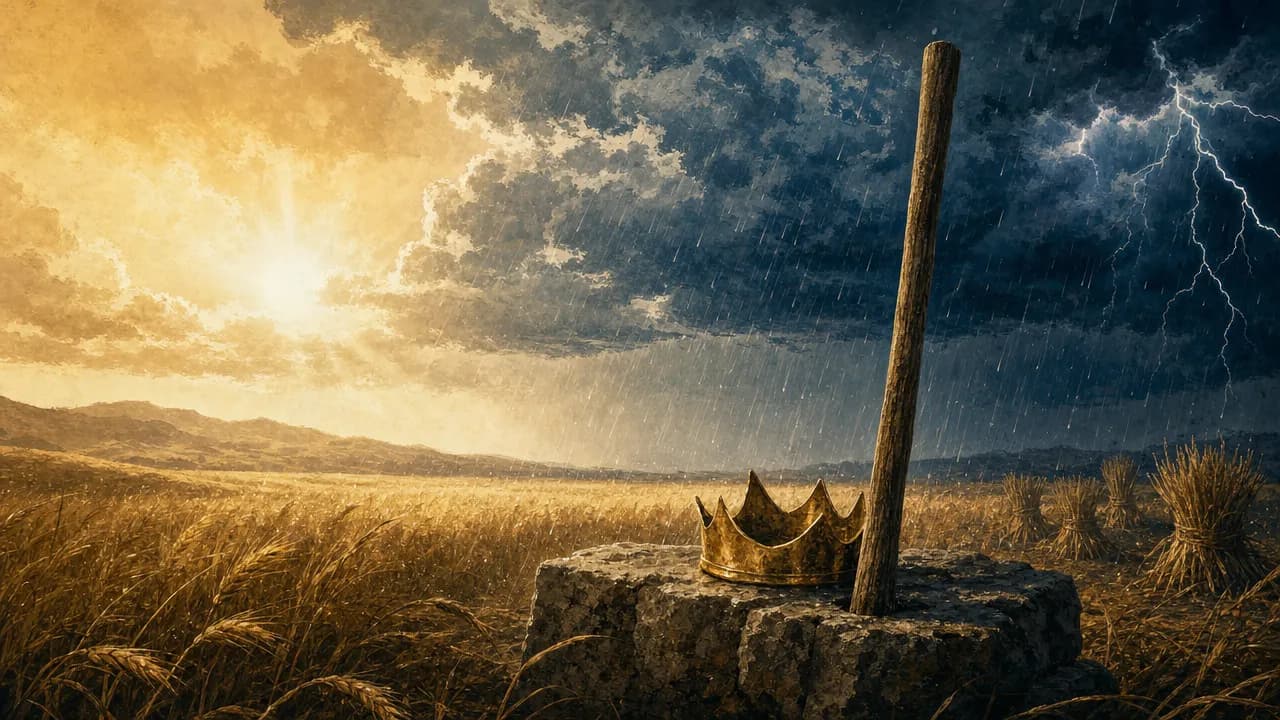
Yet when Nachash of Ammon threatened them again, the people demanded a king — though God in Heaven was already their true King. Shmuel tells them that if they revere God and keep His commandments, they and their king will endure before Him forever; if they do not listen, God's hand will strike them. To seal his words, he calls for a sign: though it is the season of the wheat harvest, when rain does not fall, he will pray and God will send thunder and rain. The rain comes, and the people, awestruck, beg Shmuel to pray that they not die for the sin of asking for a king.
Message
Shmuel's reply is the heart of the Haftarah: "Do not fear." Though they have indeed done wrong, they must not turn away from God but serve Him with their whole heart, refusing the worthless idols that can neither help nor protect. For the sake of His great name, God will never abandon His people. When Israel are in exile, the nations claim their God cannot help them; therefore the Holy One redeems them, displaying His strength and His wonders. Outside the land He does not abandon Israel because they are His people; within the land He keeps them for the sake of His holy name.
Even when Israel falters, God's faithfulness holds firm — and so we pray that He will never abandon us, but redeem us with the Mashiach.