Context
This Haftarah is taken from the opening of Sefer Yehoshua, the book that follows the death of Moshe and recounts how Bnei Yisrael, the people of Israel, crossed the Jordan and took possession of the land. Yehoshua bin Nun, Moshe's faithful disciple and successor, now leads the nation as it stands poised on the threshold of the land.
The first city before them is Jericho, a stronghold so formidable that it was reckoned as strong as the whole land of Israel together. Before any conquest, Yehoshua sends two men to reconnoiter the city and its defenses. Unlike the spies sent in the days of Moshe, who were evildoers and brought back an evil report, these two men were righteous, and their mission would unfold very differently.
The Haftarah Explained
The two spies entered Jericho with great care, appearing as deaf and dumb men so that no one would ask where they came from. They presented themselves as potters carrying pots to sell, both so that the townsfolk would leave them alone and so that women would come to buy from them. Women speak freely and tell the secrets of a city, and the spies wished to learn whether the people of the land were afraid of the Jews. They came to the house of Rahab, who kept an inn where guests would lodge.
Word reached the king of Jericho that two Israelites had come to spy out how the city and the land might be conquered, and he sent to Rahab demanding that she hand the men over. But she had already hidden them. She told the king's messengers that two men had indeed come but had departed when the gate was locked for the night, and she urged the pursuers to chase after them toward the Jordan. The verse hints that she hid only one man, for the two spies were Pinchas and Calev; Pinchas, a kohen, said he was like an angel who cannot be seen and needed no hiding, while another reading is that she hid them both in a single tight hole, so cramped they seemed as one.
Having concealed them on the roof beneath stalks of flax, Rahab came up and made her great confession. She knew that God had given the land to Israel, for the dread of them had fallen upon all the nations. She had heard how the Holy One split the sea before them and destroyed the two mighty kings, Sihon and Og; their hearts had dissolved and no man had any spirit left, for the Lord is God in the heavens above and on the earth below.
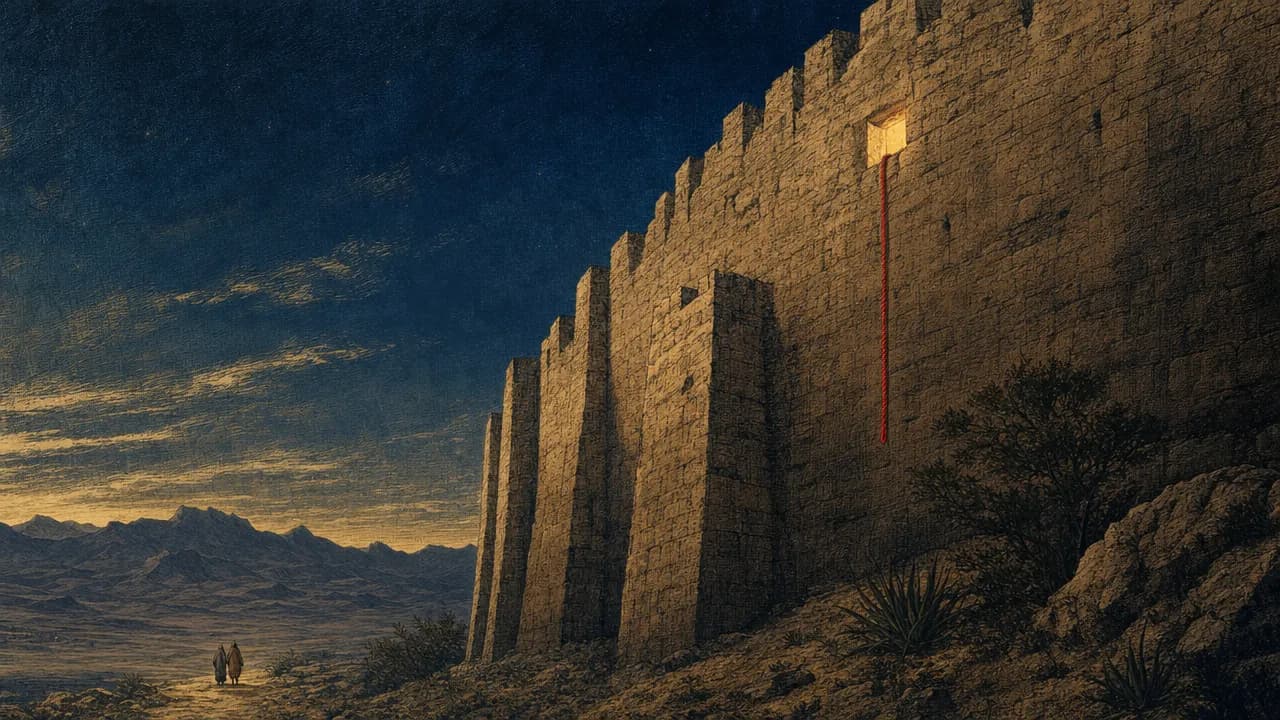
Rahab then asked the men to swear, since she had shown them kindness, that they would deal kindly with her and spare her family, giving her a true and reliable sign. They agreed, but warned her not to disclose their words or the sign, lest her neighbors adopt the same protection. She lowered them by a rope through the window in the wall and told them to hide in the mountains for three days until the pursuers returned. The men instructed her to tie a red thread at the window, gather her family within the house, and any who stayed inside would be spared.
She sent them off and tied the crimson cord at the window. It is told that Rahab would always tie a red thread when she was menstruating, so that no man should come to her, and for forty years no man approached her at such times. Now she tied it both as the spies' sign and for its accustomed purpose. The two men hid three days, the pursuers searched in vain, and Calev and Pinchas returned to Yehoshua and reported that the Holy One had given the nations into their hands, for their hearts had melted before them.
Message
The Sages teach how Rahab could declare that no man had any spirit left: she had been a prostitute for forty years, and there was no chieftain in the land who had not come to her, yet now none came, for all were paralyzed by fear of Israel. Rahab was ten years old at the Exodus and lived those forty years in sin, but afterward she converted, confessing before the Lord of the Universe her failings in the three mitzvot entrusted especially to women, Nidah, the laws of family purity, Hallah, the dough offering, and the kindling of Shabbat candles, and asking forgiveness through the rope, the window, and the wall by which she had saved His messengers. For this she merited that eight prophets descended from her, and Yehoshua himself married her.
A woman the world wrote off recognized the hand of God where mighty kings saw only their own fear, and her faith and kindness lifted her from sin to the mother of prophets.